


Published: October 31, 2026
Overview: Canadian Tax on Virtual Game Assets and Gaming Items
A rare Roblox or Adopt Me pet, Fortnite skin, Counter-Strike 2 skin, gaming account, virtual currency or other in-game item may exist only within a digital environment. That does not necessarily place it outside the Canadian income tax system.
Canadian tax consequences generally do not depend on whether property is tangible. The analysis instead focuses on the taxpayer’s legal and economic rights, why the asset was acquired, how it was used, whether it could be transferred for value, and whether the surrounding activity was personal, investment-related or commercial.
Virtual gaming economies can involve substantial real-world value. Canadian players may accumulate valuable items through gameplay, purchase virtual assets for resale, trade digital collectibles, earn rewards through play-to-earn arrangements, operate virtual-item businesses, receive gaming assets as compensation or exchange those assets for cryptocurrency.
There is no separate Canadian income tax regime specifically governing Roblox pets, Fortnite skins, CS2 skins or similar conventional gaming assets. Established Canadian tax principles must therefore be applied to the particular asset, transaction and taxpayer.
This article examines virtual pets, character and weapon skins, gaming accounts, virtual currencies, virtual collectibles, items accumulated through gameplay, assets acquired for resale, NFTs used in games, play-to-earn rewards, blockchain gaming assets, virtual land and other virtual goods with real-world value.
“Tax consequences generally depend less on the technology involved and more on the underlying facts. Whether an asset exists in a game, in a blockchain wallet or in another digital environment, Canadian tax law focuses on the economic and legal substance of the transaction.”
David Rotfleisch
Infographic: When Can a Virtual Game Asset Create a Canadian Tax Issue?

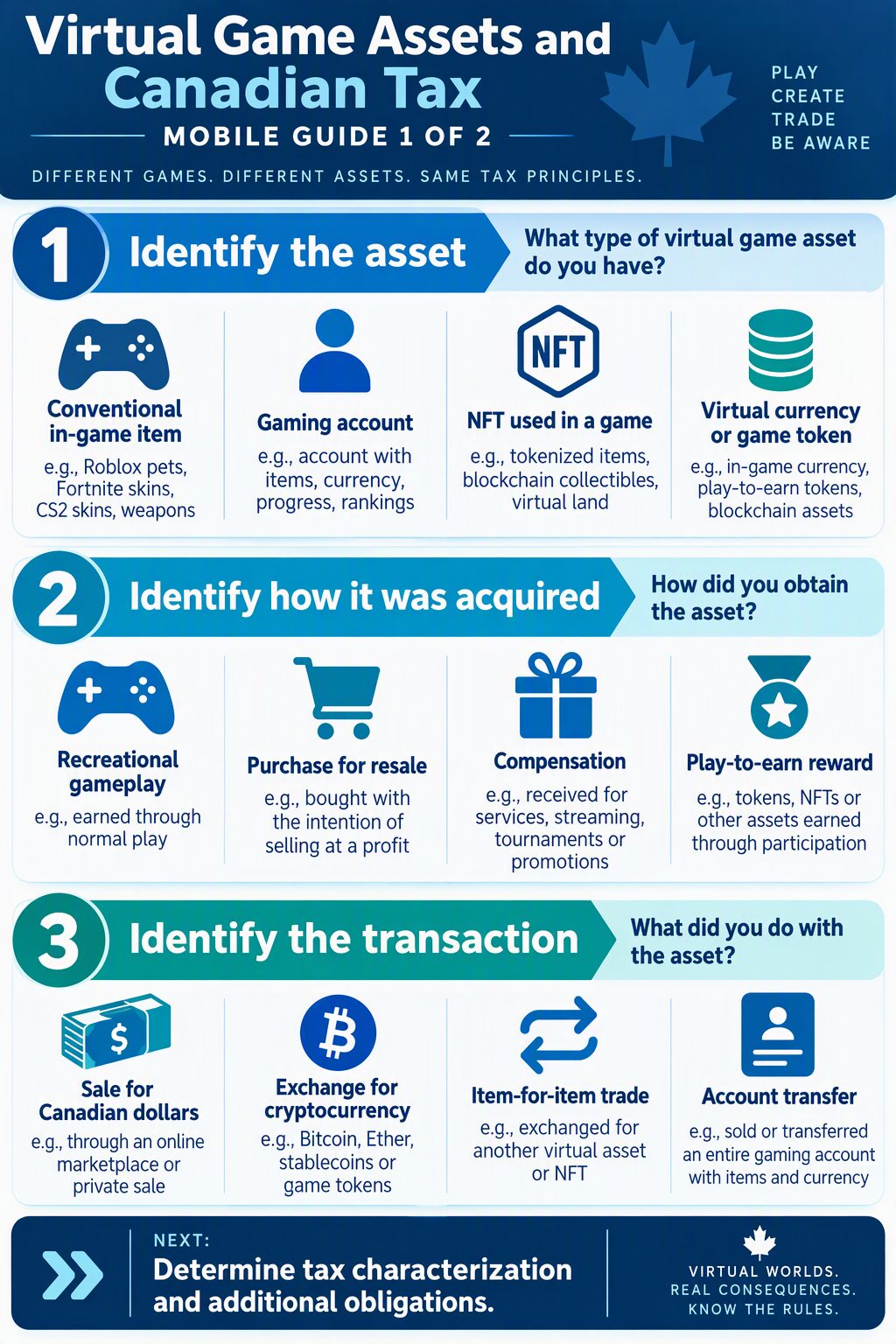

Use this framework as an initial issue-spotting tool. Each stage requires a fact-specific legal analysis, and no single label determines the Canadian income-tax or GST/HST result.
Background: Why Virtual Gaming Items Can Have Canadian Tax Consequences
A taxpayer should not assume that an asset has no tax consequences merely because it exists within software or an online platform. Virtual gaming arrangements take many different forms. A player might merely have a contractual licence to use an item within a game. Another platform might permit users to sell or transfer an item. A blockchain game might associate an item with a transferable NFT held in the player’s wallet. A gaming account might bundle together access rights, virtual currency, character progress and digital property.
These arrangements should not be treated as legally interchangeable. A conventional gaming skin maintained on a centralized platform is not automatically a crypto-asset simply because it exists digitally. An NFT, by contrast, is generally associated with blockchain technology.
Key distinction: A conventional in-game item, skin or virtual pet maintained on a centralized platform should not automatically be analyzed as a cryptocurrency or NFT. The taxpayer must first identify the legal rights, transferability and transaction actually involved.
The correct starting point is to identify what rights the taxpayer acquired, whether those rights are transferable, what the taxpayer did to acquire them, whether the activity was recreational or commercial, what the taxpayer received on the sale or exchange, and whether there were one or several relevant transactions.
Resources:
- Where gaming assets are tokenized as NFTs, see our Canadian tax guide for creating and selling NFTs for additional analysis.
- Where a transaction involves Bitcoin, Ether or another cryptocurrency, review our TaxPage guide to cryptocurrency tax in Canada and our more detailed Crypto Tax Lawyer guide to Canadian crypto tax.
Business Income vs. Capital Gains on Virtual Game Assets
One of the most important Canadian tax issues is whether a profit from a virtual game asset constitutes business income or a capital gain. Profit earned through a business or an adventure or concern in the nature of trade is generally included as business income. A disposition of capital property may instead produce a capital gain or loss.
The taxpayer’s description of the activity does not determine the result. Calling oneself a gamer, player, collector, hobbyist or investor is not conclusive. Relevant considerations can include intention, frequency and volume, holding period, time devoted, advertising, commercial organization, specialized knowledge, financing, expectations of resale and the taxpayer’s overall course of conduct.
Our analysis of CRA tax reassessments that recharacterize capital gains as business income discusses these characterization principles in greater detail.
For CS2 and Counter-Strike skins, the same characterization framework applies. A player who acquires a skin for personal enjoyment and later disposes of it presents a different factual case from a trader who repeatedly acquires skins with an organized resale strategy. The label “skin” does not determine whether a particular profit is on income or capital account.
Active Virtual-Asset Traders and Business-Income Treatment
Business-income treatment becomes more likely where a person deliberately acquires virtual assets for resale and conducts repeated transactions in a commercially organized manner. Indicators may include searching for undervalued gaming assets, maintaining inventory, advertising items, operating across marketplaces, using pricing tools, negotiating repeated transactions and devoting substantial time to trading.
Even an isolated transaction can potentially constitute an adventure or concern in the nature of trade. See our guide to an adventure or concern in the nature of trade.
Virtual Assets Accumulated Through Ordinary Gameplay
A more difficult situation arises where a player accumulates valuable virtual gaming assets through ordinary recreational gameplay rather than purchasing them as investments. Examples include rare items earned through challenges, early-player items that later become scarce, and digital collectibles accumulated without an initial resale intention.
The Canadian tax analysis may need to consider whether the original activity was personal or commercial, whether the player was carrying on a business when the item was obtained, whether the item was compensation, whether the activity later became commercial, what legal rights were acquired, whether the item can be transferred independently, what amount constitutes its cost, and what occurred when the asset was eventually disposed of.
“Many taxpayers assume that virtual assets existing solely within a game fall outside the tax system. That assumption can be dangerous where those assets have real-world value and generate profits. The tax treatment depends on the surrounding facts and circumstances.”
David Rotfleisch, Certified Specialist in Taxation Law, Law Society of Ontario
Personal-Use Property and Recreational Gaming Items
Personal-use-property treatment may be available for some virtual game assets, but the analysis begins with two threshold questions. First, the taxpayer must own “property” or a legally relevant right rather than merely have a revocable platform permission with no transferable proprietary content. Second, the property must have been used primarily for the personal use or enjoyment of the taxpayer or a related person. Recreational gameplay is therefore evidence supporting the argument, but it is not conclusive.
A stronger personal-use-property case may exist where a player acquired or earned a skin, pet, avatar item or other collectible principally to use and enjoy inside a game, held it for a substantial period, made few or no comparable trades, did not market it as inventory, and only later disposed of it after the item unexpectedly became valuable. The argument is weaker where the taxpayer selected assets for appreciation, monitored resale prices, bought with resale in mind, maintained inventory, traded repeatedly or otherwise acted commercially.
The statutory definition is broad enough to include property used primarily for personal enjoyment; it is not limited to tangible property. Nevertheless, there appears to be no specific Canadian authority establishing that every conventional in-game item is property or personal-use property. Platform terms may describe the taxpayer’s interest as a limited licence and may restrict ownership, withdrawal or transfer. Those terms must be reviewed before applying the personal-use-property rules.
If the asset is personal-use property held on capital account, section 46 generally deems both adjusted cost base and proceeds to be at least $1,000. The anti-fragmentation rule for properties ordinarily disposed of as a set must also be considered. A loss on ordinary personal-use property is generally denied. The personal-use-property analysis therefore affects both characterization and computation; it is not simply a description of recreational use.
Accordingly, personal-use-property treatment is arguable for some recreationally held virtual assets, but it should not be presented as automatic. The taxpayer must establish the nature of the right, ownership, primary personal use or enjoyment, capital-account treatment, and the absence of a business or adventure or concern in the nature of trade.
Tax consequences if the rules apply. A disposition must be computed in Canadian dollars. Section 46 generally deems both adjusted cost base and proceeds to be at least $1,000, so an item with an actual cost of $100 and actual proceeds of $800 may produce no capital gain under those minimum rules, while an item sold for $1,500 may produce a $500 capital gain before the applicable capital-gains inclusion rate and any other adjustments. Ordinary personal-use-property losses are generally denied, and items ordinarily disposed of as a set can be aggregated under the anti-fragmentation rule. Fair market value remains fact-specific.
Gaming Assets Acquired Through Gambling, Wagering, Prizes or Chance
A gaming asset can enter a taxpayer’s hands differently from an ordinary purchase or a reward earned through gameplay. A player might win a skin, token, virtual currency amount or other item through a tournament prize, promotional contest, wager, gambling-style activity or another event involving chance. The acquisition event and any later sale or exchange should be analyzed separately.
Canadian tax law does not treat every gambling or prize receipt in the same way. A genuine windfall or non-business gambling receipt may be outside income, whereas organized activity carried on in a sufficiently commercial manner and in pursuit of profit can produce business income. Characterization depends on the facts, including organization, repetition, skill, intention and the taxpayer’s overall course of conduct.
Even where the initial receipt is not itself taxable income, a later disposition of the gaming asset requires a separate analysis. The taxpayer should establish the asset’s Canadian-dollar fair market value when acquired, because that value may be relevant to determining cost for a later disposition. If the asset is later sold for Canadian dollars, exchanged for cryptocurrency or traded for another asset, the subsequent increase or decrease in value may need to be characterized as a capital gain or loss or as business income or loss.
Greater care is required where the player repeatedly wagers for valuable skins or virtual items, maintains inventories, regularly converts winnings into cash or cryptocurrency, or otherwise conducts the activity systematically for profit. Those facts can support business-income treatment rather than treatment as an occasional personal activity. Gambling-law, platform-contract and provincial regulatory issues are separate questions and should not be conflated with the income-tax characterization.
For further analysis, see our Canadian tax lawyer guide to gambling and poker winnings.
Selling Gaming Assets for Cryptocurrency
Receiving cryptocurrency rather than Canadian dollars does not necessarily prevent a taxable transaction from occurring. A player might receive Bitcoin, Ether, a stablecoin, a platform token, another NFT, another gaming item or a combination of digital and conventional consideration.
Where cryptocurrency is received, the transaction may need to be valued in Canadian dollars at the relevant time. A later disposition of the cryptocurrency may give rise to a separate tax event. Taxpayers should not wait until cryptocurrency is converted into Canadian dollars before reviewing the transaction.
Additional guidance is available in our Canadian crypto tax guide and through our Canadian crypto tax-law services.
Play-to-Earn Games and Blockchain Gaming Rewards
Play-to-earn gaming can combine gameplay, compensation, cryptocurrency and NFT transactions. A player may receive tokens, NFTs, staking or governance rewards, creator royalties, tournament prizes, referral compensation or assets awarded for providing services.
The initial receipt and later disposition should not automatically be collapsed into one transaction. The first question is whether the reward was earned in circumstances that produced income. The second is what happens when the taxpayer later sells, exchanges, transfers or uses the asset.
Creator income is a related but distinct issue. Earnings from developing games, creating experiences, streaming, sponsorships, advertising, platform payouts or selling newly created virtual items may involve a business-income analysis that differs from a player’s later disposition of an existing virtual collectible. Keeping these categories separate helps avoid collapsing creator revenue and asset-disposition questions into a single tax result.
The cryptocurrency resources on TaxLawCanada provide further discussion of cryptocurrency, NFTs and barter transactions.
Blockchain games illustrate the distinction between earning an asset and later disposing of it. See our Canadian tax guide to Axie Infinity and play-to-earn gaming for a game-specific discussion of NFT-based gaming income and transactions.
Selling a Gaming Account in Canada
Selling an entire gaming account can be more complicated than disposing of one virtual item. An account may bundle access rights, licences, character progression, accumulated virtual currency, digital items, subscription benefits, rankings and contractual rights arising under platform terms.
Platform terms may restrict or prohibit account sales. The existence of an active grey market does not necessarily establish unrestricted ownership or transfer rights. The tax analysis should begin with the legal and economic rights involved rather than treating the account as ordinary tangible property.
Gaming accounts and virtual items are in fact bought and sold through specialized third-party marketplaces. Current examples include PlayerAuctions, G2G and Eldorado. PlayerAuctions describes itself as an independent player-to-player marketplace for virtual in-game items and services, G2G has dedicated categories for game accounts and in-game items, and Eldorado lists game accounts, currencies and items and permits users to become sellers. These marketplaces may facilitate listings, payment, trade protection, seller verification or dispute resolution, but their involvement does not determine the Canadian tax characterization of the seller’s profit.
For the account seller, the tax analysis depends on the seller’s activity rather than the marketplace label. An occasional disposition of a personally used gaming account may raise capital-property and potentially personal-use-property questions, subject to the ownership, platform-contract and characterization issues discussed above. By contrast, a person who regularly acquires, develops, levels, markets or sells gaming accounts, maintains multiple listings, operates across marketplaces, negotiates repeated transactions or otherwise conducts the activity systematically for profit is more likely to be earning business income or engaging in an adventure or concern in the nature of trade.
A regular seller should record gross sale proceeds before marketplace deductions, marketplace or broker commissions, payment-processing charges, acquisition and development costs that are legally deductible, Canadian-dollar conversion and the supporting records for each transaction. The fact that a marketplace deducts its commission before remitting the balance does not mean that only the net cash received should automatically be treated as gross revenue. The correct reporting position depends on the legal arrangement and applicable income-tax rules, while properly deductible selling expenses require separate support.
The marketplace or broker-like intermediary has its own tax analysis. A Canadian business earning commissions, listing fees, transaction fees or other consideration for facilitating gaming-account or virtual-item sales would generally need to consider those receipts as business revenue and separately address GST/HST registration, collection, place-of-supply and record-keeping obligations. The intermediary’s tax treatment is separate from the seller’s Canadian tax consequences on the underlying account or virtual assets.
Platform terms remain important. Some game publishers restrict or prohibit account transfers even though third-party markets exist. A taxpayer therefore should not infer unrestricted legal ownership or transfer rights merely because PlayerAuctions, G2G, Eldorado or another marketplace provides a practical mechanism for finding a buyer. Contractual restrictions can also affect valuation, evidence and the characterization of what was actually transferred.
GST/HST on Virtual Game Assets and Gaming Businesses in Canada
GST/HST requires an analysis separate from income tax. Reporting a disposition as business income or a capital gain does not, by itself, determine its GST/HST treatment.
Relevant questions can include whether the seller is engaged in a commercial activity, whether registration is required, what property, service or rights are supplied, whether the supply is made in Canada, purchaser location and status, whether the transaction is exempt, taxable or zero-rated, whether a distribution platform is involved, and whether consideration includes cryptocurrency or another virtual asset.
Identifying the Virtual Property or Rights Supplied
The GST/HST analysis begins by identifying the actual supply. A transaction might involve intangible personal property, a licence to use intellectual property, access to a digital service, an account-related right, advertising or promotional services, an NFT, a virtual payment instrument, or a combination of property and services.
A qualifying virtual payment instrument may receive treatment as an exempt financial service. An NFT or another token carrying access, redemption or gaming rights may not qualify for the same treatment. The fact that cryptocurrency was used to purchase an asset does not make the asset itself an exempt financial instrument.
For background on tokens and underlying rights, review our Canadian NFT tax article.
GST/HST Registration for Virtual-Asset Businesses
A person engaged in occasional recreational activity should not automatically assume that GST/HST registration is required. However, an organized trader, creator or seller carrying on commercial activity must consider whether registration obligations arise. Once the applicable registration requirements are met, the taxpayer may be required to collect and remit GST/HST on taxable supplies.
Characterizing the income-tax result as a capital gain does not conclusively dispose of the GST/HST issue. Conversely, reporting a profit as business income does not automatically establish the applicable rate, place of supply or availability of an exemption or zero-rating provision.
International Purchasers and Online Marketplaces
Virtual assets may be sold through global platforms to purchasers whose identities or locations are not readily apparent. This can complicate place-of-supply analysis, the applicable GST or HST rate, evidence concerning purchaser location, potential zero-rating, invoicing, record-keeping and the respective responsibilities of sellers and distribution-platform operators.
A Canadian seller should not assume that an online marketplace has collected and remitted every amount for which the seller may be responsible. The contractual arrangements and applicable digital-economy provisions must be reviewed.
Consideration Received in Cryptocurrency
Where payment is received in cryptocurrency, the relevant GST/HST computation generally cannot be avoided merely because no Canadian dollars changed hands. The consideration may need to be valued in Canadian dollars. The virtual currency or token received should also be recorded because its later disposition can have separate income-tax consequences.
“GST/HST is not an extension of the income-tax analysis. A taxpayer must identify the actual digital property, service or right supplied and then apply the Excise Tax Act independently. Treating every gaming or blockchain transaction as though it were simply a cryptocurrency transfer can produce a materially incorrect result.”
David Rotfleisch
Valuation of Virtual Game Assets
Valuation may be one of the most difficult practical issues. Some items trade through active marketplaces with observable prices. Others trade privately, have thin markets, fluctuate dramatically or cannot officially be transferred under platform terms. A listing price does not necessarily establish fair market value.
Closed-platform balances and restricted marketplaces require particular care. A quoted platform price may not establish the cash-equivalent fair market value of an item if the proceeds cannot be freely withdrawn, the item cannot be transferred outside the platform, or platform terms materially restrict a sale. Those restrictions should be documented as part of the valuation evidence rather than ignored.
Relevant evidence may include completed marketplace sales, transaction histories, contemporaneous offers, platform statements, cryptocurrency records, documents showing the rights associated with the item, transfer restrictions, and the valuation source and exchange rate used.
All amounts reported for Canadian tax purposes must be supportable in Canadian dollars at the relevant transaction time. A taxpayer should document the marketplace price, exchange rate, timestamp, source and any restriction affecting convertibility or withdrawal.
Resources:
- Foreign-Currency Conversion: Guide to the section 261(1) spot-rate requirement,
- Separate Fair-Market-Value: Canadian tax lawyer’s guide to deemed dispositions and fair market value.
Record Keeping for Roblox, Adopt Me, Fortnite, CS2 and Other Virtual Assets
Taxpayers should retain acquisition dates and costs, details of how items were obtained, disposition dates, proceeds, Canadian-dollar values, valuation sources, screenshots, marketplace records, platform statements, communications, wallet addresses, transaction hashes, exchange records and applicable platform terms. Screenshots can corroborate other evidence but should not replace downloadable records where available.
Resources:
These resources provide additional guidance on preserving transaction histories, wallet and exchange records, Canadian-dollar values and supporting documentation.
- Canadian tax lawyer’s guide to keeping cryptocurrency records
- Record-keeping requirements for Canadian cryptocurrency traders and investors
CRA Tax Audits of Gaming and Virtual-Asset Transactions
Commercial activity does not become exempt from Canadian tax merely because it occurs inside a game or through a digital marketplace. A CRA tax audit may examine bank deposits, payment-processor records, cryptocurrency wallets, blockchain transactions, platform histories, marketplace accounts, business records, income-tax returns, GST/HST returns, unexplained deposits and discrepancies between reported income and visible economic activity.
CRA enforcement can also use publicly visible online information. Our article on CRA data mining and monitoring of social media explains that CRA may review social-media posts for indicators of unreported income or assets. For gamers, streamers, creators and virtual-asset traders, public posts showing valuable inventories, sales, marketplace activity, sponsorships, lifestyle spending or cryptocurrency transactions may be compared with filed tax returns and other records.
Taxpayers dealing with cryptocurrency should review our guide on dealing with a CRA cryptocurrency tax audit.
The Supreme Court of Canada’s decision in R. v. Jarvis distinguishes a tax audit conducted for civil tax administration from a criminal investigation whose predominant purpose is penal liability. A taxpayer facing serious allegations of deliberate non-reporting, false records or concealed transactions should obtain advice from an experienced Canadian tax litigation lawyer promptly. Our detailed analysis of the boundary between a CRA tax audit and criminal tax investigation explains the applicable framework.
CRA scrutiny is particularly relevant where gaming activity overlaps with streaming, sponsorship, subscriptions or other visible online income. Our article on CRA scrutiny of influencers and videogame streamers discusses CRA attention to unreported online income and use of open-source intelligence.
Correcting Previously Unreported Gaming Income Through the Voluntary Disclosures Program
A taxpayer who discovers material unreported gaming income or virtual-asset gains should obtain advice before simply amending prior tax returns. Depending on the facts and the status of CRA enforcement activity, the Voluntary Disclosures Program may provide a means of correcting unreported business income, omitted capital gains, cryptocurrency dispositions, GST/HST failures, foreign-reporting obligations or inaccurate prior filings.
Review our guide to the CRA Voluntary Disclosures Program rules effective October 1, 2025 and the conditions of a valid voluntary disclosure.
Timing is critical. A disclosure made after CRA enforcement has begun may receive materially different treatment or may not qualify. An experienced Canadian tax lawyer should review the history, records and enforcement status before a corrective filing strategy is chosen.
Canadian Tax Litigation Involving Virtual Assets
Potential disputes include business income versus capital gains, property characterization, personal-use property, inventory, valuation, cost determination for items accumulated through gameplay, barter and cryptocurrency consideration, GST/HST registration and collection, place of supply, evidentiary reliability and penalties.
Where a taxpayer disagrees with a CRA tax assessment or tax reassessment, the objection and appeal process generally requires evidence supporting both the legal characterization and values reported. An experienced Canadian tax litigation lawyer for CRA disputes should examine the assumptions underlying the CRA position rather than treating the dispute as a purely technological question.
Implications for Canadian Gamers, Parents and Digital Entrepreneurs
Canadian taxpayers should avoid two opposite assumptions. The first is that every gaming transaction produces taxable income. The second is that assets existing inside a virtual environment can never have Canadian tax consequences. Both are too broad.
Parents should not assume that virtual assets accumulated in a child’s account are irrelevant because the child is a minor. The legal and tax analysis must determine who acquired the asset, who beneficially owned or controlled it, who performed the activities that generated the profit, who received the sale proceeds, whether a parent acted merely as custodian, and whether funds or assets were transferred between parent and child. Account registration in a parent’s name is relevant evidence but does not necessarily determine beneficial ownership or who earned the income.
A minor can be liable for Canadian income tax on taxable business income or capital gains and must file a return where the ordinary Canadian filing rules require one. Those rules can require filing where tax is payable, CRA requests a return, capital property was disposed of or a taxable capital gain was realized, or sufficient self-employment income creates Canada Pension Plan contribution obligations. The mere receipt of some income does not automatically require every minor to file. Where the child repeatedly buys and sells virtual assets, provides services, streams, competes for prizes or otherwise carries on organized profit-making activity, business-income treatment may apply. Where a recreationally held asset is capital property, capital-gain and potentially personal-use-property rules may instead require consideration. Attribution rules can also matter where a parent transferred property or funds to a minor child, but those rules must be applied to the actual source of the income or gain rather than assumed from the family relationship alone.
Parents should preserve platform statements, acquisition records, wallet information, bank or payment-processor records, evidence of who controlled the account, records of parental funding and the basis used to value transactions in Canadian dollars. Public posts and videos can also become evidentiary records because CRA may monitor social media and compare visible commercial activity with filed returns.
A casual player who occasionally disposes of an item accumulated for recreation presents a different case from a trader who acquires and resells virtual inventory. A centralized gaming skin differs from an NFT. A gaming account may involve contractual access rights rather than unrestricted ownership. A play-to-earn reward may involve compensation where an ordinary collectible does not.
Identify the asset, identify the taxpayer and beneficial owner, identify the transaction, identify the taxpayer’s purpose and conduct, value the transaction in Canadian dollars, and then apply the relevant income-tax and GST/HST rules.
For additional enforcement and valuation context, review our article on CRA monitoring of social media and our fair-market-value guide.
Takeaway: Virtual Assets Can Produce Real Canadian Tax Obligations
A virtual asset does not need a physical form to create a Canadian tax issue. Where gaming assets are sold, exchanged, earned or used commercially, taxpayers should consider business income versus capital gains, personal-use property, inventory, cryptocurrency dispositions, GST/HST, valuation, record-keeping, CRA tax audit exposure and possible voluntary disclosure of historic non-compliance.
“The mistake is starting with the label attached to an asset. Calling something a skin, pet, token or virtual collectible does not determine its Canadian tax treatment. The analysis begins with what the taxpayer actually acquired, how it was used, what was transferred and whether the surrounding activity had a commercial character.”
David Rotfleisch
Pro Tax Tips: Protecting Yourself When Virtual Assets Have Real Value
Canadian taxpayers should not assume that virtual assets become invisible to Canadian tax law because they exist inside a game. Once those assets develop meaningful exchange value or become part of repeated commercial activity, contemporaneous records become essential. Acquisition information, marketplace records, transaction histories, Canadian-dollar values, cryptocurrency records and platform terms should be preserved before they disappear.
Taxpayers should also avoid assuming that every virtual item is an NFT, every NFT is an investment, every gaming transaction produces a capital gain or every cryptocurrency payment receives exempt GST/HST treatment.
Taxpayers who trade virtual assets regularly, operate gaming-related businesses, receive substantial play-to-earn rewards or discover material unreported historic transactions should obtain advice from an experienced Canadian tax lawyer before filing or correcting their Canadian tax returns.
Frequently Asked Questions About Virtual Game Assets and Canadian Tax
Is selling a Roblox or Adopt Me pet taxable in Canada?
Potentially. The result depends on the player’s rights, whether a meaningful disposition occurs, why the asset was acquired and whether the surrounding activity is personal, investment-related or commercial.
Are virtual game items property for Canadian tax purposes?
Some virtual assets may constitute property or represent legally relevant contractual rights, but no universal conclusion should be made across every platform. The platform terms, transferability and rights associated with the item must be reviewed.
Is selling a Fortnite account taxable?
A profitable account sale can potentially produce Canadian tax consequences. The seller must identify the rights transferred, whether the transaction was valid under platform terms and whether the profit arose from a business or disposition of capital property.
Are CS2 or Counter-Strike skins taxable in Canada?
They can be. Occasional disposition of a collectible and systematic skin trading require different analyses. Intention, frequency, commercial organization, holding period and course of conduct are relevant.
Can CRA tax gaming profits?
Business income earned through gaming, streaming, asset trading or related commercial activity can be taxable. No exemption applies merely because the activity took place through an online game.
Is occasional gameplay different from operating a gaming business?
Yes. A recreational player and an organized trader may have materially different tax results. Frequency is not the only factor, and even an isolated profit-making undertaking can require business-income analysis.
Do I have to report a transaction if I never received Canadian dollars?
Potentially. Receiving cryptocurrency, another digital asset or non-cash consideration does not necessarily prevent a disposition or barter transaction from occurring.
What happens if I exchange a gaming NFT for cryptocurrency?
The transfer of the NFT and receipt of cryptocurrency must be considered. A later sale, exchange or use of the cryptocurrency can create a separate tax event.
Are play-to-earn rewards taxable?
They may be. Relevant factors include how the reward was obtained, whether the activity was commercial, what services or participation produced it and what later happened to the asset.
Are valuable gaming items automatically personal-use property?
No. The classification is arguable only where the taxpayer owns property or a legally relevant right used primarily for personal use or enjoyment and the asset is held on capital account. Recreational acquisition and gameplay support the argument, but resale intention, repeated trading, inventory-like conduct, platform restrictions and the legal nature of the taxpayer’s rights can point away from personal-use-property treatment. If the rules apply, section 46’s $1,000 minimum adjusted-cost-base and proceeds rules and the general denial of personal-use-property losses must also be considered.
How are virtual game assets valued?
Valuation should be based on reasonable and supportable evidence. Completed arm’s-length sales are generally more persuasive than asking prices. Records should identify the valuation source and Canadian-dollar conversion methodology.
Do I have to charge GST/HST when selling virtual game assets?
Not necessarily. GST/HST depends on commercial activity, registration status, the nature and location of the supply, purchaser information and whether an exemption or zero-rating provision applies.
Does an online marketplace collect all GST/HST for the seller?
Not necessarily. The platform’s contractual role and applicable digital-economy provisions must be examined. Marketplace involvement does not necessarily eliminate every Canadian GST/HST obligation.
Does receiving cryptocurrency make the sale GST/HST exempt?
No. The GST/HST treatment of the asset supplied is not determined solely by the form of payment. The cryptocurrency consideration and gaming asset can require separate analyses.
What records should virtual-asset traders keep?
Keep acquisition and disposition dates, costs, proceeds, Canadian-dollar values, transaction histories, marketplace data, screenshots, wallet records, valuation sources and applicable platform terms.
Can CRA conduct a tax audit of gaming income?
Yes. Commercial gaming and virtual-asset activity remains subject to ordinary Canadian tax administration. CRA may examine financial, platform, marketplace and cryptocurrency records.
Can the Voluntary Disclosures Program address unreported gaming income?
Potentially. Eligibility depends on the current VDP rules, completeness, timing and whether CRA enforcement has begun. Advice should be obtained before filing.
What if I won a gaming asset through gambling, wagering or a prize?
The initial receipt and the later disposition should be analyzed separately. A genuine windfall or non-business gambling or prize receipt may be outside income, while organized, repeated and commercially conducted wagering or gaming activity may constitute a business. If the asset is later sold or exchanged, its Canadian-dollar value when acquired and its value at disposition may be relevant to calculating a later capital gain or loss or business profit or loss. The correct result depends on the source and character of the initial receipt, the taxpayer’s overall course of conduct, and whether the later asset activity is on capital or income account.
How is a minor taxed on real-world profits from gaming assets?
A minor is not exempt from Canadian income tax merely because of age. A minor must file a Canadian income-tax return where the ordinary filing rules require one, including where tax is payable, CRA requests a return, the minor disposed of capital property or realized a taxable capital gain, or the minor has sufficient self-employment income to trigger Canada Pension Plan contribution obligations. Merely receiving some income does not, by itself, mean that every minor must file; the specific filing rules must be applied. Even where filing is not mandatory, filing may be useful to report income, establish losses, preserve tax attributes or claim a refund or available credits. For gaming assets, the substantive tax result depends on who earned the income or realized the gain, beneficial ownership, the nature and frequency of the activity, and how the asset was acquired. Organized trading, streaming, services, tournaments or repeated resale may produce business income. A disposition of capital property may instead produce a capital gain, subject to any applicable personal-use-property analysis. If a parent supplied the property or purchase funds, the attribution rules may require separate review. Proceeds, costs and fair market values should be established in Canadian dollars, and records should show who controlled the account and received the proceeds.
Should parents keep records of a minor child’s valuable virtual assets?
Where a child’s activity produces material proceeds, records should be preserved. The analysis must determine who acquired, controlled and disposed of the asset and whether the activity was personal or commercial.
DISCLAIMER: This article provides broad information. It is only accurate as of the posting date. It has not been updated and may be out-of-date. It does not give legal advice and should not be relied on as tax advice. Every tax scenario is unique to its circumstances and will differ from the instances described in the article. If you have specific legal questions, you should seek the advice of a Canadian tax lawyer.
About the Author