

Published: October 19, 2026
Case Overview
He thought he was trading stocks. He was using his savings, borrowing money, researching the market, and discussing trades almost every day.
Then he tried to withdraw his money.
The people behind the platform disappeared. What had looked like a legitimate investment account turned out to be a scam.
A Canadian taxpayer resident in Ontario, whom we will call Jack because of solicitor-client confidentiality, contacted our firm after losing approximately $1.2 million net of a partial recovery through his bank. The loss included family savings and money drawn on a line of credit.
After reading our articles about investment scams, Jack came to us with a question: how could he claim the loss on his tax return and move forward with his life?
The answer turned out to depend on far more than the fact that money was stolen. It depended on whether, in the eyes of the Income Tax Act, Jack had ever been carrying on a business at all.
The Problem
How the Scam Began
Jack was not new to the stock market. He had traded securities for more than eight years through genuine brokerage accounts.
A purported trading adviser, claiming to be an expert at a well-known US investment bank, approached him about a trading program. The program promoted artificial intelligence and methods said to profit from rapid stock trades.
The operation provided books, lessons, and trading advice. An assistant of the purported adviser spoke with Jack almost daily about trades.
Jack spent time researching stocks and deciding what to buy. He generally intended to sell within a day or a few days, rather than hold positions for years. Although the assistant tried to develop a more personal relationship, Jack kept the conversations focused on the trading activity.
Over several months, Jack sent approximately $1.3 million to the platform. About two-thirds came from personal and family savings. The remainder came from a line of credit.
Jack’s account on the platform displayed what appeared to be numerous executed trades. When he asked to withdraw money, the arrangement fell apart. He then discovered that the website had copied the identity of a real investment bank, and that the operators were impersonating that institution.
What Happened After He Discovered the Fraud?
Jack reported losing approximately $1.28 million. His bank recovered roughly $78,000, leaving about $1.2 million unrecovered. He reported the fraud to the police, to his banks, and to the Canadian Anti-Fraud Centre.
The effect on Jack and his family was severe. Along with the lost savings, he still carried the debt used to fund the transfers.
The tax problem underneath the fraud
There is no provision in the Income Tax Act that gives relief for being defrauded. That is the starting point, and it surprises almost every client who calls us about a scam. The CRA has said so directly in Technical Interpretation 2023-0994641I7: there are no specific provisions in the Act addressing losses incurred as a result of fraud, and any relief must be found in the general loss provisions.
So the question is never “was I defrauded.” It is “what, in tax terms, did I lose, and was it connected to a source of income?”
That produces three possible outcomes. The difference between them decides whether the loss shelters his salary, only his future capital gains, or nothing at all.
A business loss, computed under section 9, is deductible against income from any source, including employment income. Under paragraph 111(1)(a), a non-capital loss arising after 2005 may be carried back three years and forward twenty. Carrying it back can generate a refund of tax already paid.
A capital loss under paragraph 39(1)(b) is far less valuable. Only one half of a capital loss is an allowable capital loss, the inclusion rate having remained at one half after the proposed increase to two thirds was deferred in January 2025 and then cancelled in March 2025. An allowable capital loss can be applied only against taxable capital gains, carried back three years or carried forward indefinitely. It does not shelter salary.
No loss at all. Where the money lost is characterized as personal funds rather than an investment, the CRA treats it as personal-use property, and subparagraph 40(2)(g)(iii) deems the loss to be nil. This is the outcome in the personal-scam cases, and it is the outcome a victim must be positioned away from. There is a further line of cases in which no loss of any kind was available because the taxpayer never acquired capital property at all. In Vankerk v. Canada, 2006 FCA 96, investors in fictitious partnerships said to produce sound recordings were denied business losses because no business was in fact carried on, and in Garber et al. v. The Queen, 2014 TCC 1, a yacht-chartering scheme was found to be fraudulent from beginning to end, and the so-called partnerships were not partnerships at law, so no capital property existed to generate a capital loss.
A separate hurdle is section 67: in Ruff v. The Queen, 2012 TCC 105, a taxpayer who transferred almost $400,000 in an advance-fee scheme was denied a deduction because it was not reasonable for him to have believed the story. On the other side, where a genuine pre-existing business exists and the loss is incidental to it, the deduction has been allowed: see Agnew v. The Queen, 2002 DTC 2155 (T.C.C.).
The CRA’s administrative position on losses of this kind is in Income Tax Folio S3-F9-C1, Lottery Winnings, Miscellaneous Receipts, and Income and Losses from Crime. At paragraph 1.33, the CRA states that a loss of trading assets such as inventory or cash through theft or embezzlement is normally deductible in computing income from a business provided the losses are an inherent risk of carrying on the business and the loss is reasonably incidental to the normal income-earning activities of the business. That is the test Jack has to satisfy on the business-loss branch, and paragraph 1.33 adds a point that matters directly here: only out-of-pocket losses are deductible, and profits lost or foregone are not.
Paragraph 1.44 of the same Chapter deals specifically with fraudulent investment schemes, and states that the nature of the loss must first be established before the correct tax treatment can be determined, which is the whole of Jack’s problem in one sentence. The CRA applied that Chapter directly to a scam victim in Technical Interpretation 2018-0753051E5 (17 July 2018), one of six interpretations released in August and September 2018 responding to taxpayers who had lost money in fraudulent investment schemes. In that letter the CRA pointed the taxpayer to paragraph 1.44 to characterize the loss, and to paragraphs 9 to 13 of IT-479R to decide whether the investment was held on income or capital account.
It also confirmed the business investment loss analysis set out above: an ABIL requires a share of a small business corporation or a debt owing by a CCPC that was a small business corporation, with the disposition made to an arm’s-length person or deemed to occur under subsection 50(1); where those conditions are not met, the loss does not qualify as a business investment loss, but may still qualify as a capital loss under paragraph 39(1)(b).
Where the arrangement is better characterized as a loan to the operators than as a trading activity, subsection 50(1) is the relevant route: it permits a taxpayer to elect to be deemed to have disposed of a debt for nil proceeds, and immediately reacquired it at nil cost, where the debt is established to have become a bad debt in the year. That election converts an uncollectible advance into a capital loss, with any later recovery treated as a capital gain.
There is no prescribed form: the CRA’s Capital Gains Guide T4037 indicates the election is made by a signed letter attached to the return. The CRA also cautions that if the debt was not acquired for the purpose of gaining or producing income from a business or property, the loss may be denied. It is unlikely to assist Jack, whose transfers funded what he believed was his own trading rather than a loan, but it should be considered and ruled out expressly rather than overlooked.
A fourth route, an allowable business investment loss under paragraph 39(1)(c), is usually unavailable in fake-platform cases because it requires a share of, or a debt owing by, a small business corporation. Note also that an ABIL carries its own timetable rather than the ordinary non-capital loss timetable: it may be carried back three years and forward ten, and if it has not been deducted as a non-capital loss by the end of that period it becomes a net capital loss at the end of the tenth year, which may then be carried forward indefinitely against taxable capital gains beginning in the eleventh year.
The CRA also notes that, unlike an ordinary allowable capital loss, an ABIL may be deducted from all sources of income in the year it arises. Our analysis of allowable business investment losses sets out those requirements. A fake offshore trading website is not a Canadian-controlled private corporation, and the point is worth confirming early rather than discovering late.
What the three outcomes are worth on Jack’s numbers
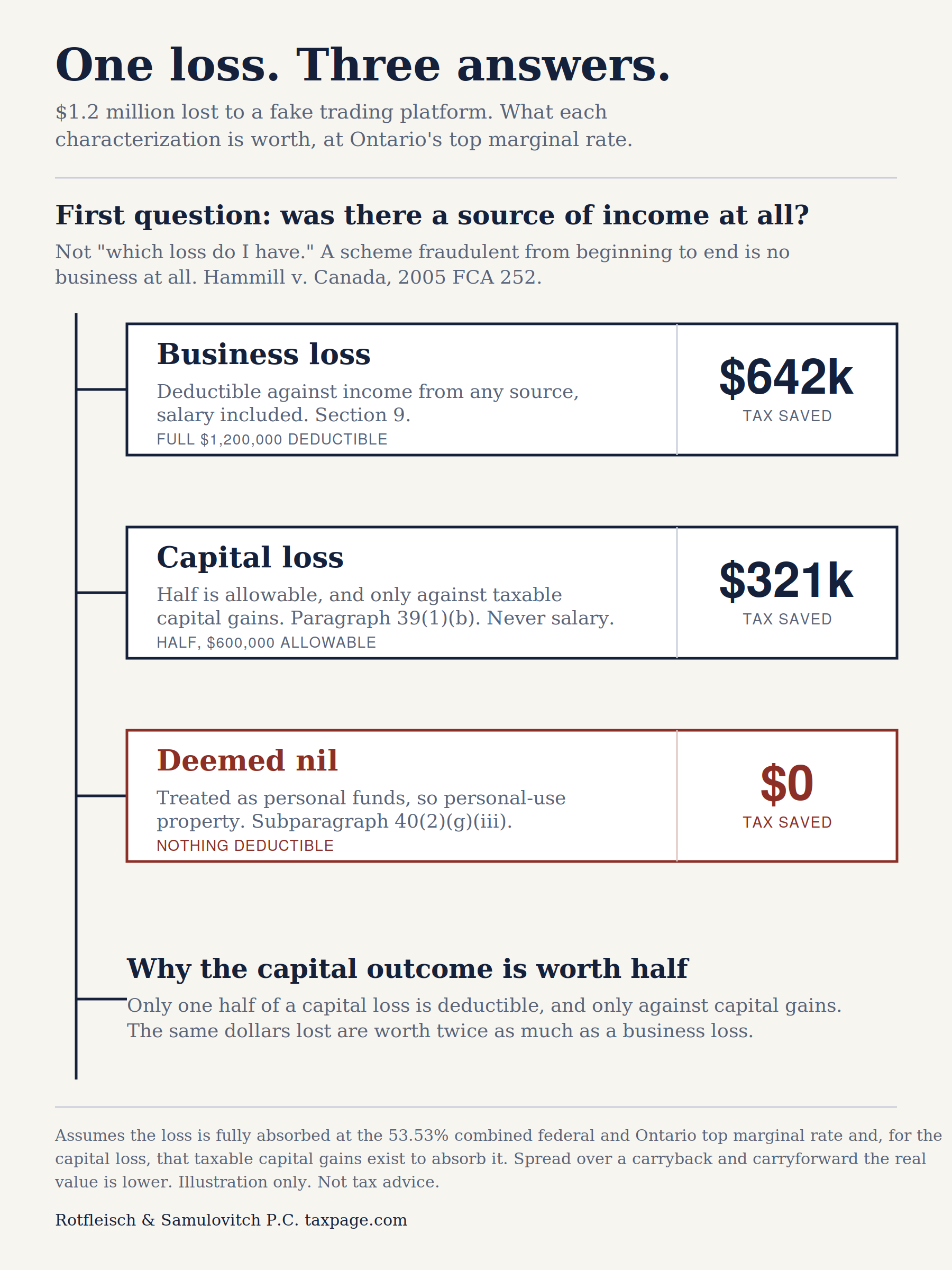
The gap between the three characterizations is not academic. Taking Jack’s unrecovered $1.2 million and a combined federal and Ontario top marginal rate of 53.53 percent, and assuming in each case that he has enough income of the right kind to absorb the loss:
As a business loss, the full $1.2 million is deductible against income from any source. At 53.53 percent, that is worth approximately $642,000 in tax.
As a capital loss, only one half is an allowable capital loss, so $600,000 is deductible, and only against taxable capital gains. At 53.53 percent, that is worth approximately $321,000.
As a personal-use loss deemed nil under subparagraph 40(2)(g)(iii), it is worth nothing.
The business-loss figure is exactly twice the capital-loss figure, and that is not a coincidence; it falls directly out of the one-half inclusion rate, which is the arithmetic check on both numbers. The practical gap is roughly $321,000 between a business loss and a capital loss, and roughly $642,000 between a business loss and no loss at all.
Two qualifications matter. These figures assume the loss is fully absorbed at the top marginal rate, which will rarely happen in a single year; spread across a carryback and carryforward the real value is lower, because some of it will be absorbed at lower marginal rates. And the capital-loss figure assumes taxable capital gains exist to absorb it, which for many scam victims they do not, in which case an allowable capital loss is worth nothing until they do.
A tax deduction does not mean the CRA refunds the stolen money. It may reduce tax, but the benefit depends on the loss allowed and on the income available to absorb it.
“There are no special provisions in the Income Tax Act that deal specifically with losses suffered through theft or fraud. Any available tax deductions are subject to the general principles relating to the taxation of income from business or property and income earned on account of capital.”
David J. Rotfleisch, Certified Specialist in Taxation Law (Law Society of Ontario)
Our Approach
Why We Considered a Business-Loss Claim
During the initial consultation, our Canadian tax lawyer identified a possible business-loss position based on the trading activity and the evidence described. Several details mattered:
- Jack had years of stock-market experience, including genuine brokerage trading before the scam.
- He discussed trades almost daily.
- He aimed to profit from rapid trades rather than long-term appreciation.
- He spent substantial time researching the market.
- He borrowed part of the money used for the activity.
- He preserved messages and a screen recording of the apparent trades.
These are not loosely described CRA preferences. They come from Vancouver Art Metal Works Ltd. v. The Queen, 93 DTC 5116, [1993] 1 C.T.C. 346 (F.C.A.), in which Letourneau J.A. held that “trader or dealer in securities” in paragraph 39(5)(a) extends to anyone whose dealings amount to carrying on a business, not merely to registered brokers, and identified the relevant indicators as the frequency of the transactions, the duration of the holdings, the intention to acquire for resale at a profit, the nature and quantity of the securities involved, and the time spent on the activity. The CRA restates the same list administratively in Interpretation Bulletin IT-479R, Transactions in Securities, at paragraphs 10 to 12, adding at paragraph 12 that no single factor need be sufficient on its own while a combination of them may well be. The test has not moved since.
In Canadian Western Trust Company v. The King, 2024 FCA 108, the Federal Court of Appeal confirmed that Vancouver Art Metal continues to supply the relevant factors for deciding whether buying and selling securities amounts to carrying on a business. The related development is at the prior stage of the analysis: in Canada v. Paletta Estate, 2022 FCA 86, the Federal Court of Appeal held that the Tax Court had gone further than the Supreme Court intended in Stewart v. Canada, 2002 SCC 46, by treating the mere appearances of commerciality as establishing a source of income; activity carried on without a genuine pursuit of profit is not a business at all.
Our full analysis of that decision is in The Queen v Paletta: Guidance on the Legal Test for Business Income, and the two-stage source test it applies is set out in our analysis of Stewart v. Canada. That matters here, because the first question in Jack’s file is not which kind of loss he has but whether there was a source at all, which is the same question Hammill answers against the victim. Our comparison of the business-loss and capital-loss treatment of trading losses in the crypto context appears in How Cryptocurrency Losses are Taxed in the United States and Canada, and the same factors are applied to fake platforms in our article on claiming tax losses from pig-butchering investment scams. The taxpayer’s intention at the time of acquisition carries the most weight.
The advice given at the consultation was a position to pursue. It was not a guarantee that the CRA would accept the claim.
The hard question: was there ever a real business?
This is the central issue in fake-platform cases, and it is where most commentary on scam losses stops short.
Jack believed he was trading. His messages and recordings help show what he was trying to do. They do not show that the platform ever bought or sold a single share.
The leading authority is Hammill v. Canada, 2005 FCA 252, affirming 2004 TCC 595, leave to appeal to the Supreme Court of Canada refused, [2006] S.C.C.A. No. 451. Mr. Hammill accumulated an inventory of precious gems and then paid roughly $1.65 million in fees to a fraudulent selling agent who promised to sell them at a profit. The Tax Court found he had been the victim of a fraud from beginning to end, and the Federal Court of Appeal held that a fraudulent scheme from beginning to end cannot give rise to a source of income from the victim’s point of view, and so cannot be a business under any definition.
A point often lost in the retelling: the CRA had in fact allowed Mr. Hammill a deduction for the theft of his gem inventory, as a loss from an adventure in the nature of trade. What was denied were the other expenses, struck down under section 67 as unreasonable, with the no-source reasoning supplying the wider principle. The distinction matters to Jack, because it shows that even in Hammill the stolen capital itself was not automatically beyond relief.
Hammill is often quoted as though it ends the discussion. It does not, and the two cases that follow it are what a scam victim actually needs to know.
In Johnson v. Canada, 2012 FCA 253, the Federal Court of Appeal held that amounts a taxpayer received out of a Ponzi scheme, above her original investment, were taxable income. The Court was explicit that there can be a source of income arising out of a fraudulent scheme, and that Hammill applies where the circumstances are analogous to Hammill, which is to say where there was no business even though the taxpayer honestly believed there was.
In Roszko v. The Queen, 2014 TCC 59, the Tax Court distinguished Johnson and followed Hammill. Mr. Roszko advanced $800,000 to TransCap Corporation, which was running a Ponzi scheme, and received $156,000 back in 2008. The Court held that the $156,000 was a return of his own capital, not interest income under paragraph 12(1)(c), because he had been the victim of a fraud from start to finish and there was no source.
The line between these cases is the line Jack’s file sits on. Two features of his situation distinguish him from Mr. Hammill:
- He sent money to fund trading, not to pay fees. The disputed payments in Hammill were purported selling expenses laid out against an inventory he already owned. Jack’s transfers were the capital of the activity itself.
He had traded before the scam, through real brokerage accounts. Mr. Hammill’s gem inventory was itself found to have been acquired as part of the fraud. If Jack’s pre-existing trading amounted to a business, the scam may be an incident of that business rather than a scheme that was fraudulent from inception.
Neither distinction makes the loss deductible on its own. Years of investing experience do not answer the question either. Jack’s actual trading records before the scam have to be examined, which is precisely why a Canadian tax lawyer has to look past the fake account’s displayed transactions.
Preserving the evidence
The platform did not permit Jack to download his trading history. He made a video recording of his screen showing the apparent trades, and he saved the message threads in which the trading was discussed. Those records help explain what happened after the website vanished. Section 230 of the Income Tax Act requires every taxpayer to keep adequate books and records, and the practical consequences of failing to do so are set out in our article on record keeping to deduct business expenses.
If you have suffered a similar loss, preserve bank statements showing what you sent and what came back, records of money borrowed, messages and emails with the people running the scheme, screenshots or recordings of the account, your trading instructions and your own research, records of trading through genuine brokerage accounts, and police reports and correspondence with your bank.
You do not need everything perfectly organized before seeking advice. Bring what you have and explain what is missing. Our general analysis of the documentation the CRA expects in theft and fraud cases is set out in Tax Losses from Theft and Embezzlement of Bitcoin and Other Assets.
Establishing who lost what, and when
Jack’s account was funded with personal and family savings, which makes ownership a live issue. A Canadian tax lawyer has to establish whose money was transferred and who is entitled to claim the loss. The person who operated the platform account cannot simply assume he may claim amounts contributed by family members.
Recoveries matter too. The amount the bank recovered had to be reconciled against the original transfers. Under the CRA’s position in Technical Interpretation 2014-0531171M6, a recovery of a previously deducted business loss is taxable under section 9 up to the amount deducted, and a recovery of a previously deducted capital loss is taxable as a capital gain to the extent of the excess. A recovery in a later year does not undo the claim, but it does have to be reported.
The displayed balance on the platform is not the amount lost. It includes profits that never existed, and this is where a great many scam-loss claims go wrong. Phantom gains have no adjusted cost base, because nothing was ever acquired. Johnson shows that amounts actually received out of a fraudulent scheme can be taxable; Roszko shows that amounts which merely came back to the taxpayer out of his own capital are not income. Neither case supports a claim built on a number the fraudsters put on a screen. The claim is measured by what left Jack’s bank account and did not come back.
There is a further route the CRA itself has opened, and it is the one most often missed. In the six technical interpretations released in August and September 2018, whose comments are substantially the same in each, the CRA stated that there is no provision allowing investment income already received and included in income to be removed from income, citing paragraph 1.42 of Folio S3-F9-C1.
But it went on to say that where investment income purportedly earned from a scheme was included in the taxpayer’s income and was not actually received or withdrawn, the taxpayer may claim a bad debt deduction under paragraph 20(1)(p) in the year the debt is established to be bad. The Tax Court allowed exactly that deduction in Donne v. The Queen, 2015 TCC 150. For a victim who reported paper profits that were never paid out, paragraph 20(1)(p) is often the practical answer.
There is a tension here that a taxpayer should know about. The CRA’s interpretations do not mention Roszko and their position is difficult to reconcile with it, since Roszko held that a receipt out of a fraudulent scheme was a return of capital rather than income at all. Commentators have observed that the CRA’s view that amounts cannot be removed from income is arguably not correct at law. A taxpayer in Jack’s position may still wish to advance a Roszko-style argument, particularly where the receipt is not in the nature of interest.
The taxation year of the claim also needs review, since the year of discovery, the year of transfer, and the year of recovery may differ. The CRA has confirmed that other deductions incurred in respect of the investment but not previously claimed, such as interest expense and carrying charges, may be addressed through a T1-ADJ Adjustment Request, and it directs taxpayers to the taxpayer relief provisions in Information Circular IC07-1R1 where relief from interest or penalties is in issue.
The Result
The consultation produced a defined position rather than a filed claim: a business-loss claim supported by Jack’s pre-scam trading record, his transaction frequency, his use of borrowed funds and the time he devoted to the activity, with the Hammill risk identified in advance rather than discovered on a CRA tax audit.
The outstanding work was set out plainly for him. His genuine brokerage records from the years before the scam have to be obtained and analyzed, because they are what distinguishes his situation from Hammill. The ownership of the transferred funds has to be allocated among the family members who contributed them. The bank recovery has to be reconciled. The correct taxation year has to be fixed. Any claim of this size, built on a fraud, should be expected to draw a CRA tax audit, and the file has to be assembled on that assumption from the start.
What the consultation did not produce is a guarantee. On these facts the CRA may well take the position that there was never a trading business, and the answer may ultimately be a capital loss, or nothing at all. A client is better served by knowing that before filing than by learning it from a notice of reassessment three years later.
Pro Tax Tips
Telling your Canadian tax lawyer that you lost money to an investment scam is only the starting point. What determines the outcome is what you were doing before and during the scam, and almost none of it is obvious to a client. Explain your previous trading experience, how often you traded, how much time you spent, where the money came from, whether any of it was borrowed, and what you believed the platform was doing with it. Those details are what allowed our tax lawyer to identify a possible business-loss claim in this consultation. Another person’s circumstances may well lead to different advice.
Resist the instinct to use the platform’s closing balance as your loss. It is the single most common error in these files, and it is the one most likely to turn a sympathetic claim into a credibility problem on a CRA tax audit. Claim what left your account and did not come back, and be able to prove it from bank records rather than from screenshots the fraudsters controlled.
Finally, do not let the pursuit of the money and the pursuit of the tax relief run on the same clock. Recovery efforts through your bank, the police and the Canadian Anti-Fraud Centre can run for years. Filing deadlines and reassessment periods will not wait for them. A review before you file will tell you the strengths of your claim, the questions the CRA is likely to ask, and the records you need to answer them.
Frequently Asked Questions
Can I claim a tax loss if the scam involved stocks rather than cryptocurrency?
Possibly. The asset class is not what matters. What matters is whether the money was lost in the course of an income-earning activity and how that activity is characterized. Neither a stock scam nor a crypto scam qualifies automatically.
Does daily trading guarantee a business-loss deduction?
No. Frequent trading is a relevant factor, but a fake platform raises the prior question of whether a real trading business ever existed. Hammill v. Canada, 2005 FCA 252 holds that a scheme that was fraudulent from beginning to end is not a business from the victim’s point of view.
Can I claim the loss because I borrowed the money?
Borrowing is one factor pointing toward business characterization. It does not create a deduction by itself. Whether the interest on the borrowed money is deductible under paragraph 20(1)(c) is a separate question, and it generally depends on whether the borrowed funds were used for an eligible income-earning purpose.
Should I get tax advice even if my bank says it cannot recover the money?
Yes. Recovering stolen money and claiming a tax loss are entirely separate processes. A failed recovery does not determine whether tax relief is available, and in some cases it helps establish that the loss is final.
What is the difference between a personal scam and an investment scam for tax purposes?
It is the difference between some relief and none. The CRA’s position, set out in Technical Interpretation 2023-0994641I7, is that losses from personal scams such as grandparent scams and phishing produce no loss from employment, business, property or a business investment loss, because there is no income-earning activity. The funds are personal-use property and subparagraph 40(2)(g)(iii) deems the loss to be nil. An investment scam may produce a business loss or a capital loss.
The fake platform showed large profits I never received. Am I taxed on them?
You should not be. Those balances were never received and nothing was ever acquired, so there is no disposition and no adjusted cost base. Roszko v. The Queen, 2014 TCC 59 held that payments out of a Ponzi scheme were a return of the taxpayer’s own capital rather than taxable interest. Be aware, though, that Johnson v. Canada, 2012 FCA 253 found amounts actually received above the original investment to be taxable, so money that did reach your account needs separate analysis.
Do I claim the loss in the year I sent the money or the year I discovered the fraud?
It depends on the characterization. For a capital asset lost to theft where no proceeds are recoverable, the CRA’s position in Income Tax Folio S3-F9-C1 is that the date of disposition is the date the loss was discovered. For a business loss, the timing follows ordinary business principles. Where transfers spanned more than one taxation year, this needs specific analysis.
What happens if my bank or the police recover money in a later year?
The recovery is reported in the later year. Under Technical Interpretation 2014-0531171M6, recovery of a previously deducted business loss is taxable under section 9 up to the amount deducted, and recovery of a previously deducted capital loss is taxable as a capital gain to the extent of any excess. A later recovery does not invalidate the original claim.
My family contributed some of the money. Can I claim the whole loss?
No, not simply because the account was in your name. The loss belongs to whoever beneficially owned the funds. Transfers from family members need to be traced and allocated, and in some cases each contributor claims a separate loss. Getting this wrong invites a CRA tax audit on the whole claim.
Can I claim an allowable business investment loss instead?
Usually not in fake-platform cases. An ABIL under paragraph 39(1)(c) requires a capital loss on a share of, or debt owing by, a small business corporation, which generally means a Canadian-controlled private corporation carrying on an active business. An offshore scam website does not meet that test.
Will claiming this trigger a CRA tax audit?
A large loss claimed against employment income, arising out of a fraud, should be expected to attract CRA attention. That is not a reason to avoid claiming it. It is a reason to assemble the supporting records before filing rather than after a query arrives.
What if I have already filed without claiming the loss?
You may be able to adjust prior returns. Any amendment should be prepared with the characterization settled first, because an adjustment request that mischaracterizes the loss is harder to correct than one that was never made.
Do I have to report the fraud to the police before claiming?
There is no statutory requirement to do so. In practice, a police report, a Canadian Anti-Fraud Centre file number and correspondence with your bank corroborate that the loss was real and final, and the courts have expected taxpayers to make reasonable efforts to obtain restitution.
How long do I have to make the claim?
The normal reassessment period for an individual is three years from the date of the original notice of assessment under subsection 152(3.1), and loss carrybacks have their own limits. We set out the rule and its exceptions in Errors in Reporting Income and the Normal Reassessment Period. The practical answer is that these claims should not be left, because the records needed to support them get harder to obtain as time passes and platforms and correspondents disappear.
DISCLAIMER: This article provides broad information. It is only accurate as of the posting date. It has not been updated and may be out-of-date. It does not give legal advice and should not be relied on as tax advice. Every tax scenario is unique to its circumstances and will differ from the instances described in the article. If you have specific legal questions, you should seek the advice of a Canadian tax lawyer.
Disclaimer:
"This article provides information of a general nature only. It is only current at the posting date. It is not updated and it may no longer be current. It does not provide legal advice nor can it or should it be relied upon. All tax situations are specific to their facts and will differ from the situations in the articles. If you have specific legal questions you should consult a lawyer."