

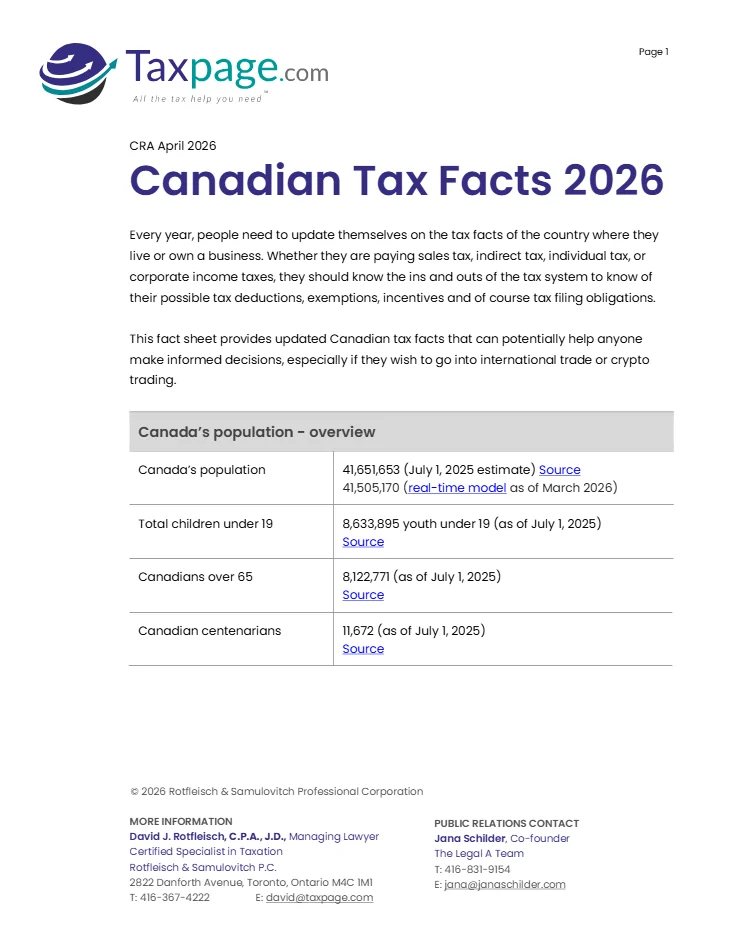
Canadian Tax Facts 2026
Explore 2026 Canadian tax rates, CRA statistics, corporate income tax facts, international tax considerations and more in our latest 58-page report.
Explore Canadian income tax rates, CRA statistics, corporate tax facts and key tax developments for 2026. Download the latest report or browse previous editions.
Prepared by Canadian tax lawyer David J. Rotfleisch, the 58-page Canadian Tax Facts 2026 report provides an overview of Canada’s tax system, including key rates, statistics, compliance requirements and tax developments.
The report covers:
Explore highlights from the report below, including the latest tax statistics, historical comparisons and key Canadian tax considerations.
The Canadian Tax Facts 2026 report highlights key figures on Canada’s population, federal tax revenues and income tax filing activity. The following statistics provide a snapshot of Canada’s tax system using the latest reporting periods included in the publication.
| Canadian Tax Fact | Reported Figure |
|---|---|
| Canada’s population (July 1, 2025 estimate) | 41,651,653 |
| Individual income tax returns filed in 2025 | Approximately 33.8 million |
| Total federal government revenue (2024-25) | $510.95 billion |
| Personal income tax revenue (2024-25) | $234.3 billion |
| Corporate income tax revenue (2024-25) | $97 billion |
Note: Statistics reflect the reporting periods identified in the 2026 report and do not necessarily represent data collected during the 2026 calendar year.
How have Canadian tax revenues and filing activity changed over time? The following comparison highlights personal income tax revenue, corporate income tax revenue and individual tax returns filed, based on figures published in the annual Canadian Tax Facts reports from 2022 to 2026.
| Report Edition | Personal Income Tax Revenue | Corporate Income Tax Revenue | Individual Tax Returns Filed |
|---|---|---|---|
| 2022 | $174.8 billion (2020-21) | $54.1 billion (2020-21) | 30.86 million (2021) |
| 2023 | $198.4 billion (2021-22) | $78.8 billion (2021-22) | 31.28 million (2022) |
| 2024 | $207.9 billion (2022-23) | $93.9 billion (2022-23) | 32.19 million (2023) |
| 2025 | $217.7 billion (2023-24) | $82.5 billion (2023-24) | 33.45 million (2024) |
| 2026 | $234.3 billion (2024-25) | $97 billion (2024-25) | Approximately 33.8 million (2025) |
These figures provide historical context but do not, by themselves, indicate changes in individual tax burdens. Revenues can be influenced by inflation, economic growth, employment, corporate profitability, tax policy and other factors. All amounts are nominal dollars, not adjusted for inflation.
Note: Each annual report includes the most recently available statistics at the time of publication. The reporting periods shown in parentheses identify when the figures were collected and may differ from the report’s publication year.
For more detailed information, explore the complete Canadian Tax Facts reports below, including historical personal income tax brackets, provincial and territorial tax rates, corporate taxation and CRA statistics.
Explore the latest Canadian Tax Facts report or browse previous editions dating back to 2022. Each downloadable PDF provides a historical reference for Canadian income tax rates, corporate taxation, CRA statistics and other developments in Canada’s tax system.
Explore 2026 Canadian tax rates, CRA statistics, corporate income tax facts, international tax considerations and more in our latest 58-page report.
Several changes affect the 2026 tax year. Some were confirmed after the April 2026 report was published, so they are noted here to keep this page current.
Canada uses a progressive income tax system, meaning different portions of an individual’s taxable income are taxed at different rates.
Federal income tax applies across Canada, while provincial or territorial income taxes are generally calculated separately based on the taxpayer’s province or territory of residence.
| Taxable Income (2026) | Federal Marginal Tax Rate |
|---|---|
| $58,523 or less | 14% |
| Over $58,523 up to $117,045 | 20.5% |
| Over $117,045 up to $181,440 | 26% |
| Over $181,440 up to $258,482 | 29% |
| Over $258,482 | 33% |
Each province and territory establishes its own personal income tax rates and brackets. As a result, taxpayers with similar incomes may face different combined federal and provincial or territorial income tax obligations depending on where they live.
The table below shows the top combined federal and provincial or territorial marginal income tax rates on regular income for 2026:
| Province or Territory | Top Combined Marginal Tax Rate |
|---|---|
| Newfoundland and Labrador | 54.80% |
| Nova Scotia | 54.00% |
| Ontario | 53.53% |
| British Columbia | 53.50% |
| Quebec | 53.31% |
| Prince Edward Island | 53.00% |
| New Brunswick | 52.50% |
| Manitoba | 50.40% |
| Alberta | 48.00% |
| Saskatchewan | 47.50% |
| Yukon | 48.00% |
| Northwest Territories | 47.05% |
| Nunavut | 44.50% |
These figures are the highest combined federal and provincial or territorial marginal rates on regular income in 2026, not the effective rate paid on a taxpayer’s entire income. Rates differ for capital gains and dividends. Quebec’s rate accounts for the federal tax abatement, and Ontario’s includes the provincial surtaxes. Prince Edward Island’s 53.00% reflects a new 20% provincial bracket on income over $200,000, confirmed for January 1, 2026 after the April 2026 report was published (the report lists 51.37%).
Canadian corporations are generally subject to federal and provincial or territorial corporate income taxes. Applicable rates depend on factors such as the corporation’s jurisdiction, type of income and eligibility for available tax reductions.
Corporate income taxes are a major source of federal government revenue. According to the Canadian Tax Facts 2026 report, the federal government collected approximately $97 billion in corporate income taxes during the 2024-25 fiscal year.
Corporate income tax rates vary between countries, making international tax considerations important for Canadian businesses operating or investing abroad.
The 2026 report provides the following comparison of business tax rates in selected countries:
| Country | Corporate Income Tax Rate Listed in the 2026 Report |
|---|---|
| Canada | 26.5% |
| United States | 21% |
| United Kingdom | 25% |
| Australia | 30% |
| Brazil | 34% |
| Argentina | 35% |
| Austria | 23% |
| Belgium | 25% |
These figures provide a general international comparison. Actual corporate tax liabilities may differ depending on jurisdiction, business structure, deductions, incentives and other applicable tax rules. Canada’s 26.5% figure is a representative combined rate, rather than a uniform rate for every corporation.
The Canada Revenue Agency administers federal tax laws and many provincial and territorial tax programs. Its responsibilities include processing tax returns, collecting taxes, administering benefits and tax credits, and enforcing tax legislation.
Canada operates under a self-assessment tax system, meaning taxpayers are generally responsible for accurately reporting their income, calculating their tax obligations and filing returns by the applicable deadlines.
The CRA reviews tax returns and may conduct audits to verify compliance with Canadian tax laws.
According to the Canadian Tax Facts 2026 report, the CRA conducted approximately 96,000 individual tax audits during the 2023-24 fiscal year.
A CRA audit may involve reviewing income records, business expenses, deductions, credits and supporting financial documentation.
Taxpayers facing an audit should understand their legal rights, recordkeeping obligations and available options for responding to CRA requests.
The Canadian Tax Facts 2026 report also discusses findings from the Auditor General of Canada’s review of CRA call centres, released in October 2025.
The report highlights two notable figures:
The CRA has since launched a 100-day Service Improvement Plan focused on capacity, modernization and accuracy. For important decisions, it is worth confirming tax information in writing or with a qualified tax professional.
| Return or Slip | Deadline |
|---|---|
| Individual income tax return | April 30 |
| Self-employed individuals (and their spouses or common-law partners) | June 15, with any balance owing still due April 30 |
| T4 and T5 slips and summaries | Last day of February |
| Corporation income tax return (T2) | Six months after the corporation’s tax year-end |
| Trust income tax return (T3) | 90 days after the trust’s tax year-end |
| Foreign income verification statement (T1135) | Same due date as the taxpayer’s income tax return |
Late filings, outstanding balances and inaccurate reporting may result in interest, penalties or further CRA compliance action.
Canadian taxpayers have options for challenging CRA assessments or correcting previous tax reporting errors.
Taxpayers who disagree with a CRA assessment or reassessment may be entitled to challenge the decision through the formal objection and appeals process.
Depending on the circumstances, this may involve filing a Notice of Objection, responding to a CRA review or appealing to the Tax Court of Canada.
For individuals, a Notice of Objection is generally due by the later of one year after the return’s filing due date or 90 days after the date on the notice of assessment. For corporations, the deadline is 90 days.
According to the 2026 report, the CRA received about 128,000 objections in 2024-25, and roughly 62% to 63% were resolved fully or partly in the taxpayer’s favour.
The CRA’s Voluntary Disclosures Program (VDP) allows eligible taxpayers to voluntarily disclose certain previously unreported income, incorrect tax filings or other tax compliance issues.
Applications received on or after October 1, 2025 fall under updated rules with two relief tiers. Unprompted applications generally receive general relief: 100% of penalties and 75% of interest. Prompted applications may receive partial relief: up to 100% of penalties and 25% of interest.
Eligibility and available relief depend on the circumstances of the disclosure and the CRA’s applicable rules.
Canadian residents and businesses with foreign income, assets or business operations may face additional tax reporting and compliance requirements. International tax obligations can arise from foreign investments, overseas business activities, cross-border transactions and ownership of property outside Canada.
The Canadian Tax Facts 2026 report examines international taxation and foreign holdings, including historical estimates of unpaid Canadian personal income tax associated with offshore assets. The report cites an estimated $1 billion to $3 billion in unpaid personal income tax from foreign holdings, based on 2018 figures.
Canadian residents whose specified foreign property costs more than $100,000 at any time in the year generally must report it to the CRA on Form T1135, filed by the due date of their income tax return.
Cryptocurrency and other digital assets create additional tax considerations for Canadian individuals and businesses.
Depending on the nature of the activity, cryptocurrency transactions may have income tax or capital gains implications. Activities such as cryptocurrency trading, mining and receiving digital assets as payment can result in taxable transactions.
According to the Canadian Tax Facts 2026 report, the CRA treats cryptocurrency like a commodity. Gains are reported as business income or capital gains depending on factors such as intention, and using crypto to pay for goods or services is treated as a barter transaction. As of December 2025, the CRA had 35 auditors in its dedicated crypto asset program.
As cryptocurrency reporting and compliance requirements continue to evolve, taxpayers should maintain accurate transaction records and understand how Canadian crypto tax rules apply to their activities.
Canada’s federal personal income tax rates for 2026 range from 14% to 33%, depending on taxable income. Provincial and territorial income taxes generally apply in addition to federal income taxes.
According to the Canadian Tax Facts 2026 report, approximately 33.8 million individual income tax returns were filed in 2025.
The Canadian Tax Facts 2026 report identifies approximately $234.3 billion in personal income tax revenue and $97 billion in corporate income tax revenue for the 2024-25 fiscal year.
The highest combined federal and provincial or territorial marginal income tax rate depends on where you live. For 2026, the highest is 54.80% in Newfoundland and Labrador, followed by 54.00% in Nova Scotia and 53.53% in Ontario.
Most individuals must file their income tax return by April 30. Self-employed individuals and their spouses or common-law partners have until June 15, but any balance owing is still due April 30.
Previous editions of Canadian Tax Facts can be accessed through the report archive on this page, including editions from 2022, 2023, 2024, 2025 and 2026. Each edition provides historical information about Canadian tax rates, CRA statistics and tax developments.
Access the latest 58-page Canadian Tax Facts report prepared by David J. Rotfleisch, Canadian tax lawyer and Certified Specialist in Taxation.
Disclaimer: This resource is provided for general informational purposes and does not constitute legal or tax advice. Tax laws, rates and administrative policies may change. The statistics presented reflect the reporting periods identified in the source material. Consult a qualified Canadian tax professional regarding your specific circumstances.

Copyright © 2026 Rotfleisch & Samulovitch Professional Corporation, Taxpage