


Published: October 20, 2026
Last Updated: October 27, 2026
Overview
Since 2024, Canada’s alternative minimum tax (AMT) has been transformed from a rarely-triggered backstop into a levy that can intrude on the ordinary tax planning of business owners, investors, executives, and philanthropists. The AMT rate rose from 15% to 20.5%, the exemption grew from $40,000 to $181,440 for 2026, and the tax base was broadened to capture nearly all of a taxpayer’s capital gains, employee stock option benefits, and even the accrued gain on donations of publicly listed securities.
At the same time, the federal government has been moving in a different direction on capital and investment. In March 2025, Prime Minister Mark Carney cancelled the proposed increase to the capital gains inclusion rate to encourage builders, innovators, and entrepreneurs to invest and grow their businesses in Canada. Budget 2025 continued that investment-focused approach through measures affecting entrepreneurs, business owners, and capital planning. For further discussion, see Canada’s 2025 Federal Budget: What Tax Changes Mean for Entrepreneurs and Business Owners.
The contradiction is difficult to miss. Corporate Canada is being offered generational incentives to invest. The individuals who actually supply the equity behind that investment, namely the founder who sells shares to fund the next venture, the executive who exercises stock options, the philanthropist who donates appreciated securities, the private investor who backs a growth company, are, since 2024, more likely than ever to be taxed at rates that exceed their ordinary tax liability precisely because of the AMT. This article explains how the AMT regime reached this point, why its effects are unfair and, in several respects, perverse, and what taxpayers and policymakers should do about it.
Background and Legal Context
The AMT is set out in sections 127.5 to 127.55 of the Income Tax Act (the “ITA”). It requires a parallel calculation of “adjusted taxable income” (ATI), computed on Form T691, using a much broader tax base than the regular calculation permits. A flat rate is applied to ATI, and the taxpayer pays whichever amount is higher: regular federal tax or minimum tax. AMT paid in excess of regular tax generally becomes a non-refundable credit that can be applied against regular federal tax for the following seven taxation years. AMT does not apply in the year of an individual’s death, and graduated rate estates and qualifying employee ownership trusts have been excluded from AMT for taxation years beginning after 2023.
The current regime traces back to the Liberal Party’s 2021 election platform, which promised to “[c]reate a minimum tax rule … removing [high-income individuals’] ability to artificially pay no tax through excessive use of deductions and credits,” a commitment repeated in the 2021 Deputy Prime Minister and Minister of Finance mandate letter as a “minimum 15 percent tax rule for top-bracket earners.” The eventual legislation, tabled in the 2023 federal budget and enacted through Bill C-69 (the Budget Implementation Act, 2024, No. 1), which received royal assent on June 20, 2024, went well beyond a 15% rate. The amendments made the following changes to the AMT base and rate:
- The AMT rate increased from 15% to 20.5%.
- The basic exemption increased from a flat $40,000 to the threshold of the fourth federal tax bracket, indexed annually, $181,440 for 2026, though the exemption remains unavailable to most trusts other than qualified disability trusts.
- Capital gains are now included in ATI at 100%, up from 80%.
- Employee stock option benefits are now included in ATI at 100%, up from 80%.
- Capital gains realized on donations of publicly listed securities, which were previously fully excluded from ATI just as they are fully excluded from regular taxable income, are now included in ATI at 30%, and only 80% of the resulting donation tax credit (down from close to 100%) can be applied against AMT.
- Capital and non-capital loss carryforwards, and allowable business investment losses, are only 50% deductible in computing ATI, down from 80%.
- Carrying charges such as interest expense and investment counsel fees incurred to earn income from property are only 50% deductible in computing ATI.
These amendments were developed during the same policy period as the proposed increase in the capital gains inclusion rate from one-half to two-thirds announced in Budget 2024. Prime Minister Carney cancelled that proposed increase in March 2025, but the AMT rate increase was not reversed. The result is that the amended AMT can impose an effective federal tax rate on a large capital gain that exceeds the rate produced by the regular federal tax calculation, even though the proposed increase to the regular capital gains inclusion rate was never enacted.
The direction of federal policy on business investment has since become more pronounced rather than less. Budget 2025 packaged a set of accelerated capital cost allowance measures as the Productivity Super-Deduction, providing immediate expensing for roughly 15% of capital investment.
In September 2026 the government went considerably further and proposed the Productivity Mega Deduction, which extends immediate expensing to approximately 65% of capital investment, is permanent rather than subject to a phase-out, and is projected to reduce Canada’s marginal effective tax rate on new business investment to 6.4%, the lowest among Canada’s principal trading partners. Corporate investment is therefore being offered the most favourable treatment in a generation during the same period in which the individuals who supply the equity capital behind that investment face a broadened minimum tax the moment they realize a gain.
Budget 2025, tabled on November 4, 2025, removed the Canadian Entrepreneurs’ Incentive, which had been proposed to provide a reduced inclusion rate on qualifying business dispositions. For entrepreneurs and business owners, these measures should be considered together with the continuing AMT expansion when planning business dispositions, resource investments, and other transactions capable of producing significant adjusted taxable income. For further discussion, see Canada’s 2025 Federal Budget: What Tax Changes Mean for Entrepreneurs and Business Owners.
Key Issues and Findings
AMT on Capital Gains Now Exceeds Regular Tax on a Stand-Alone Gain
Before 2024, AMT was rarely relevant to a taxpayer whose only tax preference was the capital gains inclusion rate, because the pre-2024 AMT rate of 15% applied to only 80% of the gain, producing an effective rate on the gain of about 12%, well below the 16.5% effective rate under the regular system (one-half of the gain taxed at the top federal rate of 33%). Since 2024, the same $10 million capital gain, with no other deductions or credits, produces an effective AMT rate of 20.5%, now higher than the regular effective rate. The table below illustrates the comparison.
| Regular federal tax | Pre-2024 AMT | Post-2024 AMT (2026) | |
| Capital gain | $10,000,000 | $10,000,000 | $10,000,000 |
| Inclusion rate | 50% | 80% | 100% |
| Basic exemption | n/a | ($40,000) | ($181,440) |
| Applicable rate | 33% (top marginal, one-half included) | 15% | 20.5% |
| Federal tax payable | $1,650,000 | $1,194,000 | $2,012,805 |
| Effective rate on the gain | 16.5% | 12.0% | 20.1% |
As the table shows, federal tax on this stand-alone capital gain has risen by more than $360,000 solely because of the AMT amendments, despite the fact that the CGIR increase these amendments were calibrated against was never enacted. A minimum tax meant to catch taxpayers using aggressive preferences is, in this scenario, simply taxing an ordinary capital gain more heavily than Parliament’s own regular tax rules provide.
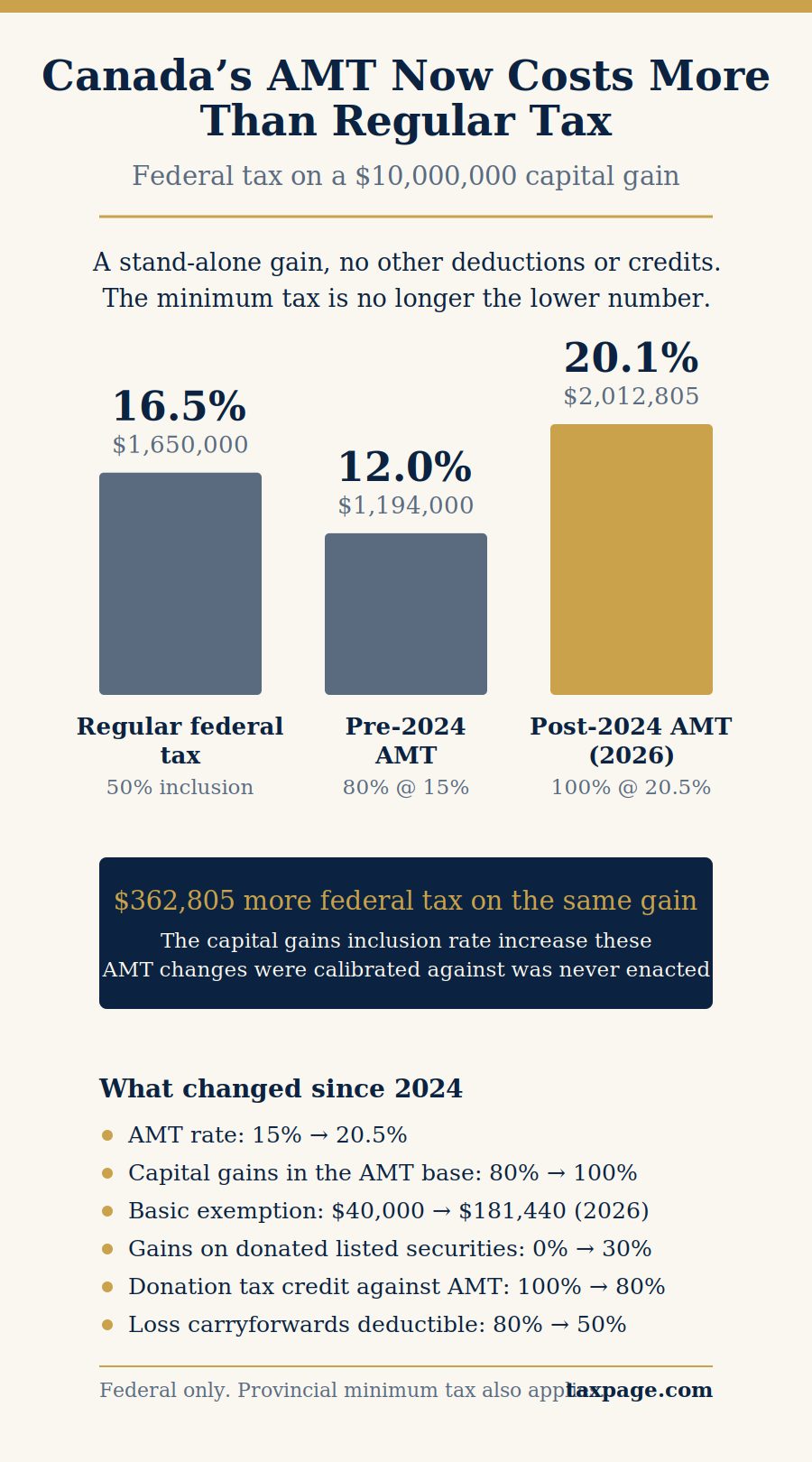
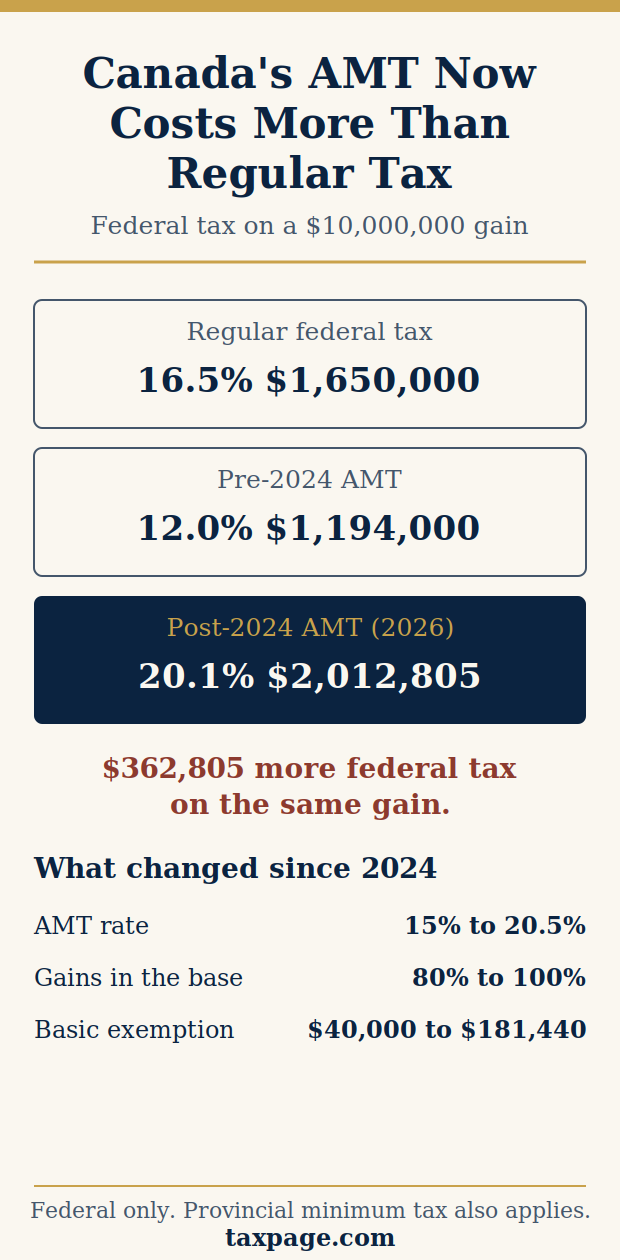
Federal tax on a $10,000,000 stand-alone capital gain, comparing the regular tax calculation, the pre-2024 AMT and the post-2024 AMT. Federal only; provincial minimum tax applies in addition.
The comparison above is federal only. It assumes a stand-alone gain with no other income, deductions or credits, and it excludes provincial and territorial minimum tax and the non-refundable credits allowed at 50% in computing AMT, so the figures on an actual file will differ.
The provincial layer matters and is routinely left out of published commentary on the amended AMT. Every province and territory other than Quebec computes its own minimum tax as a percentage of the federal minimum tax. Ontario’s additional tax for minimum tax purposes was 33.67% of the federal amount, a figure calibrated against the former 15% federal AMT rate. When the federal rate rose to 20.5%, that ratio would have raised Ontario’s effective rate on the AMT base, so Ontario’s 2024 Economic Outlook and Fiscal Review reduced the provincial rate to 24.63%, beginning with the 2024 taxation year, in order to hold the effective Ontario rate at its lowest personal rate of 5.05%. Ontario surtax may apply on top of that amount. A taxpayer reading a commentary that still quotes 33.67% is therefore working from a superseded figure, and in any event the practical point stands: the real cash cost of an AMT event is meaningfully higher than the federal calculation alone suggests, and any projection should be prepared on a combined federal and provincial basis.
Business Owners Using the Lifetime Capital Gains Exemption Are Not Spared
Consider a founder who sells shares of a qualified small business corporation and realizes a $1,275,000 capital gain, all of which is sheltered by the lifetime capital gains exemption, which is $1,275,000 for 2026, indexed upward from the $1,250,000 base that applies to dispositions occurring after June 24, 2024, assuming the founder otherwise qualifies and has sufficient exemption room. Under the regular tax calculation, the founder may owe no federal tax on the gain. Under the amended AMT rules, however, the full gain is included in adjusted taxable income, while the capital gains deduction is recognized at 7/5 of the amount claimed, offsetting 70% of the gain for AMT purposes, and the basic exemption is then applied. The transaction can therefore produce AMT even where the regular federal tax calculation produces none. The interaction is especially important in family-business succession planning; for further discussion, see Planning for Intergenerational Business Transfers and Alternative Minimum Tax After Bill C-59.
Stock Option Exercises Stack With Sheltered Gains in the Same Minimum Tax Base
The preference items do not sit in separate boxes. They accumulate in one adjusted taxable income figure, and the combination that catches founders most often is an option exercise in the same taxation year as a share sale. A benefit arising on the exercise of an employee stock option is employment income under section 7 of the Income Tax Act, and the deduction available under paragraph 110(1)(d) or (d.1) reduces it to an effective one-half inclusion for regular tax purposes. For AMT purposes, that deduction is not available, so 100% of the benefit enters adjusted taxable income.
A founder who exercises options and disposes of qualifying shares in the same year therefore places two preference items in the same minimum tax base: the full option benefit, and the gain sheltered by the lifetime capital gains exemption at its effective 30% inclusion. Because the basic exemption of $181,440 is applied once rather than once per item, and because the 20.5% rate applies to the combined excess, the liability produced by the two events together is materially larger than the sum of what each would have produced in isolation. Separating the exercise year from the sale year is frequently the single most valuable adjustment available to a founder, and it is a decision that has to be made before the exercise, not at filing. For the underlying treatment of options, see Employee Stock Options: Tax Implications for Canadian Employees.
The same stacking logic applies to a gift of appreciated publicly listed securities made in a year that already contains a large gain or an option exercise, which is why the donation planning described below cannot sensibly be done in isolation from the rest of the year.
The size of that exposure is easy to underestimate, so it is worth working through. Assume a founder realizes a $1,275,000 capital gain on qualifying QSBC shares in 2026 and shelters the entire gain with the lifetime capital gains exemption, with no other income, deductions or credits. Regular federal tax on the gain is nil. For AMT purposes, the full $1,275,000 enters adjusted taxable income, while the $637,500 capital gains deduction is recognized at 7/5 under subparagraph 127.52(1)(h)(ii), being $892,500, which leaves adjusted taxable income of $382,500, or 30% of the gain. Subtracting the $181,440 basic exemption leaves $201,060, which at 20.5% produces gross minimum tax of approximately $41,200.
After the basic minimum tax credit, which is one half of the credit for the base basic personal amount rather than the enhanced amount, federal AMT is roughly $40,200. Ontario’s additional tax for minimum tax purposes at 24.63% adds approximately $9,900 before surtax, and that provincial amount does not ride on the federal seven-year credit because Ontario operates its own minimum tax carryover, so the two are recovered separately. The combined liability is in the order of $50,100. That is roughly $50,100 payable in the year of a transaction on which the regular tax calculation produces nothing at all, recoverable only if the founder generates enough regular federal tax within the following seven taxation years to absorb the credit.
Charitable Donations of Appreciated Securities Are Taxed for the First Time in Decades
The exemption for capital gains on donations of publicly listed securities to registered charities is one of the Income Tax Act’s most effective philanthropic incentives: it allows a donor to contribute the full value of appreciated securities without first selling them and realizing a taxable capital gain under the regular tax calculation. Before 2024, the exempt gain was also excluded from adjusted taxable income for AMT purposes. Since 2024, 30% of the accrued gain is included in adjusted taxable income, and only 80% of the associated donation tax credit may be used in computing AMT. A sufficiently large gift, especially in a year containing other AMT preference items, can therefore generate an AMT liability. For the underlying donation rules and planning considerations, see Donating Appreciated Publicly Traded Securities to Charity.
A Structural Bias Toward Debt, Corporate Holding, and Inaction
Because AMT applies only to individuals and (with limited exceptions) trusts, and not to corporations, taxpayers who expect to realize significant capital gains have a growing incentive to hold appreciated assets inside a Canadian-controlled private corporation rather than personally, deferring the AMT exposure that would arise on a personal disposition. Thus, the amended AMT rules add a further reason for that preference, one that has little to do with the commercial merits of holding an asset inside a corporation and everything to do with avoiding a punitive personal tax result. More broadly, because a capital gain can itself trigger AMT, and because carrying charges on debt-financed investments are only 50% deductible for AMT purposes, taxpayers who already carry unused AMT balances are pushed toward income-producing debt instruments and away from the growth-oriented equity positions that venture capital, angel investment, and business succession all depend on. That is the opposite of what the government’s own competitiveness agenda is trying to achieve.
The AMT also creates asymmetries that have no obvious policy justification. A capital loss realized in the same year as a capital gain fully offsets that gain for AMT purposes, but the identical loss, if carried forward from an earlier year, offsets only 50% of a later gain, penalizing taxpayers for a timing difference the rest of the ITA treats as irrelevant. And because unused AMT credits expire after seven years with no mechanism for an estate to recover AMT paid by the deceased in the years before death, taxpayers face pressure to either accelerate dispositions purely to use an expiring credit, or to defer dispositions and simply hold appreciated capital until death. That is the opposite of the liquidity that functioning equity markets, and the government’s investment agenda, both require.
Departure, Non-Resident, and Trust Traps
An individual who emigrates from Canada is deemed to dispose of most property at fair market value, and any resulting AMT can become permanent rather than temporary if the individual has little or no further Canadian-source income against which to claim the seven-year credit. The same problem affects a non-resident who disposes of taxable Canadian property, and a trust facing a deemed disposition on its 21-year anniversary, since most trusts, unlike individuals, have no access to the basic AMT exemption at all. In each case, a tax that Parliament describes as temporary functions, in practice, as a permanent and often unrecoverable charge.
There is, however, one measure of relief on the departure side that is frequently missed. Subsection 220(4.5) of the Income Tax Act permits an emigrating individual to elect to defer payment of the tax arising on the deemed disposition, including the AMT component of that tax, until the property is actually disposed of or the individual resumes Canadian residence. The deferral carries no interest. The election is made on Form T1244 and must be filed by April 30 of the year following emigration, although the CRA may accept a late election under subsection 220(4.54) where it would be just and equitable to do so.
Adequate security must be posted where the federal tax on the deemed disposition exceeds $16,500, or $13,777.50 for a former Quebec resident, and subsection 220(4.51) relieves an individual from posting security on the first $100,000 of deemed capital gains even where the total gain is larger. The election addresses the cash-flow problem of paying tax on an unrealized gain. It does not make the AMT recoverable, because the seven-year credit still requires future Canadian federal tax to be applied against, so the deferral should be understood as buying time rather than as curing the permanence problem described above.
“The departure and trust cases are where the AMT stops being a timing rule and becomes a real tax,” says David J. Rotfleisch, founding tax lawyer and CPA at Rotfleisch & Samulovitch, and a Law Society of Ontario Certified Specialist in Taxation. “The standing answer to the fairness objection has always been that AMT is only a prepayment, recoverable over seven years. That answer assumes future Canadian income to recover it against. An emigrant, a non-resident disposing of taxable Canadian property, and a trust meeting its 21-year deemed disposition frequently have none, and most trusts cannot claim the basic exemption at all. For those taxpayers, the minimum tax is permanent, and it should be modelled as a hard cost rather than as a deferral.”
Predictability Is Itself a Casualty
Perhaps the most practical problem is that even sophisticated taxpayers and their advisers can no longer reliably predict, before a transaction closes, whether AMT will apply and in what amount. That uncertainty is corrosive to precisely the incentives Parliament has deliberately built into the ITA, including the LCGE, the donation credit for listed securities, and preferential treatment for employee stock options, because a taxpayer who cannot be confident of the after-tax result of a transaction the incentive is meant to encourage will, at the margin, be less inclined to undertake it.
“Every year, I see founders and long-time investors walk into a significant capital gain believing that the lifetime capital gains exemption, or the fifty percent inclusion rate, has told them the whole story, only to discover that the AMT calculation has quietly clawed back a large part of what they thought they had sheltered,” says David J. Rotfleisch. “The federal government wants Canadians to put real equity capital behind Canadian businesses, and that is the entire premise of measures like the Productivity Mega Deduction. But the AMT rules, as they stand today, tax the very exit event, the option exercise, or the donation that makes equity investment worthwhile in the first place. A regime meant to catch a small number of taxpayers who paid no tax at all is now capturing ordinary, one-time liquidity events for entrepreneurs and long-term investors who have paid tax all along.”
Practical Implications
For business owners contemplating a sale, an AMT projection using Form T691 should be prepared alongside the lifetime capital gains exemption analysis before any agreement is signed, not after the transaction closes. The projection should account for whether the shares qualify, the seller’s remaining exemption room, available losses and deductions, and the likelihood that any AMT credit can be recovered during the following seven taxation years. For background on qualifying shares and common planning traps, see Lifetime Capital Gains Exemption and Qualified Small Business Corporation Shares. For executives and employees holding stock options, exercises should likewise be modelled over multiple taxation years because concentrating a large benefit in one year can create materially different AMT results. For further discussion, see Employee Stock Options: Tax Implications for Canadian Employees.
Donors planning a significant gift of appreciated publicly listed securities should model the after-AMT benefit of the gift before committing to it, and should consider whether spreading the donation over more than one taxation year, or timing it away from other AMT-generating events in the same year, preserves more of the intended tax benefit. Owners of private corporations should weigh the AMT-driven incentive to retain appreciated assets inside the corporation against the integration and anti-avoidance policies that already govern private corporation taxation, and against the AMT exposure that will eventually arise on a personal realization of those gains.
Taxpayers planning to leave Canada, and non-residents disposing of taxable Canadian property, should have departure tax and AMT modelled together, since the interaction between the two can convert a supposedly temporary minimum tax into a permanent one. Trustees should review any trust approaching its 21-year deemed disposition anniversary well in advance, given that most trusts have no access to the basic AMT exemption available to individuals.
Because CRA’s administration of the amended AMT base is still relatively new, and because the interaction among the LCGE, loss carryforwards, and donation credit ordering rules has not yet been extensively tested, taxpayers undertaking a large transaction should expect CRA scrutiny of the resulting AMT calculation and should retain contemporaneous documentation supporting their Form T691 filing position. Where CRA reassesses an AMT calculation, the taxpayer’s rights are the same as on any other tax reassessment: a notice of objection under section 165 of the ITA, followed, if necessary, by an appeal to the Tax Court of Canada.
No significant jurisprudence has yet interpreted the amended AMT provisions specifically, since the rules have applied only since the 2024 taxation year and tax disputes typically take years to reach the Tax Court, but the same complexity that makes AMT hard to predict prospectively is likely, over time, to generate litigation over the classification and timing of items included in ATI, the ordering of donation and loss credits, and the AMT treatment of corporate reorganizations. Given the stakes and the genuine technical uncertainty involved, taxpayers facing a large AMT liability, or a CRA tax reassessment of one, are well advised to retain an experienced Canadian tax lawyer for CRA disputes before positions harden on either side.
Takeaway: Planning Around AMT and Equity Investment
- Model AMT, using Form T691, before completing any transaction expected to generate a large capital gain, stock option benefit, or gift of appreciated securities, not after CRA issues a notice of tax assessment.
- Treat an AMT credit balance as an asset with its own seven-year expiry that requires active, multi-year management, not a passive carryforward that will simply be used up in due course.
- Recognize that the AMT regime, as currently designed, rewards holding appreciated equity, sometimes until death, and penalizes realizing it, and plan liquidity events with this asymmetry in mind rather than assuming ordinary capital gains treatment will apply.
- Watch for further legislative change. Commentators in the Canadian tax community have publicly flagged the tension between the AMT’s design and the government’s own equity-investment and competitiveness agenda, and reform proposals, including lowering the AMT rate, restoring an 80% capital gains inclusion rate for AMT purposes, reinstating the donation exemption for listed securities, and removing the seven-year credit expiry, are already circulating among tax policy commentators.
Pro Tax Tips
Before completing a transaction likely to generate a large capital gain, business owners, investors, executives, and donors should compare the ordinary tax calculation with a full AMT projection on Form T691. The analysis should test whether spreading a disposition, stock-option exercise, or donation over more than one taxation year would reduce AMT; whether current-year losses or credits can be aligned with the transaction; and whether any resulting AMT credit is likely to be recovered before its seven-year expiry. Special care is required for emigration, major gifts of publicly listed securities, and other transactions in which the AMT may become effectively permanent. Because these results are difficult to reverse after closing, transaction documents and timing decisions should be reviewed with a Canadian tax lawyer in advance.
FAQs
What is the Alternative Minimum Tax and how has it changed since 2024?
The AMT is a parallel tax calculation, set out in sections 127.5 to 127.55 of the Income Tax Act, that recalculates a taxpayer’s income using a broader base than the regular tax rules and taxes that base at a flat rate. Since 2024, the rate has increased from 15% to 20.5%, the exemption has increased from $40,000 to $181,440 (for 2026), and the base has been broadened to include capital gains, employee stock option benefits, and donations of listed securities far more heavily than before.
Who is most likely to be affected by the new AMT rules?
Individuals who realize a large, one-time capital gain, typically business owners selling a company, executives exercising stock options, or investors realizing significant gains, and donors making substantial gifts of appreciated publicly listed securities are most exposed. Individuals whose income is mainly salary, professional income, or eligible dividends are far less likely to owe AMT under the current rules, even at high income levels.
Does the AMT apply to a capital gain sheltered by the lifetime capital gains exemption?
Yes. Although the LCGE can eliminate regular federal tax on a qualifying gain entirely, the LCGE deduction is available for AMT purposes at 7/5 of the amount claimed, offsetting 70% of the gain for AMT purposes, and the full capital gain is otherwise included in adjusted taxable income. A gain that generates no regular tax at all can still generate a meaningful AMT liability.
What happens if I exercise stock options and sell my business in the same year?
The two events stack in one minimum tax calculation. For AMT purposes, 100% of the stock option benefit is included in adjusted taxable income, without the deduction available under the regular calculation, and a gain sheltered by the lifetime capital gains exemption is included at an effective 30%. The basic exemption is applied once against the combined total rather than once per event, so the resulting AMT exceeds what each event would have generated separately. Where the timing is flexible, moving the exercise into a different taxation year from the disposition is usually the most effective single step available.
How does AMT affect donations of publicly listed securities to charity?
Before 2024, the capital gain on a donation of publicly listed securities was fully excluded from both regular taxable income and adjusted taxable income. Since 2024, 30% of that gain is included in adjusted taxable income, and only 80% of the resulting donation tax credit can be used to reduce AMT, so a sufficiently large gift can now trigger real AMT liability for the donor.
Can AMT paid in one year be recovered in a later year?
Generally, yes: AMT paid in excess of regular federal tax becomes a credit that can be applied against regular federal tax for the following seven taxation years. However, that credit is lost if it is not used within seven years, and it may be effectively unrecoverable for taxpayers who emigrate from Canada, non-residents who dispose of taxable Canadian property, or trusts and estates that lack sufficient future Canadian income against which to claim it.
Does the AMT apply to corporations?
No. The AMT applies to individuals and, subject to limited exceptions, trusts. It does not apply to corporations, which creates an incentive for individuals expecting large capital gains to hold appreciated assets inside a private corporation rather than personally.
Is the AMT regime likely to be reformed?
No confirmed legislative proposal to amend the post-2023 AMT rules has been identified as of this writing. The regime nevertheless remains an active policy issue because its treatment of capital gains, charitable gifts, loss carryforwards, and other preference items can conflict with federal objectives concerning investment and business growth. Taxpayers should plan on the basis of the law currently in force and monitor future budgets, draft legislation, and enacted amendments rather than assuming that a particular reform will proceed.
How can a Canadian tax lawyer help with AMT planning or a CRA dispute?
An experienced Canadian tax lawyer for CRA disputes can model AMT exposure before a transaction closes, structure the timing of dispositions, stock option exercises, and charitable gifts to manage AMT and preserve the resulting credit, and represent a taxpayer through a notice of objection or Tax Court appeal if CRA reassesses an AMT calculation. Given how new and technically uncertain the amended rules remain, obtaining that advice before a transaction is generally far more effective, and less costly, than disputing a tax assessment after the fact.
How does AMT interact with a departure from Canada?
An individual who ceases to be a resident of Canada is deemed under subsection 128.1(4) of the Income Tax Act to dispose of most property at fair market value on departure. The resulting deemed capital gain is included in adjusted taxable income at 100% for AMT purposes, so emigration can generate AMT in the departure year. Because the AMT credit can only be applied against future regular Canadian federal tax, an emigrant with little or no continuing Canadian-source income may never recover it. Departure tax and AMT should always be modelled together before the residence change occurs. An election under subsection 220(4.5), made on Form T1244 by April 30 of the following year, can defer payment of the departure tax and its AMT component interest-free until the property is actually sold, but it does not make the AMT credit recoverable.
Can a trust be subject to AMT on its 21-year deemed disposition?
Yes. A personal trust is deemed to dispose of its capital property at fair market value on the twenty-first anniversary of its creation, and that deemed gain enters adjusted taxable income at 100%. Most trusts have no access to the basic AMT exemption available to individuals, so the exposure begins at the first dollar of gain. Graduated rate estates, qualifying employee ownership trusts, and certain other trusts are excluded from AMT for taxation years beginning after 2023.
Does AMT apply in the year a taxpayer dies?
No. AMT does not apply for the taxation year in which an individual dies, so the large deemed disposition that arises on death does not itself generate AMT. The practical difficulty runs the other way: there is no mechanism for an estate to recover AMT the deceased paid in earlier years if the seven-year credit period has not been used up, which is one reason AMT credit balances need active management during the taxpayer’s lifetime.
Is AMT a federal tax only, or do the provinces charge it as well?
The calculation described above is the federal AMT. Most provinces and territories impose their own minimum tax, generally computed as a percentage of the federal minimum tax, so the real cash cost of an AMT event is higher than the federal figures alone suggest. Ontario, for example, applies a provincial minimum tax tied to the federal calculation. Any AMT projection prepared before a transaction should be run on a combined federal and provincial basis.
DISCLAIMER: This article provides broad information. It is only accurate as of the posting date. It has not been updated and may be out-of-date. It does not give legal advice and should not be relied on as tax advice. Every tax scenario is unique to its circumstances and will differ from the instances described in the article. If you have specific legal questions, you should seek the advice of a Canadian tax lawyer.
About the Author