

Published: July 21, 2026
How a Canadian Tax Lawyer Secured $908,000 in GST/HST Relief and Full Penalty Elimination at the Tax Court of Canada
GST/HST Tax Court Appeal: Case Overview and Result
A disciplined, multi-year litigation strategy resulted in the complete elimination of gross-negligence penalties and a reduction of approximately $908,000 in disputed GST/HST amounts for a corporate taxpayer in the vehicle export business.
Spanning approximately five years — from initial retainer in January 2021 through settlement in April 2026, eight months before a scheduled Tax Court trial date in December — the result required correcting procedural deficiencies, rebuilding the evidentiary record, and maintaining persistent follow-up with the Canadian tax litigation lawyer acting for the CRA.
“Tax litigation success is rarely immediate. It requires persistence, disciplined execution, and a clear understanding of both the legal burden and the facts.”
— David J. Rotfleisch, Founding Tax Lawyer and CPA, Rotfleisch & Samulovitch P.C.
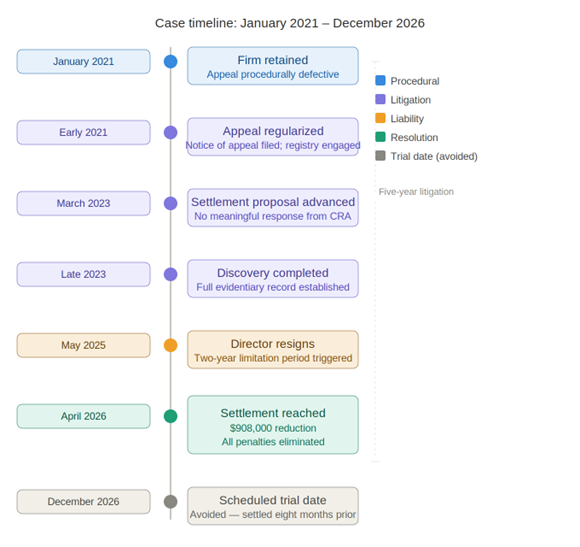
Figure 1: Key milestones from initial retainer (January 2021) through settlement (April 2026) and avoided trial date (December 2026)
CRA GST/HST Audit and Defective Tax Court Appeal: Background
The taxpayer, a corporation in the business of purchasing and exporting vehicles, became the subject of a CRA GST/HST tax audit that resulted in denied input tax credits and alleged unreported sales based primarily on a bank-deposit analysis. When Rotfleisch & Samulovitch P.C. was first retained in January 2021, the file was procedurally defective. Although an appeal had been initiated, it had not been properly perfected, and as a result the matter had not progressed to discovery or any meaningful stage of litigation. This was not a case of missed litigation deadlines; rather, the matter had never entered the litigation stream in a procedurally valid way.
The firm immediately took steps to regularize the appeal by filing a compliant notice of appeal, engaging with the Tax Court registry to ensure the appeal was properly accepted, addressing filing deficiencies and procedural gaps, and reconstructing the evidentiary foundation of the case. Only after these corrective steps could the matter proceed through document disclosure and discovery, which were completed by late 2023.
Taxpayers and advisors facing similar procedural issues should be aware that an improperly perfected appeal can jeopardize the entire case before substantive arguments are ever advanced. For a discussion of how the Tax Court appeal process works and what constitutes a properly perfected appeal, see our overview of Tax Court of Canada appeals for GST/HST disputes.
Core Legal Issues: Input Tax Credits, Bank-Deposit Analysis, and Gross-Negligence Penalties
CRA Bank-Deposit Analysis and Denied Input Tax Credits: How the Assessment Was Built
The CRA relied heavily on a bank-deposit analysis that treated various deposits as unreported revenue. The firm’s review demonstrated that many deposits were not taxable — including GST refunds and inter-account transfers. Correcting these assumptions materially reduced the CRA’s reassessment.
However, certain amounts the taxpayer claimed were loans lacked supporting documentation. There were no agreements, no repayment schedules, and no corroborating records. The strategic decision was made to concede those amounts.
“Strong advocacy requires judgment. Conceding positions that cannot be proven strengthens credibility and allows us to focus on achieving the greatest possible tax savings.”
— David J. Rotfleisch
For a broader discussion of how deposit-based assessments frequently overstate income and how taxpayers can respond, see our article on CRA tax audits and income reconstruction.
Gross-Negligence Penalties Under the Excise Tax Act: The Legal Test and CRA’s Burden of Proof
The CRA justified gross-negligence penalties by pointing to discrepancies identified in its audit, denied input tax credits, and gaps in documentation. Canadian tax law, however, sets a high bar. In Venne v. The Queen, the Federal Court held that gross negligence involves greater neglect than simply a failure to use reasonable care — it must amount to an indifference as to whether the law is complied with or not. This standard, affirmed consistently in subsequent jurisprudence, is far more demanding than ordinary negligence. Critically, the CRA bears the burden of proving that this elevated threshold has been met.
“The gross-negligence test from Venne v. The Queen requires more than careless errors or poor recordkeeping. The CRA must show conduct amounting to an indifference as to whether the law is complied with — a standard most taxpayers facing audit discrepancies will not meet when their conduct is properly examined.”
— David J. Rotfleisch, Canadian Tax Lawyer and Certified Specialist in Taxation (Law Society of Ontario)
For a discussion of gross-negligence penalties and the burden of proof in the Tax Court context, see our article on voluntary disclosures and penalty exposure.
Tax Court Litigation Strategy: How Persistent Follow-Up Eliminated GST/HST Penalties
The most decisive factor in this case was not the strength of any single legal argument but the structured, persistent follow-up that the firm maintained over several years. After the evidentiary record was substantially complete and document disclosure and discovery were finished by late 2023, the firm advanced a formal settlement proposal to the Canadian tax litigation lawyer acting for the CRA in March 2023. What followed was not a negotiation — it was silence.
The Canadian tax litigation lawyer acting for the CRA did not meaningfully respond to the settlement proposal. Weeks became months. Rather than treating the absence of a response as a closed door, the firm treated it as an open one. A disciplined follow-up protocol was implemented: each communication was timed, documented, and purpose-built to keep the file visible and to place the Canadian tax litigation lawyer acting for the CRA in the position of having to either engage or explain the failure to do so.
Each follow-up served a specific function in the litigation strategy. It kept the file active and prevented it from drifting into administrative dormancy. It required the Canadian tax litigation lawyer acting for the CRA to revisit the file and reassess the Crown’s position in light of the improved evidentiary record. It isolated gross-negligence penalties as a discrete issue — separating them from the underlying tax dispute so that the CRA’s burden on the penalty question could be examined on its own terms. And as the underlying tax amount was progressively reduced through negotiation, each follow-up highlighted the growing disconnect between a shrinking tax liability and the continued assertion of penalties that required proof of conduct amounting to indifference toward legal compliance.
As the scheduled December 2026 trial date drew closer, the pressure of each follow-up compounded. A trial date is not an abstraction — it is a deadline that forces the Canadian tax litigation lawyer acting for the CRA to make a binary choice: settle or go to court and defend a penalty position that had become increasingly difficult to justify. The evidentiary record had improved. The underlying tax had been reduced. The burden remained on the CRA. And every follow-up had required a principled explanation for why penalties should survive in those circumstances.
After multiple rounds of persistent follow-up, the Canadian tax litigation lawyer acting for the CRA ultimately agreed to eliminate the gross-negligence penalties entirely. The settlement was reached in April 2026, eight months before the December trial date.
“This result was not achieved in a single step. It required sustained follow-up and disciplined pressure over time until the position became untenable.”
— David J. Rotfleisch
Implications for Canadian Taxpayers Facing CRA GST/HST Reassessments
This case has several implications for taxpayers and advisors dealing with CRA GST/HST reassessments and Tax Court litigation.
The first is procedural: an appeal that has not been properly perfected provides no protection. Taxpayers who receive a notice of reassessment and wish to challenge it must file a compliant notice of objection, and — if the objection is unsuccessful — a properly structured notice of appeal with the Tax Court of Canada. Procedural deficiencies at the appeal stage can cause years of delay and may jeopardize the taxpayer’s substantive rights entirely.
The second is evidentiary: CRA bank-deposit analyses are routinely used in GST/HST audits and frequently overstate taxable revenue by including non-taxable receipts such as refunds, inter-account transfers, and genuine loan proceeds. A careful forensic review of the deposit analysis is essential, but that review must be supported by documentation. Where records are absent, strategic concessions may be necessary to maintain credibility on the issues that can be defended.
The third is the penalty burden: gross-negligence penalties under the Excise Tax Act represent an additional financial exposure that can reach 25 percent of the net tax owing. The CRA cannot impose these penalties simply because a reassessment reveals discrepancies. Under Venne v. The Queen, the CRA must prove conduct amounting to an indifference as to whether the law is complied with — a standard that most audit discrepancies, even serious ones, will not satisfy. A well-prepared penalty defence is often the most consequential aspect of the litigation.
Finally, director liability adds a personal dimension to corporate GST/HST disputes. Resigned directors benefit from a two-year limitation period under the Excise Tax Act. Timing a resignation strategically — while the underlying corporate dispute remains active — can significantly reduce personal exposure. For more on this topic, see our article on director liability for corporate tax debts.
Key Takeaways: How to Defend Against CRA GST/HST Reassessments and Gross-Negligence Penalty Appeals
The outcome of this case — a $908,000 reduction in disputed GST/HST amounts and the complete elimination of gross-negligence penalties — reflects several principles that should inform how taxpayers approach CRA reassessments and Tax Court litigation.
Properly perfecting an appeal from the outset is not optional; it is a prerequisite to meaningful advocacy. Input tax credit claims must be supported by documentation, and where they are not, targeted concessions protect credibility on the issues that matter. Bank-deposit analyses should be subjected to rigorous forensic review, with particular attention to non-taxable receipts that inflate the CRA’s position.
On the penalty question, the law is clear: the CRA must prove conduct amounting to indifference as to whether the law is complied with under Venne v. The Queen, and most audit discrepancies do not satisfy that standard. Sustained, structured follow-up over the life of the file — including disciplined persistence in the face of prolonged non-response from the Canadian tax litigation lawyer acting for the CRA — played a decisive role in driving the concession of the penalty issue entirely, eight months before the scheduled trial date.
“A taxpayer’s result is not determined at the audit stage. It is determined by how effectively the case is advanced afterward.”
— David J. Rotfleisch

Figure 2: CRA’s original position versus final settlement — $908,000 tax reduction and full elimination of gross-negligence penalties
Pro Tax Tips: GST/HST Audit Defence and Tax Court Appeals in Canada
Taxpayers facing a CRA GST/HST tax reassessment should ensure that any appeal is filed in proper form and perfected without delay, as procedural deficiencies can foreclose substantive arguments entirely. Input tax credit claims should be supported by clear documentation at the time of filing, and bank-deposit analyses received from the CRA should be reviewed carefully for non-taxable amounts. Where certain positions cannot be substantiated, a targeted strategic concession is preferable to overextending the case.
On the penalty question, taxpayers should understand that gross-negligence penalties require the CRA to prove conduct amounting to an indifference as to whether the law is complied with — the standard from Venne v. The Queen — a threshold the CRA frequently cannot meet when the underlying facts are properly analyzed and presented. Persistent, structured follow-up in the face of extended non-response from the Canadian tax litigation lawyer acting for the CRA can be the single most important factor in achieving a favourable settlement well before a scheduled trial date.
Director-shareholders should assess their potential personal liability for corporate GST/HST debts and consider the timing of any resignation relative to the two-year limitation period under the Excise Tax Act.
Frequently Asked Questions: CRA GST/HST Audits, Tax Court Appeals, and Gross-Negligence Penalties
What was the central procedural problem when the firm was first retained?
When Rotfleisch & Samulovitch P.C. was retained in January 2021, the taxpayer had initiated an appeal but had not properly perfected it. This meant the matter had not entered the litigation stream in a procedurally valid way and had not progressed to disclosure or discovery. The firm’s first task was to regularize the appeal, file a compliant notice of appeal, and address the procedural gaps before any substantive work could proceed. Taxpayers should never assume that filing a notice of objection alone is sufficient; a properly structured Tax Court appeal is a separate and mandatory step.
Did prior counsel miss any Tax Court deadlines?
No. The issue was not that deadlines had passed but that the appeal had not been perfected in compliance with Tax Court procedural requirements. The matter simply had not reached the litigation stage. This is a distinction that matters: a missed deadline can be fatal to an appeal, whereas a procedural deficiency that has not yet caused prejudice can often be corrected if addressed promptly.
What is the legal test for gross-negligence penalties under the Excise Tax Act?
The leading authority is Venne v. The Queen, in which the Federal Court held that gross negligence involves greater neglect than simply a failure to use reasonable care — it must amount to an indifference as to whether the law is complied with or not. This is a significantly higher threshold than ordinary negligence or careless recordkeeping. Audit discrepancies, denied ITCs, and incomplete documentation do not automatically satisfy it. The conduct must reflect a degree of wilful blindness or indifference toward legal compliance that goes well beyond inadvertent error.
Who bears the burden of proving gross-negligence penalties?
The CRA bears the burden of proving on a balance of probabilities that the taxpayer’s conduct meets the gross-negligence threshold. This is significant because it reverses the usual dynamic in tax litigation, where the taxpayer must generally disprove the facts underlying a reassessment. On the penalty question, the CRA must bring forward the evidence and make the case; the taxpayer need only undermine it.
How much was the GST/HST liability reduced?
The disputed amounts were reduced by approximately $908,000. In addition, all gross-negligence penalties were eliminated. Because gross-negligence penalties under the Excise Tax Act can reach 25 percent of the net tax owing, their removal produced substantial additional savings on top of the underlying tax reduction.
Why did the firm concede certain amounts relating to alleged loans?
Several amounts that the taxpayer characterized as loans lacked any supporting documentation — no loan agreements, no repayment schedules, and no corroborating financial records. Advancing a position that cannot be substantiated at trial damages credibility on every other issue in the case. The strategic decision to concede those amounts allowed the firm to focus on the positions that were defensible and to present a credible overall record to the CRA and the Court.
How do CRA bank-deposit analyses work, and why are they often inaccurate?
In a bank-deposit audit, the CRA reconstructs income by treating all deposits into the taxpayer’s accounts as revenue, then subtracting amounts the taxpayer can prove are non-taxable. This method is inherently blunt. It routinely captures GST refunds, inter-account transfers, genuine loan proceeds, shareholder contributions, and other non-taxable receipts. Challenging a deposit analysis requires a forensic review of every transaction, supported by bank records and corroborating documentation, to identify and isolate non-taxable items. In this case, that review materially reduced the CRA’s position.
What role did the Canadian tax litigation lawyer acting for the CRA’s failure to respond play in the outcome?
After the firm advanced a settlement proposal in March 2023, the Canadian tax litigation lawyer acting for the CRA did not meaningfully respond for an extended period. Rather than treating this as a barrier, the firm implemented a structured follow-up strategy that kept the file active, required the Canadian tax litigation lawyer acting for the CRA to revisit the file repeatedly, and placed the penalty issue under sustained scrutiny. The prolonged non-response ultimately made the penalty position harder to maintain — each follow-up required a principled justification for penalties that the evidentiary record was making progressively more difficult to sustain. The settlement was ultimately reached in April 2026, eight months before the December trial date.
What role did the director’s resignation play in the outcome?
The director of the corporate taxpayer resigned in May 2025, triggering the two-year limitation period under section 323 of the Excise Tax Act. Under that provision, a director who has resigned more than two years before the CRA commences an assessment of the director personally cannot be held liable for the corporation’s unremitted net tax. Timing the resignation to align with the ongoing litigation significantly reduced potential personal exposure while settlement discussions continued. Directors of corporations facing GST/HST reassessments should assess this timing carefully with counsel.
How long do complex GST/HST disputes at the Tax Court typically take?
Complex GST/HST matters routinely take several years from initial reassessment to final resolution. This case spanned approximately five years from retainer to settlement. That timeline reflects the time required to correct procedural deficiencies, rebuild the evidentiary record, complete disclosure and discovery, advance a settlement proposal, and sustain the follow-up necessary to bring the Canadian tax litigation lawyer acting for the CRA to a final position. Taxpayers should approach Tax Court litigation with realistic expectations about duration and the sustained commitment it requires.
Can gross-negligence penalties be removed without going to trial?
Yes. In this case, the penalties were eliminated through negotiation and sustained advocacy rather than a judicial ruling. A well-developed evidentiary record and persistent follow-up that forced the Canadian tax litigation lawyer acting for the CRA to reassess the penalty position were central to achieving that result. As the underlying tax exposure diminished and the December trial date approached, the ability to justify the penalty position under the demanding standard in Venne v. The Queen became increasingly difficult to maintain. Settlement was reached in April 2026.
What is the most important practical lesson from this case?
The outcome illustrates that the result of a CRA tax audit is not fixed at the audit stage. Effective advocacy — including procedural correction, rigorous evidentiary development, strategic concessions, and above all sustained and structured follow-up in the face of non-response from the Canadian tax litigation lawyer acting for the CRA — can materially change the outcome even in a complex, multi-year dispute. Persistence, combined with a clear understanding of the legal standard the CRA must meet on the penalty question, can produce results that the audit outcome alone would not have suggested.
Disclaimer
This article provides broad information. It is only accurate as of the posting date. It has not been updated and may be out of date. It does not give legal advice and should not be relied on as tax advice. Every tax scenario is unique. If you have specific legal questions, you should seek advice from a Canadian tax lawyer.
Disclaimer:
"This article provides information of a general nature only. It is only current at the posting date. It is not updated and it may no longer be current. It does not provide legal advice nor can it or should it be relied upon. All tax situations are specific to their facts and will differ from the situations in the articles. If you have specific legal questions you should consult a lawyer."