

Published: June 30, 2026
Last Updated: June 30, 2026
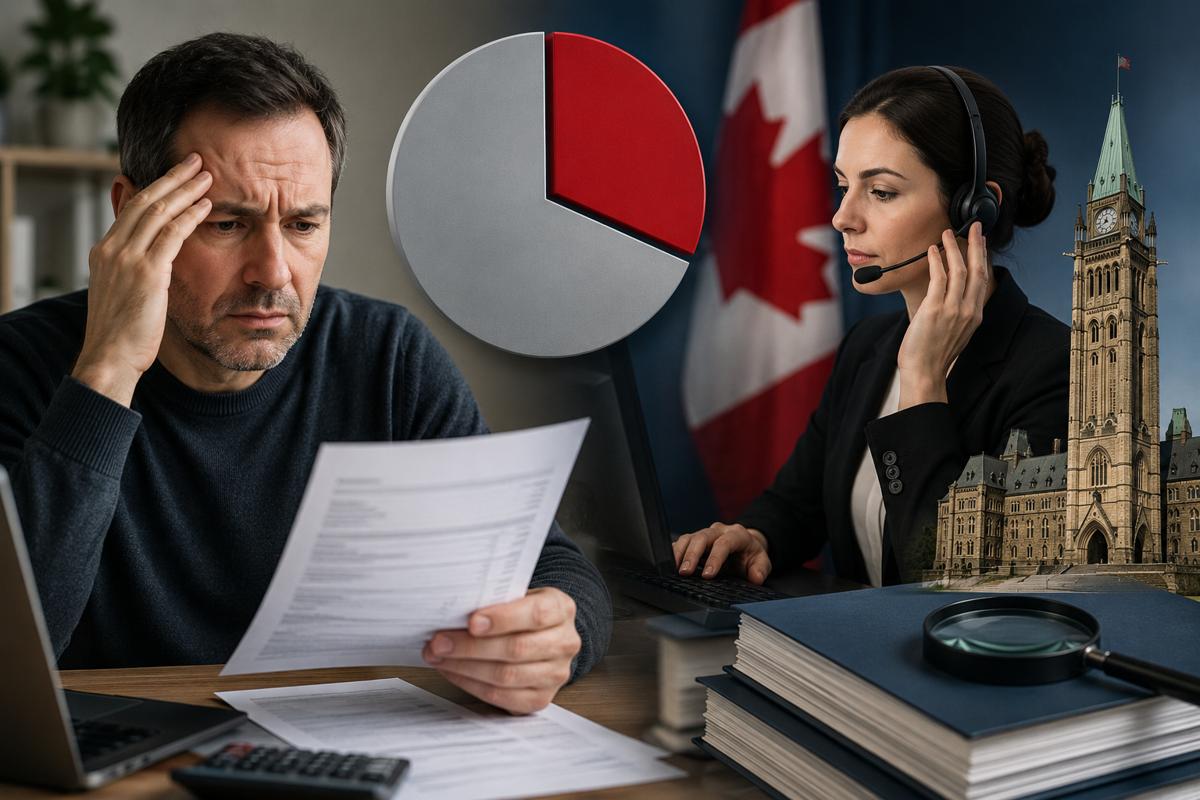
The government’s own Auditor General has confirmed it: if you call the CRA for tax advice, there is an 83% chance the answer will be wrong.
Auditor General of Canada Karen Hogan has released a report finding that CRA contact centre agents answered only 17% of tax questions accurately during a structured testing exercise conducted between February and May 2025. That means 83 out of every 100 answers provided by CRA telephone agents were wrong or incomplete. The Auditor General’s office found that the CRA appeared more concerned with adhering to shift schedules and break times than with the accuracy of the information its agents provided to callers.
The findings are reinforced by the Taxpayers’ Ombudsperson François Boileau, whose office has separately identified CRA contact centre service failures as a systemic problem and has made formal recommendations requiring improvement. The combined weight of both reports triggered a formal study by the House of Commons Standing Committee on Public Accounts (PACP), which required the CRA to appear and answer for its contact centre failures. Finance Minister François-Philippe Champagne set a 100-day deadline ending December 11, 2025 for the CRA to address contact centre delays — a deadline that has since passed without resolving the underlying accuracy problem.
As a Canadian tax lawyer and CPA who has practised tax law for over 35 years, I was quoted in the Canadian Press coverage of the Auditor General’s report. My position remains what it has always been: under the Income Tax Act, Canadian taxpayers are responsible for filing accurate returns and cannot legally rely on the CRA’s general information line.
This is not merely a cautious professional opinion — it is a settled legal principle. The Auditor General’s 17% accuracy finding makes it more urgent than ever that taxpayers understand this rule and act accordingly.
Who Conducted These Reports and Why Do They Matter?
Two independent government accountability offices have now examined CRA contact centre service, and both have reached deeply unflattering conclusions:
- The Office of the Auditor General of Canada (OAG) is Canada’s supreme audit institution, established by statute and reporting directly to Parliament. Auditor General Karen Hogan’s October 2025 report on CRA contact centres is based on structured testing: her office placed calls to CRA agents over four months, posed tax questions, and evaluated the accuracy of the responses. The 17% accuracy rate is not an estimate or a sample — it is the measured result of that testing exercise.
- The Office of the Taxpayers’ Ombudsperson, led by François Boileau, independently identified contact centre accuracy as a systemic service failure affecting large numbers of taxpayers. The Ombudsperson made two formal recommendations to the CRA, both of which the CRA accepted. These include requirements to improve internal accuracy monitoring and to publicly report contact centre accuracy metrics on the CRA’s Continuous Service Improvement web page.
- The Standing Committee on Public Accounts (PACP) opened a formal Parliamentary study of these findings, calling the CRA to testify. The PACP specifically asked what options taxpayers have when they rely on incorrect information from CRA agents — a recognition that this is a taxpayer rights issue, not merely an administrative one.
When three separate accountability mechanisms — the OAG, the Ombudsperson, and a Parliamentary committee — converge on the same finding, the conclusion is unambiguous: the CRA’s telephone information service is not reliable, and taxpayers who depend on it are at serious risk.
| “Under the Income Tax Act, Canadians are responsible for filing accurate tax returns and they cannot and should not rely on the CRA’s general information line, which is notoriously wrong. The Auditor General’s finding that CRA agents answered only 17% of questions accurately is a stunning indictment of a service that millions of Canadians have been trusting with their tax compliance. As a Certified Specialist in Taxation with over 35 years of experience, I have been saying this for decades — but now the government’s own Auditor General has confirmed it with data. You have a better chance of winning at Poker than you do getting a right answer out of the CRA Customer Service Centre.”
— David Rotfleisch, Founding Tax Lawyer and Certified Specialist in Taxation, Rotfleisch & Samulovitch P.C. |
The Legal Problem: CRA Is Not Bound by Its Own Agents’ Errors
The Auditor General’s finding creates a troubling legal reality: the CRA’s telephone service is providing inaccurate information at a massive scale, yet under Canadian tax law, the CRA is not bound by what its agents say. This combination is what makes the situation so dangerous for ordinary taxpayers.
The governing legal principle comes from Goldstein v. Canada, [1995] 2 CTC 2036 (TCC), where the Tax Court confirmed that the doctrine of estoppel does not apply against the Crown in matters governed by statute. The Income Tax Act is a statute. Therefore, if a CRA agent tells a taxpayer that certain income is not taxable and the taxpayer omits it from their return, the CRA can audit, reassess, and impose interest and penalties regardless of what its agent said.
The principle has been consistently applied by the Tax Court and the Federal Court of Appeal. There is no judicial exception for taxpayers who acted in good faith on a CRA agent’s advice. There is no exception for taxpayers who could not reasonably have known the advice was wrong. The only formal mechanism that can bind the CRA is an Advance Tax Ruling issued in writing by the CRA’s Income Tax Rulings Directorate, which is available only for proposed transactions, takes months, and involves a formal written application process.
The OAG report specifically noted that the CRA appeared more focused on “the accuracy and completeness of information they provided to callers” being secondary to scheduling adherence. This is an institutional culture problem, not merely a training gap.
What Gross Negligence Penalties Mean in This Context
While the CRA is not legally bound by its agents’ errors, one practical protection exists in the penalty framework. Gross negligence penalties under subsection 163(2) of the Income Tax Act require proof that the taxpayer made a false statement or omission knowingly, or in a manner tantamount to intentional acting. A taxpayer who genuinely relied on a CRA agent’s advice and filed accordingly is not acting knowingly or with gross negligence — they are attempting to comply.
As I stated in the Canadian Press coverage: taxpayers who file incorrectly due to bad CRA advice can appeal any resulting interest or penalties, and will not be hit with gross negligence penalties, provided they acted in good faith. However, the underlying tax is still owed. Interest will still run. And securing relief from penalties requires a formal process.
See our analysis of gross negligence penalties for the full legal framework.
Taxpayer Relief Under Subsection 220(3.1): The Available Remedy
Subsection 220(3.1) of the Income Tax Act gives the CRA discretion to cancel or waive interest and penalties where a taxpayer demonstrates that CRA conduct contributed to the problem. This taxpayer relief mechanism is the principal formal remedy for Canadians who have been misled by CRA agent advice. The Auditor General’s report and the Ombudsperson’s systemic findings now provide important contextual support for such applications.
Critical limitations apply:
- Relief is discretionary — the CRA can deny an application even where the facts are compelling.
- Relief applies to interest and penalties only — not to the underlying tax amount, which must be paid.
- The taxpayer must document the CRA’s error: date of call, agent ID number, and a detailed contemporaneous record of what was said.
- Denials are subject to judicial review in Federal Court, not the Tax Court of Canada.
- Applications are time-limited. The further removed from the original error, the more difficult the application becomes.
A well-prepared taxpayer relief application referencing the Auditor General’s 17% accuracy finding and the Ombudsperson’s systemic recommendations may materially strengthen the argument that the error was institutional rather than personal. An experienced Canadian tax lawyer should prepare or review any such application.
The Voluntary Disclosure Program: Why CRA Phone Advice Is Especially Dangerous
The stakes are highest for taxpayers who call the CRA’s contact line with questions that bear on whether to make a voluntary disclosure. If an agent incorrectly advises that certain offshore income, cryptocurrency gains, or business revenues are not taxable or not reportable, a taxpayer who follows that advice loses the VDP window entirely the moment the CRA opens an audit. There is no remedy. Once the CRA initiates contact for enforcement purposes, a VDP application is inadmissible.
This risk is especially acute for cryptocurrency holders: the CRA is now using AI and blockchain analytics to identify unreported crypto profits, and a taxpayer who was incorrectly told by a CRA agent that their crypto gains are not reportable — and acted on that advice — may find the VDP door has closed by the time the audit letter arrives. See our detailed guide on crypto VDP and CRA AI enforcement.
Given that CRA agents answered only 17% of questions accurately in the OAG’s testing, the statistical probability of receiving correct advice on a complex VDP question from a telephone agent is effectively negligible. Taxpayers dealing with offshore accounts, unreported income, cryptocurrency holdings, or GST/HST obligations must consult a Canadian tax lawyer before making any disclosure decision — not call the CRA’s general inquiry line.
| “Never ask a CRA telephone agent whether you should make a voluntary disclosure. That question requires legal advice from a Canadian tax lawyer. The Auditor General has now confirmed that CRA agents answer only 17% of questions correctly. For a question that determines whether you can access the VDP — and avoid criminal prosecution — those are not acceptable odds.”
— David Rotfleisch, Certified Specialist in Taxation, Rotfleisch & Samulovitch P.C. |
How CRA Audits Intersect with the Inaccurate Information Problem
When the CRA conducts a tax audit, the legal framework governing the audit is separate from the question of whether a taxpayer relied on CRA agent advice. As we explain in our article on CRA tax audits and the Jarvis framework, there is an important constitutional distinction between a civil audit (designed to assess tax) and a criminal investigation (governed by R. v. Jarvis, 2002 SCC 73, which protects taxpayers’ section 8 Charter rights once investigators have a predominant purpose of criminal investigation). Taxpayers who are audited after relying on incorrect CRA advice need both competent tax representation and an understanding of which regime applies to their situation.
The audit is also where the consequences of relying on bad CRA telephone advice become concrete: an auditor who finds underreported income will not credit the taxpayer for having called the CRA’s general inquiry line and been told the income was not taxable. The auditor’s job is to apply the law as written, not to investigate what the CRA’s own contact centre may have said.
GST/HST and Business Taxpayers: An Overlooked Risk
The CRA’s contact centre inaccuracy problem is not limited to personal income tax. Business owners and self-employed individuals who call the CRA about GST/HST registration obligations, input tax credits, or remittance requirements are equally exposed to the risk of receiving wrong information. An incorrect answer about whether a business must register for GST/HST, or whether a particular supply is taxable, can result in years of unremitted tax, interest, and penalties — plus potential director’s liability if the business is incorporated.
Business owners should treat any CRA telephone guidance on GST/HST matters as preliminary at best. Material business decisions about tax registration, invoicing, and remittance should be confirmed with a Canadian tax lawyer or qualified tax accountant, not with a contact centre agent operating under the regime the Auditor General has now rated at 17% accuracy.
The Expired 100-Day Deadline: What the Post-Deadline Record Reveals
Finance Minister François-Philippe Champagne set a 100-day deadline ending December 11, 2025 for the CRA to address contact centre delays. That deadline has now passed. At the time, the Taxpayers’ Ombudsperson warned publicly that processing delays far exceeding CRA service standards made it unlikely the backlog would reach a sustainable level by December 11, and that “a longer-term commitment and adequate resources will be necessary.”
The post-deadline record is not one of improvement. Six months after the deadline expired, the Taxpayers’ Ombudsperson tabled his 2025-2026 annual report, titled “In Pursuit of Better Service: Taxpayers Deserve More,” containing seven new recommendations to the CRA — an increase from prior years that reflects deepening, not receding, service dysfunction.
In the same month, the Ombudsperson opened two further systemic examinations: one into how taxpayers resolve complaints with the CRA (citing confusion around complaint options causing delays), and one into CRA delays in processing complex T1 adjustment requests, with processing times described as far exceeding service standards. A formal Service Improvement Request on contact centre reporting had already been sent in March 2026, three months after the deadline, indicating the CRA had still not met its transparency commitments.
Taken together, the post-deadline record is one of continued institutional dysfunction requiring ongoing Parliamentary and Ombudsperson intervention. A political 100-day deadline cannot retrain thousands of agents, rebuild quality control systems, or reverse the institutional culture that the Auditor General identified as prioritizing scheduling compliance over information accuracy.
The CRA’s Continuous Service Improvement web page, where the CRA is now required to publish accuracy metrics pursuant to the Ombudsperson’s recommendations, provides the primary ongoing public accountability mechanism. Taxpayers and practitioners can monitor that page to assess whether genuine progress eventually materializes.
| “The Finance Minister’s 100-day deadline has come and gone. What followed was not a resolution: it was a new annual report with seven recommendations, two new systemic examinations, and a formal service improvement request on the very contact centre reporting the CRA had already committed to fix. As a Certified Specialist in Taxation with over 35 years of experience, I have seen this pattern before. Political deadlines create headlines; they do not change institutional behaviour. Do not rely on CRA telephone agents for tax guidance, and do not assume that because a deadline passed, the problem was solved.”
— David Rotfleisch, Certified Specialist in Taxation, Founding Tax Lawyer, Rotfleisch & Samulovitch P.C. |
Pro Tax Tips: Protecting Yourself from CRA Contact Centre Errors
- Record every CRA call – note the date, agent ID number, and a detailed contemporaneous summary of what was said. This documentation is essential for any future taxpayer relief application.
- Never make a significant tax decision — not reporting income, claiming a deduction, missing a deadline, or foregoing a voluntary disclosure — based solely on a CRA telephone agent’s advice.
- For proposed transactions, apply for a formal Advance Tax Ruling from the CRA’s Income Tax Rulings Directorate. Only a ruling binds the CRA.
- If you have already filed in reliance on incorrect CRA advice and face a reassessment, immediately consult a Canadian tax lawyer about a taxpayer relief application under s.220(3.1) of the Income Tax Act.
- For VDP, offshore income, cryptocurrency, undisclosed business income, or GST/HST questions: consult a tax lawyer before speaking to the CRA.
- Report inaccurate CRA service to the Ombudsperson’s office at canada.ca/en/taxpayers-ombudsperson. Individual complaints build the systemic record.
- Monitor the CRA’s Continuous Service Improvement page for published accuracy metrics, which the CRA is now required to report following the Ombudsperson’s recommendations.
Frequently Asked Questions
CRA agents answered only 17% of questions accurately. Where does this figure come from?
The 17% accuracy rate comes from the October 2025 report of the Auditor General of Canada, Karen Hogan. Her office placed calls to CRA contact centre agents between February and May 2025, posed tax questions, and evaluated the accuracy of the responses. Her office found that agents answered only 17% of questions accurately, with the CRA prioritizing schedule adherence over information quality. The report was released October 21, 2025.
Is the CRA legally bound by what its telephone agents tell me?
No. Under Goldstein v. Canada, [1995] 2 CTC 2036 (TCC), estoppel does not apply against the Crown in matters governed by statute. The CRA can reassess you based on the correct law regardless of what its agent told you. The only exception is a formal Advance Tax Ruling from the Income Tax Rulings Directorate, which binds the CRA for the specific transaction described.
Will I face gross negligence penalties if I filed incorrectly based on CRA advice?
Not if you acted in good faith. Gross negligence penalties under s.163(2) of the Income Tax Act require proof of wilful default or conduct tantamount to intentional acting. A taxpayer who genuinely relied on CRA agent advice is not acting wilfully. However, the underlying tax is still owed, interest will run, and you will need to apply formally for penalty relief.
What can I do if a CRA agent gave me wrong information and I now face a reassessment?
Consult a Canadian tax lawyer immediately. You may qualify for taxpayer relief under s.220(3.1) of the Income Tax Act to cancel or waive interest and penalties. Your records of the call — date, agent ID, contemporaneous notes — are essential. If the reassessment itself is incorrect, file a Notice of Objection within 90 days. If relief is denied, judicial review in Federal Court is available.
Why is calling the CRA about the Voluntary Disclosure Program especially dangerous?
The VDP window closes permanently the moment the CRA initiates enforcement contact. If a CRA agent tells you no disclosure is needed and you rely on that advice, and the CRA later audits you, the VDP is gone. Given the 17% accuracy rate, relying on telephone agent advice for a VDP question is extremely high risk.
What is the Taxpayers’ Ombudsperson’s role in this issue?
Taxpayers’ Ombudsperson François Boileau independently examined CRA contact centre service and found systemic problems. He made two formal recommendations: (1) that the CRA improve internal accuracy monitoring and agent training, and (2) that the CRA publicly report contact centre accuracy metrics on its Continuous Service Improvement web page. The CRA accepted both. The Ombudsperson’s office correctly forecast that the government’s 100-day deadline ending December 11, 2025 would not resolve the underlying problems, and continues to monitor CRA compliance with its accepted recommendations.
What is a taxpayer relief application and how do I make one?
A taxpayer relief application is a formal request to the CRA under s.220(3.1) of the Income Tax Act to cancel or waive interest and/or penalties on a tax debt. You must document the circumstances — including evidence of CRA agent error where that is the basis — and submit Form RC4288. Applications are complex and the success rate is meaningfully higher when prepared by an experienced Canadian tax lawyer. Denials are subject to judicial review in Federal Court.
Does GST/HST advice from CRA agents carry the same risk?
Yes. The 17% accuracy finding applies to the CRA’s general contact centre service across all subject matter. Business owners who receive incorrect guidance about GST/HST registration requirements, input tax credits, or exempt supplies from a CRA agent, and who act on that guidance, face the same legal exposure: the CRA is not bound by its agent’s error, and unremitted GST/HST carries significant interest and potential director’s liability.
How can I monitor whether the CRA is improving contact centre accuracy?
The CRA’s Continuous Service Improvement page at canada.ca is now required to publish contact centre accuracy metrics as a result of the Ombudsperson’s recommendations. The Ombudsperson’s office has also submitted a formal Service Improvement Request dated March 12, 2026 requiring the CRA to enhance this reporting. Practitioners and taxpayers can monitor that page going forward.
Can I rely on information from the CRA’s website instead of calling?
The Taxpayers’ Ombudsperson’s 2024-2025 Annual Report identified significant problems with CRA online information as well, including inaccurate, outdated, misleading, and incomplete content. CRA webpages are more useful than telephone agents for straightforward factual questions, but they are not infallible, not legally binding, and not a substitute for professional legal advice on any matter of substance.
What does this mean for taxpayers who were audited after relying on CRA phone advice?
It means you have grounds to challenge any gross negligence penalties and to apply for taxpayer relief on interest charges, provided you have records of the call and acted in good faith. The Auditor General’s finding that 83% of CRA agent answers were inaccurate is powerful contextual evidence supporting the position that your reliance was reasonable. An experienced Canadian tax lawyer can advise on the specific steps available in your case.
What makes Rotfleisch & Samulovitch P.C. qualified to advise on CRA disputes?
Rotfleisch & Samulovitch P.C. is a Toronto-based boutique tax law firm. David Rotfleisch, the founding tax lawyer, is both a Certified Specialist in Taxation (Law Society of Ontario) and a CPA with over 35 years of experience.
He was quoted in the Canadian Press coverage of the Auditor General’s October 2025 report on CRA contact centre accuracy. The firm regularly represents taxpayers in CRA audits, objections, Tax Court appeals, voluntary disclosures, and taxpayer relief applications. The firm’s counsel team includes Kevin Persaud (Senior Associate), Jack Wang, Hoang Nguyen, Osinachi Obi-Njoku, and other associates.
Have you received incorrect information from the CRA that has led to a reassessment, interest, or penalties? Contact Rotfleisch & Samulovitch P.C. for a FREE 10-minute telephone consultation with a student-at-law (Canada only).
416-367-4222
TAXPAGE DISCLAIMER: This article provides general information only and is current as of its publication date. It has not been updated and may be out of date. It does not constitute legal advice and should not be relied upon as such. Every tax situation is unique and may differ from the examples discussed in this article. If you have specific legal questions, you should seek the advice of a Canadian tax lawyer.
About the Author