


Published: April 10, 2020
Last Updated: July 23, 2026
Overview: What Is the Disability Tax Credit in Canada
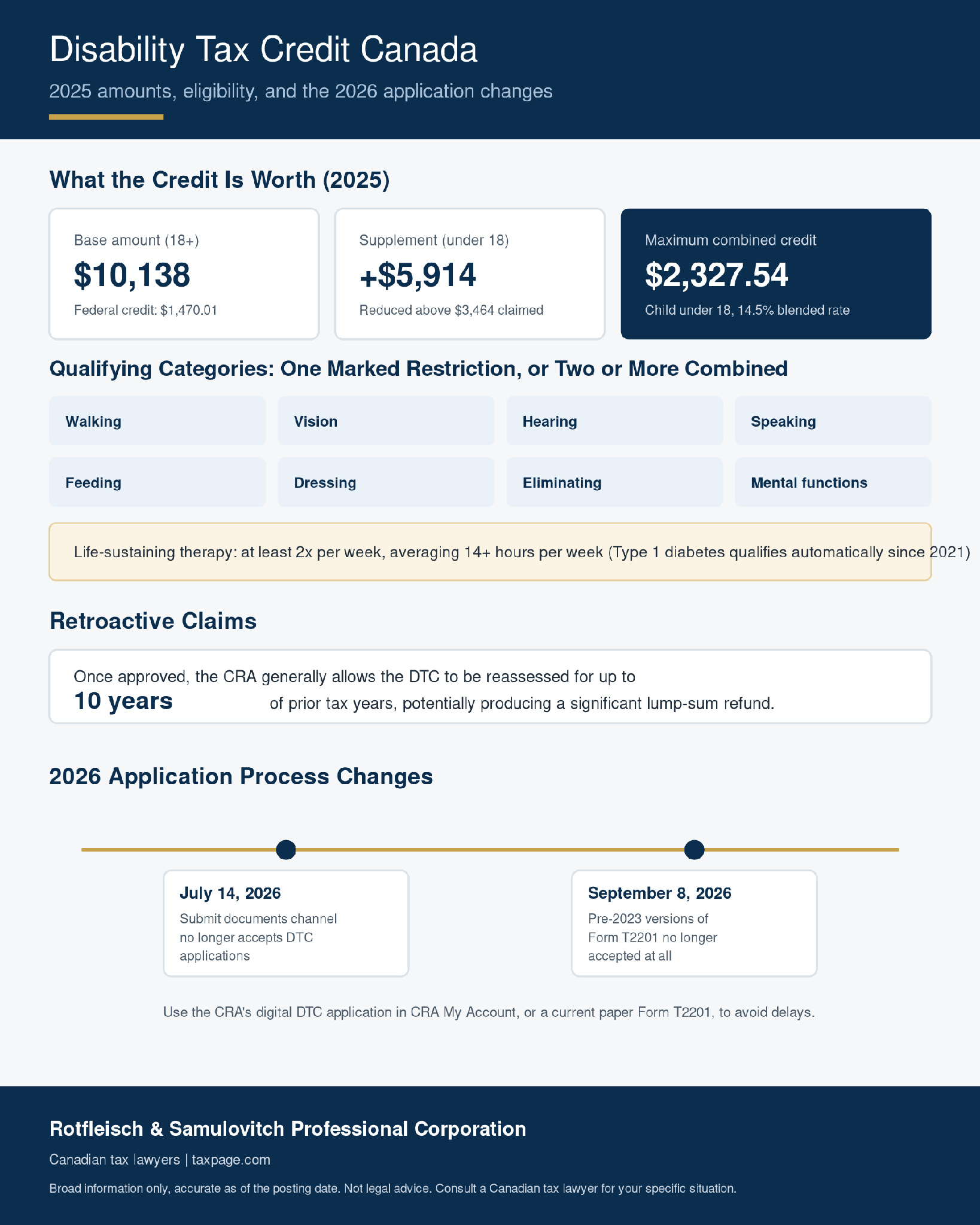
If you have one or more severe and prolonged impairments that restrict your ability to perform a basic activity of daily living, you may be eligible to claim the Canadian disability tax credit on your personal income tax return. The amount of the credit is dependent on your circumstances, but for the 2025 tax year can be as high as $2,327.54, as a direct reduction of your Canadian income tax payable to CRA.
If your circumstances allow, you may also be able to access the disability tax credit for previous years. Some taxpayers have received large refunds by amending their past 10 years of income tax returns once approved for the disability tax credit.
The income tax credit is not refundable, so the disabled person eligible for the tax credit can at most reduce their income tax payable to zero, and they will not receive money from CRA for reducing their tax payable below zero. However, unused disability tax credits can be transferred to the spouse of the eligible individual or to certain persons who support the eligible individual.
Before you can claim the disability tax credit, you must apply to CRA by submitting a T2201 form filled out by you and a qualified medical practitioner, either on paper or through the CRA’s digital DTC application, which the CRA has directed most applicants toward since changing its intake process in the summer of 2026. If your application is denied by CRA, one of our top tax lawyers in Toronto can help you contest CRA’s decision.
Disability Tax Credit Eligibility Criteria in Canada
In order to qualify for the disability tax credit, you must have one or more severe and prolonged impairments. Your impairment is prolonged if it has lasted or can reasonably be expected to last for at least 12 months. The impairments must markedly restrict your ability to perform a daily task of living or they must significantly restrict several daily tasks of living where the cumulative effect is equivalent to having a marked restriction in your ability to perform a daily task of living.
You also qualify if your impairments would markedly restrict your ability to perform a daily task of living but for a therapy that is vital to sustain a vital function and cannot reasonably be expected to be of significant benefit to persons who are not so impaired. The therapy must also need to be administered at least two times a week for a total combined duration averaging not less than fourteen hours per week; the frequency requirement was reduced from three times a week to two times a week by 2021 legislative amendments, so some taxpayers who did not qualify under the old rule may qualify now. The impairments must also be certified by a qualified medical practitioner, usually a medical doctor.
The disability tax credit cannot be claimed if any individual claims the medical expenses tax credit for attendant or nursing home expenses incurred for the care of the impaired individual. If you need help determining if you qualify, please contact one of our expert Toronto tax lawyers for more information.
Since January 1, 2021, every Canadian diagnosed with Type 1 diabetes is deemed by law to meet the life-sustaining therapy criteria automatically, without having to demonstrate the 14-hour weekly threshold. For a detailed look at that change and how it can support a retroactive claim, see our guide to the Disability Tax Credit for Type 1 diabetics.
The federal government’s 2026 Spring Economic Update proposes further streamlining the certification requirements for certain long-lasting medical conditions, reportedly including Autism Spectrum Disorder Level 3, permanent colostomy and ileostomy, and lifelong hemodialysis and peritoneal dialysis. As of this update, that proposal had not yet been enacted into law, so it does not currently change eligibility, but taxpayers and medical practitioners dealing with those conditions should watch for its progress through Parliament.
Basic Activities of Daily Living for the Disability Tax Credit
The Canadian Income Tax Act exhaustively defines what qualifies as a basic activity of daily living. The activities defined as such in the tax act include feeding oneself, dressing oneself, walking, speaking to be understood in quiet conditions, hearing to understand in quiet conditions, vision, bowel functions, and bladder functions.
The act also includes mental functions necessary for everyday life in the same category, which since 2021 has been broadened to include attention, concentration, memory, judgement, perception of reality, problem solving, goal setting, regulation of behaviour and emotions, verbal and non-verbal comprehension, and adaptive functioning.
That broader definition has significantly improved access to the credit for taxpayers with autism, ADHD, and other cognitive or psychiatric conditions. The Canadian Income Tax Act specifically excludes procuring clothing, procuring food, and preparing food, to the extent the time necessary for the activity would not be necessary but for a dietary restriction, from the list of basic activities of daily living.
Your ability to perform a basic activity of daily living is markedly restricted when you are unable to perform that activity all or substantially all the time. Your ability also counts as markedly restricted if performing the activity takes an inordinate amount of time all or substantially all the time. An inordinate amount of time means significantly more time than an average person performing the same activity.
The Tax Court of Canada’s decision in Norman v. The King, 2025 TCC 165, illustrates how strictly this standard is applied: the court found that six bathroom visits of ten minutes each, representing about 4 percent of a 24-hour day, was not an inordinate amount of time, and that the taxpayer’s ability to work as an apprentice electrician, a job requiring sustained attention and concentration, was inconsistent with a marked restriction in mental functions.
A supportive diagnosis alone is not enough; the medical practitioner completing your Form T2201 needs to describe the specific functional impact and time burden of your condition. If you need help with determining whether an individual’s impairments will make them eligible for the disability tax credit, don’t hesitate to contact one of our top Canadian tax lawyers.
“The Disability Tax Credit is a remedial provision, and it is meant to be interpreted generously, not narrowly. But cases like Norman show that generosity has statutory limits. The certificate a physician completes needs to speak to the actual time burden of the condition, not just confirm that the condition exists, or a legitimate claim can still fail.” — David Rotfleisch, founding tax lawyer and Law Society of Ontario Certified Specialist in Taxation at Rotfleisch & Samulovitch Professional Corporation
How Much Is the Disability Tax Credit Worth in 2025
If you are eligible for the disability tax credit then you are entitled to a tax credit equal to a base amount multiplied by the lowest marginal tax rate for the year. For the 2025 tax year, the base amount is $10,138.
The lowest marginal tax rate itself changed partway through 2025: the federal government reduced it from 15% to 14%, effective July 1, 2025, which works out to a blended rate of 14.5% for the 2025 tax year as a whole, and 14% for 2026 onward.
Applying the 2025 blended rate, the base credit is $1,470.01. This credit is deducted from your Canadian income tax payable for the year. The tax credit is not refundable, so if your income is not large enough to absorb the credit, you will not receive money from CRA if the tax credit you receive reduces your income tax payable below zero. As discussed later in this article, you may be able to transfer the unused portion of your tax credit to someone else.
If you are under the age of 18 at the end of the tax year, you may be eligible to receive a supplemental credit in addition to the base credit. For the 2025 tax year, the supplement amount is $5,914, which combined with the base amount gives a maximum disability amount of $16,052 for a child under 18, before applying the 14.5% blended credit rate, for a maximum combined credit of $2,327.54. The supplement is reduced once child care expenses or attendant care expenses claimed for the child under certain other provisions of the Income Tax Act exceed $3,464 for 2025, and is eliminated entirely once those claims exceed $9,378 for 2025.
The base amount, supplement, and these thresholds are indexed for inflation each year, so the 2026 figures will be somewhat higher, but as of this update the CRA had not yet published its official 2026 figures, which it typically confirms later in the year; taxpayers filing a 2026 return should check the CRA’s current figures rather than relying on the 2025 amounts above. If you need help determining how large a disability tax credit you are entitled to, don’t hesitate to contact our experienced Toronto tax lawyers.
“Taxpayers reconstructing a multi-year retroactive claim need to be careful to apply the rate and base amount that were actually in effect for each year being claimed, not today’s numbers. The mid-year 2025 rate change is a good example: a claim that touches both halves of 2025 uses a blended rate for that year, and that is easy to get wrong without checking the historical figures for each tax year.” — David Rotfleisch
For example, a taxpayer approved in 2026 who claims the disability amount retroactively for the 2023, 2024, and 2025 tax years would use the base amount and rate that applied in each of those years separately, not the 2025 or 2026 figures across the board. For 2023, the base amount was $9,428 at the 15% rate, for a credit of $1,414.20. For 2024, the base amount was $9,872, also at 15%, for a credit of $1,480.80. For 2025, the base amount is $10,138 at the blended 14.5% rate, for a credit of $1,470.01. Adding those three years together gives a combined retroactive federal credit of $4,365.01, before any provincial or territorial amounts, illustrating why a retroactive claim should be calculated year by year rather than by multiplying the current year’s credit by the number of years being claimed.
Transferring the Disability Tax Credit to a Spouse or Common-law Partner
If your spouse or common law partner is eligible for the disability tax credit but does not have enough tax payable to fully use the tax credit, then you can make use of the unused portion of their tax credit to reduce your own income tax payable. For the purposes of the Canadian Income Tax Act, an individual is your spouse if you are legally married to them. Likewise, an individual who is not your spouse is your common law partner for the purposes of the Canadian Income Tax Act if you are living in a conjugal relationship with them and at least one of the following three criteria is met:
You have been living with them in a conjugal relationship for a continuous period of at least 12 months; they are the parent of your child by birth or adoption; or they have custody and control of your child who is wholly dependent on that person for support.
If you are living separate and apart from your spouse or common law partner due to relationship breakdown at the end of the year and for 90 days starting at the beginning of the next year, then you cannot transfer the unused credits. For more information on whether you are able to transfer credits from an eligible individual, please consult one of our knowledgeable Canadian income tax lawyers.
Transferring the Disability Tax Credit to a Supporting Individual
If you are supporting a dependant who qualifies for the disability tax credit you may be able to use the unused portion of their tax credit. If the dependant is your or your spouse/common law partner’s child, grandchild, parent, grandparent, brother, sister, aunt, uncle, nephew, or niece then you can transfer their unused tax credits. You may also be able to transfer credits from someone who lives with you and depends wholly on you for support.
You cannot access the unused tax credits for a dependant if you or another taxpayer is claiming medical expenses for an attendant or nursing home for the dependant. If more than one individual supports the dependant, the sum of all the tax credits the supporting individuals claim cannot exceed the total amount of unused credits that the dependant has.
Qualifying for the disability tax credit is also worth pursuing beyond the credit itself, since it opens access to the Registered Disability Savings Plan and the Child Disability Benefit, both of which can be worth considerably more than the tax credit alone over time.
How to Apply for the Disability Tax Credit in 2026
Prior to claiming the disability tax credit, you need to apply to CRA by submitting a T2201 form. The T2201 form needs to be filled out by both the individual eligible for the disability tax credit and the medical practitioner who is certifying their impairment.
The CRA changed how it accepts DTC applications in two stages during the summer of 2026. As of July 14, 2026, the CRA no longer accepts DTC applications or supporting documents sent through the “submit documents” section of a CRA account; that channel is now reserved for follow-up information the CRA specifically requests in connection with an existing case. The CRA is instead directing applicants to its digital DTC application within CRA My Account, which it says is faster and ensures both you and your medical practitioner are working from the current version of the form.
A paper Form T2201 remains available if you cannot apply online, but starting September 8, 2026, the CRA will no longer accept applications filed on a pre-2023 version of the form, so if you are filing on paper, make sure you download the current version before that date. CRA will respond to your application either by approving your application or dismissing it. If your application is approved, the eligible individual can claim the disability tax credit each year on their tax return.
If you were eligible in previous tax years, you may also be able to amend your income tax returns for those previous years to claim the disability tax credit in those years as well. This has led to some taxpayers being approved for large refunds by amending their last 10 years of income tax returns. You do not need to file a new T2201 form each year so long as your circumstances don’t change.
The CRA may ask for additional information or a new T2201 form and you must provide it to them if you wish to continue claiming the disability tax credit. If your application was dismissed, you can apply for a second-level review or file a notice of objection. Our Toronto tax litigation lawyers can help you assess whether you have been denied a credit you are entitled to and dispute the CRA’s decision if necessary through a Notice of Objection or a court appeal.
Takeaway: Is the Disability Tax Credit Worth Applying For
If you have a long-term impairment that has severely impacted your life, it is worth looking into whether you are entitled to the disability tax credit. The eligibility rules have broadened in recent years, particularly for cognitive and psychiatric conditions and for Type 1 diabetes, so it is worth revisiting even if you were previously denied or never applied.
If your spouse, partner, or one of your dependents has an impairment that qualifies them for the disability tax credit, you may be able to make use of their unused disability tax credits. For more information on the disability tax credit, please contact one of our top Toronto tax lawyers.
“We are seeing renewed interest in this credit from people who were turned down years ago under the old, narrower rules. The cumulative-effect category and the broader definition of mental functions mean some of those past denials would come out differently today, and with a 10-year retroactive window, it is worth taking a second look rather than assuming an old denial is the final word.” — David Rotfleisch
Top Tax Tips for the Disability Tax Credit
Before assuming you do not qualify, check whether the cumulative effect of two or more significant limitations applies to you, since that route was expanded in 2021 and catches taxpayers who do not meet the marked-restriction threshold in any single category on its own. If your claim rests on mental functions such as attention, memory, or regulation of behaviour and emotions, ask your medical practitioner to describe the specific daily tasks affected and the extra time or support you need, rather than relying on the diagnosis alone, since that level of detail is what actually withstands CRA and Tax Court scrutiny.
If you have lived with a qualifying impairment for years without applying, do not assume you can only benefit going forward, since the CRA generally allows the credit to be reassessed for up to 10 years once you are approved, and a retroactive claim spanning multiple years should be calculated using each year’s own base amount and tax rate rather than today’s figures. If you are a Type 1 diabetic who has never applied, or who was denied before 2021, revisit your eligibility now that the diagnosis alone satisfies the life-sustaining therapy criteria.
Families supporting a dependant should decide in advance who is best positioned to use any unused credit, since the transfer rules are specific about which relationships qualify, and should also check whether the Canada Caregiver Credit can be claimed alongside the disability amount rather than instead of it. If a paper Form T2201 is your only option, confirm it is the current version before it is signed and mailed, since the CRA will not process an outdated form once the September 8, 2026 cutoff takes effect.
If your application is denied, read the CRA’s stated reasons carefully before responding, since a request for reconsideration with more specific medical evidence often succeeds where the original certificate was too generic, and consult an experienced Canadian tax lawyer before filing a Notice of Objection or an appeal to the Tax Court of Canada, since the deadlines and evidentiary requirements are strict.
Frequently Asked Questions
How much is the Disability Tax Credit worth in 2025?
For the 2025 tax year, the base disability amount is $10,138 for an applicant 18 or older. Because the lowest federal tax rate was reduced from 15% to 14% partway through 2025, a blended rate of 14.5% applies for the year, generating a federal credit of $1,470.01. An applicant under 18 may also claim a supplement of $5,914, bringing the combined disability amount to $16,052 before the credit rate is applied, for a maximum combined credit of $2,327.54. The supplement is reduced once child care or attendant care expenses claimed for the child exceed $3,464 for 2025, and is eliminated once those claims exceed $9,378.
What changed in the Disability Tax Credit eligibility rules since this article was first published?
Since 2021, the life-sustaining therapy frequency threshold was reduced from three times a week to two times a week, the definition of mental functions necessary for everyday life was broadened to explicitly include attention, concentration, regulation of behaviour and emotions, and verbal and non-verbal comprehension, and every Canadian diagnosed with Type 1 diabetes has been deemed to automatically meet the life-sustaining therapy criteria.
Does Type 1 diabetes automatically qualify for the Disability Tax Credit?
Yes. Since January 1, 2021, a Type 1 diabetes diagnosis alone satisfies the life-sustaining therapy criteria, without needing to document insulin management hours. Type 2 diabetics on insulin therapy may still qualify, but must demonstrate the full 14-hour-per-week threshold.
Is vision a qualifying basic activity of daily living?
Yes. Vision is one of the categories listed in the Income Tax Act alongside walking, feeding, dressing, hearing, speaking, and eliminating.
Why would a Disability Tax Credit application be denied even with a supporting diagnosis?
As the Tax Court’s decision in Norman v. The King, 2025 TCC 165 shows, a diagnosis is not sufficient on its own. The CRA and the Tax Court assess whether the specific statutory language, an inordinate amount of time or a marked restriction all or substantially all of the time, is actually satisfied based on the functional detail in Form T2201, not the diagnosis alone.
Can the Disability Tax Credit be claimed retroactively?
Yes. The CRA generally allows a disability tax credit claim to be reassessed for up to 10 years once eligibility is established for those prior years, which can produce a significant lump-sum refund in addition to the ongoing annual credit.
Can the Disability Tax Credit be transferred to a family member?
Yes. If the person with the disability does not have enough taxable income to use the full credit, the unused portion can generally be transferred to a supporting spouse, common-law partner, or other eligible family member, subject to the specific relationship and support tests described above.
How do I apply for the Disability Tax Credit?
You need a completed Form T2201, with Part A completed by you or your legal representative and Part B completed by a medical practitioner. As of July 14, 2026, the CRA no longer accepts DTC applications or supporting documents through the “submit documents” section of a CRA account, so new applications should go through the CRA’s digital DTC application in CRA My Account instead, which the CRA says processes faster and always uses the current version of the form. A paper Form T2201 remains an option, but beginning September 8, 2026, the CRA will stop accepting applications filed on a pre-2023 version of the form, so make sure any paper copy is current before mailing it in.
What should I do if my Disability Tax Credit application is denied?
Review the CRA’s stated reasons for denial. A request for reconsideration with more specific medical evidence often succeeds where the original certificate did not adequately describe functional impact. If the denial is confirmed, you can file a Notice of Objection and, if necessary, appeal to the Tax Court of Canada.
Does Disability Tax Credit approval provide access to other benefits?
Yes. Approval is generally required to open a Registered Disability Savings Plan and can also affect eligibility for the Child Disability Benefit and certain provincial programs, in addition to the federal tax credit itself.
How does the Disability Tax Credit interact with the Canada Caregiver Credit?
The Disability Tax Credit and the Canada Caregiver Credit are separate, non-refundable credits with separate eligibility tests, and they can often be claimed together. For 2025, a taxpayer supporting an infirm child under 18 may claim up to $2,687 under the Canada Caregiver Credit, and a taxpayer supporting an infirm dependant 18 or older, other than a spouse or common-law partner, may claim up to $8,601. The CRA will accept an approved Form T2201 as supporting documentation for the Canada Caregiver Credit, but Canada Caregiver Credit eligibility does not require DTC approval, since it uses a somewhat broader “dependent on others” test rather than the DTC’s specific marked-restriction or life-sustaining-therapy criteria.
DISCLAIMER: This article provides broad information. It is only accurate as of the posting date. It has not been updated and may be out-of-date. It does not give legal advice and should not be relied on as tax advice. Every tax scenario is unique to its circumstances and will differ from the instances described in the article. If you have specific legal questions, you should seek the advice of a Canadian tax lawyer.
About the Author