


Published: November 18, 2026
Key takeaways
- Canada has no estate or inheritance tax, but the deemed disposition on death taxes accrued gains on the deceased’s final return.
- Private company shares can be taxed twice: once as a capital gain on death and again as a dividend when the estate extracts corporate value. Without planning, the combined rate can exceed 70% in some provinces.
- The two main fixes are the subsection 164(6) loss carryback and the post-mortem pipeline. Both have strict timing and anti-avoidance limits.
- For deaths on or after August 12, 2024, the 164(6) loss may arise in any of the estate’s first three taxation years, but only if the estate is a graduated rate estate.
- Executors should not redeem shares, pay dividends or distribute assets until the elections, stop-loss rules and anti-avoidance provisions have been reviewed.
What is post-mortem tax planning in Canada?
Post-mortem tax planning means using legally permitted elections and reorganizations after death to reduce income tax on the deceased’s final return and during estate administration. It matters most where the deceased owned private corporation shares, investment or rental property, or other appreciated assets.
“Executors should treat the first corporate distribution as a tax-planning decision, not an administrative step. A premature redemption, dividend or wind-up can permanently narrow the estate’s options,” advises David J. Rotfleisch, Canadian tax lawyer and Certified Specialist in Taxation.
The deemed disposition on death
Subsection 70(5) of the Income Tax Act generally deems a deceased taxpayer to have disposed of each capital property immediately before death for proceeds equal to its fair market value. The person acquiring the property as a consequence of death generally receives a matching cost equal to that fair market value.
For example, if private corporation shares cost $100,000 and are worth $1 million at death, the deemed disposition generally produces a $900,000 capital gain. At the current one-half inclusion rate, $450,000 is a taxable capital gain before any rollover, loss, exemption or other adjustment. The one-half inclusion rate remains the enacted rule for individuals, corporations and trusts.
The rule reaches more than shares and real estate. Cryptocurrency and NFTs held as capital property are also deemed disposed of at death, and executors face added valuation and access problems with digital assets in an estate.
A spousal rollover may defer the gain where property passes to a spouse or common-law partner resident in Canada, or to a qualifying spousal trust. The property must generally vest indefeasibly within 36 months after death, subject to an extension accepted by the CRA.
Why double or triple taxation arises on private company shares
The deemed disposition creates tax at the shareholder level, but it does not increase the paid-up capital of the shares. When the estate later extracts value through a dividend, share redemption or wind-up, that value is taxed a second time as a dividend. A third, corporate-level tax can arise if the corporation must sell appreciated assets to fund the distribution.
The precise result depends on the corporation’s adjusted cost bases, paid-up capital, capital dividend account, refundable tax balances, available losses, the estate’s cash needs and the structure and timing of the transactions.
A simple illustration of the double-tax problem
Assume private-company shares have an adjusted cost base of $100,000 and a fair market value of $1 million immediately before death. The deemed-disposition rule generally produces a $900,000 capital gain. If the estate later extracts the same corporate value through a redemption or wind-up without appropriate post-mortem planning, a second shareholder-level tax can arise. The figures are deliberately simplified: the actual result depends on paid-up capital, corporate asset tax bases, CDA and refundable-tax balances, available losses, exemptions and the transactions used.
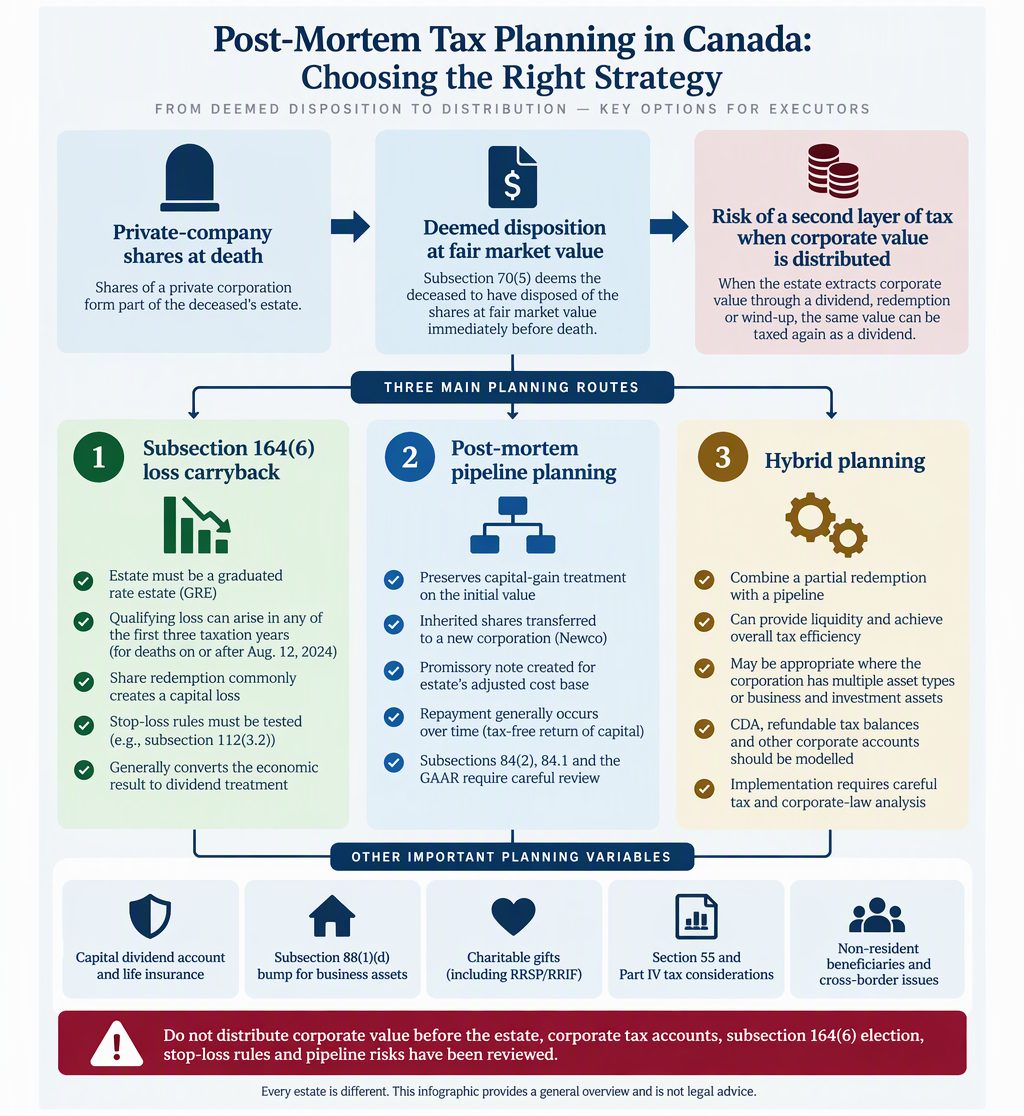
Figure 1. Post-mortem tax planning in Canada: choosing among a subsection 164(6) loss carryback, post-mortem pipeline and hybrid strategy.
Strategy 1: Subsection 164(6) capital loss carryback
Subsection 164(6) lets a qualifying graduated rate estate carry certain losses back to the deceased’s final taxation year. For deaths on or after August 12, 2024, the loss may arise in any of the estate’s first three taxation years rather than only the first.
The provision applies where, in a taxation year within that period:
- the estate’s total capital losses exceed its total capital gains; or
- the estate disposes of all depreciable property of a prescribed class and the remaining undepreciated capital cost is deductible.
The legal representative may elect, in prescribed form, to treat eligible losses as losses of the deceased in the final year. The elected amount cannot exceed the applicable excess, and the election is generally due by the filing-due date for the estate’s relevant taxation year. The will should authorize the executor to make tax elections; most lawyer-drafted wills do.
A common example is a redemption of the estate’s shares. The redemption produces a deemed dividend and a capital loss, because the estate’s cost base reflects fair market value at death. Subject to the stop-loss rules, the loss can be carried back against the capital gain on the final return, so the value is taxed once, as a dividend.
Capital dividend and stop-loss caution. A capital dividend can reduce the loss available for carryback under subsection 112(3.2), particularly where the shares are not grandfathered. A loss should not be assumed to be fully available just because shares are redeemed at their adjusted cost base.
A single redemption generally cannot be split between a capital dividend and a taxable dividend through a partial election, because a subsection 83(2) election on Form T2054 applies to the full dividend. Alternatives include paying a capital dividend before the redemption, an excessive capital dividend election under subsection 184(3), or increasing paid-up capital first. Each has its own technical and corporate-law requirements.
Strategy 2: Post-mortem pipeline planning
A post-mortem pipeline extracts corporate value as a tax-free return of the estate’s high adjusted cost base rather than as a second, taxable dividend. If successfully implemented, the pipeline generally preserves capital-gain treatment on the value taxed at death and avoids a second shareholder-level dividend. The actual Ontario effective rate depends on the deceased’s income, available exemptions and credits, and the year of death.
A typical pipeline runs in four steps:
- The estate acquires the deceased’s shares at a cost equal to fair market value under paragraph 70(5)(b).
- The estate transfers those shares to a new corporation (Newco) for a promissory note and, in some cases, shares.
- The original corporation pays an intercorporate dividend or amalgamates with Newco.
- Newco repays the note to the estate progressively.
The pipeline is not automatically tax-free. Subsection 84(2) can deem a dividend where corporate funds are distributed to shareholders on a winding-up, discontinuance or reorganization of the business, and courts have read it broadly (see also McMullen). Section 84.1, the surplus-stripping rule, must also be considered on a non-arm’s-length share transfer. The CRA treats these provisions as addressing different but overlapping concerns.
The CRA has flagged higher subsection 84(2) risk where:
- corporate funds are distributed to the estate shortly after death;
- the original corporation is essentially a cash corporation; and
- the corporation has no continuing business or activities.
Favourable rulings have generally involved continuing the business for about one year, then making progressive distributions. These are administrative indicators, not a statutory safe harbour. In a 2022 advance ruling, the CRA confirmed that subsection 84(2) and paragraph 84.1(1)(b) would not apply where, among other facts, no note repayment, share redemption or business reorganization occurred in the following year and the amalgamation came after at least one year. The ruling binds only on its disclosed facts. Other rulings have allowed limited first-year payments to fund the estate’s tax liabilities.
Case law caution. In Robillard Estate (2022), the Tax Court reluctantly followed the Federal Court of Appeal’s broad reading of subsection 84(2) in MacDonald and applied it to a pipeline. A pipeline that skips the waiting period or empties the corporation early remains exposed to reassessment.
GAAR after 2024. Amendments to the general anti-avoidance rule in June 2024 lowered the avoidance-purpose threshold to “one of the main purposes,” added an economic-substance factor and introduced a 25% penalty. The CRA has said it will continue to issue favourable pipeline rulings, but documentation of business continuity now matters more than ever.
Pipeline vs. 164(6) loss carryback: which is better?
| Factor | 164(6) loss carryback | Post-mortem pipeline |
| How value is taxed | Once, as a dividend (higher rate) | Once, as a capital gain (lower rate) |
| Deadline | Loss within the estate’s first 3 taxation years (deaths on or after Aug 12, 2024) | No statutory deadline; usually a 1-year wait before distributions |
| Speed of distribution | Faster; suits a quick wind-up | Slower; progressive note repayment |
| CRA / anti-avoidance risk | Lower; the stop-loss rules are the main limit | Higher; 84(2), 84.1 and GAAR must be managed |
| Works best when | Corporation has refundable tax (RDTOH), CDA or insurance proceeds to offset dividend tax | Corporation has a continuing business and estate can wait |
| Can be combined? | Yes: redeem some shares under 164(6), pipeline the rest | Yes |
“The best post-mortem plan is not necessarily the transaction with the lowest tax in isolation. It is the plan that produces the lowest defensible estate-wide tax cost while preserving liquidity and an administrable path for the executor,” explains David J. Rotfleisch, Canadian tax lawyer and Certified Specialist in Taxation.
Strategy 3: Charitable donations
Donations by will, or by designation of RRSP, RRIF, TFSA or life insurance proceeds, may be treated as donations of the estate. For a graduated rate estate, the representative can allocate the credit between the estate and the deceased’s final two taxation years. In the year of death and the year before, the limit rises to 100% of net income.
The beneficiary designation matters: see naming your estate rather than a charity as RRSP or RRIF beneficiary and RRSP and RRIF donations from estates. A donation made personally by a beneficiary does not create a credit for the deceased or the estate.
Strategy 4: Capital gains bump planning
In a qualifying amalgamation or wind-up, subsection 87(11) and paragraphs 88(1)(c) and (d) may increase the cost of certain non-depreciable capital property held by the subsidiary. The bump is limited, subject to detailed conditions and restricted where property goes to specified persons in the same series of transactions. The CRA has ruled favourably on eligible land held continuously by an operating corporation. An investment portfolio should not be assumed to qualify.
Strategy 5: Capital dividend account and life insurance
Where a corporation receives life insurance proceeds, its capital dividend account generally increases by the death benefit less the policy’s adjusted cost basis. The corporation can then elect that a dividend, including a deemed dividend on redemption, be a tax-free capital dividend. The election must be coordinated with the redemption and the stop-loss rules, and an excess capital dividend can trigger a 60% Part III tax.
Section 55 and Part IV tax must be modelled in corporate-distribution planning
A pipeline or hybrid plan commonly moves value between connected corporations before funds reach the estate. Intercorporate dividends are not simply “tax-free” in every practical sense. Section 55 can convert an otherwise deductible intercorporate dividend into a capital gain where one of the statutory purpose tests and other conditions are met. Part IV tax and dividend-refund consequences may also alter cash flow. Before declaring an intercorporate dividend, the advisors should document safe income, connected-corporation status, refundable tax balances and the commercial purpose of each step.
“Post-mortem planning succeeds or fails on sequencing. Every dividend, redemption, note repayment and amalgamation must be tested across the deceased, the estate and each corporation before documents are signed,” notes David J. Rotfleisch.
Choosing and implementing a strategy
No single strategy fits every estate. The analysis should consider:
- fair market value and adjusted cost base of each asset, supported by a formal valuation;
- the deemed disposition reported and any lifetime capital gains exemption available;
- the estate’s graduated rate estate status and filing deadlines;
- the corporation’s paid-up capital, capital dividend account, general rate income pool and refundable tax balances;
- whether a capital dividend triggers or increases a stop-loss restriction;
- the corporation’s actual business activities and whether it is a cash corporation;
- cash needed to fund the deceased’s and the estate’s tax liabilities;
- whether corporate assets must be sold to fund distributions;
- whether the estate or any beneficiary is a non-resident of Canada; and
- whether the will, shareholder agreements and trust deeds permit the reorganization.
Executor checklist
Before distributing corporate or estate assets, the executor should:
- obtain reliable valuations and confirm adjusted cost bases;
- calculate tax on the final return and any optional returns;
- designate the estate as a graduated rate estate in its first T3 return;
- identify all 164(6), charitable donation and other elections and their deadlines;
- review the capital dividend account and refundable tax balances;
- test whether a redemption creates a usable loss or triggers the stop-loss rules;
- document the corporation’s continuing business if a pipeline is planned;
- reserve cash for tax, arrears interest and administration costs;
- check that all of the deceased’s past returns were filed and correct, and consider a voluntary disclosure for the estate if they were not; and
- obtain an income tax clearance certificate and, if the deceased was a GST/HST registrant, a separate GST/HST clearance certificate before final distribution.
Tax on the final return may need to be paid before a 164(6) carryback is processed. In recent pipeline rulings, tax funding was handled separately from the eventual carryback, and arrears interest remained a cost.
Pro tax tip: review corporate tax accounts before distributing estate assets
Before distributing inherited corporate assets, get a full review of the corporation’s financial statements, capital dividend account, refundable tax balances and share cost base. These records often reveal opportunities to combine a pipeline, a loss carryback and capital dividends. Do not redeem shares or move corporate funds until the elections, stop-loss rules and anti-avoidance provisions have been reviewed; the sequence and documentation can matter as much as the tax calculation.
Takeaway for Executors and Canadian Private-Company Families
Post-mortem tax planning can mitigate or, in appropriate circumstances, eliminate much of the double tax that arises when a Canadian dies owning private corporation shares or other appreciated property. Loss carrybacks, pipelines, charitable gifts, capital dividends and bumps each work only within precise statutory conditions, deadlines and facts.
The most important step is to review the final-return liability, the estate’s tax attributes and the corporation’s accounts before redeeming shares or distributing value. Before implementing any transaction, seek advice from an experienced Canadian tax lawyer and Certified Specialist in Taxation at Taxpage.com before acting, so elections are preserved and subsection 84(2), section 84.1 and GAAR risks are managed.
Frequently asked questions
Is there an estate or inheritance tax in Canada?
No. Canada instead taxes accrued gains through the deemed disposition on death, reported on the deceased’s final return, and provinces charge probate fees.
What is post-mortem tax planning in Canada?
It is the use of statutory elections and reorganizations after death to reduce tax on the final return and during estate administration. Common tools are 164(6) loss carrybacks, pipelines, charitable gifts, capital dividends and bumps.
What is the deemed disposition rule on death?
Under subsection 70(5), the deceased is treated as selling capital property at fair market value immediately before death, and the estate or heir takes that value as its cost. A gain can arise with no actual sale.
What causes double taxation on death?
The deceased is taxed on the gain in private company shares, and the estate is taxed again on a dividend when it extracts the same value. A third corporate-level tax can arise if appreciated assets must be sold.
How does subsection 164(6) reduce tax on death?
It lets a graduated rate estate carry a capital loss, usually from a share redemption, back to the deceased’s final year to offset the gain. For deaths on or after August 12, 2024, the loss may arise in any of the estate’s first three taxation years. See our 164(6) analysis.
What is a post-mortem pipeline?
It is a transfer of the inherited shares to a new corporation for a promissory note, which is then repaid from corporate value. The aim is to return the estate’s high cost base tax-free instead of paying a second, taxable dividend. See our pipeline planning guide.
Is a pipeline or a 164(6) loss carryback better?
A pipeline usually produces less tax because value is taxed as a capital gain, not a dividend. A loss carryback is faster, carries less anti-avoidance risk and can be better where the corporation has refundable tax or capital dividend account balances. Many estates combine both.
Is there a one-year safe harbour for pipeline planning?
No. Continuing the business for about a year and repaying the note progressively are features of favourable CRA rulings, not a statutory safe harbour. The CRA reviews subsection 84(2) case by case.
What is a graduated rate estate?
It is an estate that designates itself as such in its first T3 return and meets the other conditions in the Act; it is taxed at graduated rates for up to 36 months. Only a graduated rate estate can use 164(6) and the flexible donation rules.
Can charitable donations reduce tax after death?
Yes. Gifts by will or by beneficiary designation can generate credits allocated between the estate and the deceased’s final two years, with a 100% net-income limit in the year of death and the year before.
What is a capital gains bump?
It is an increase to the tax cost of certain non-depreciable capital property on a qualifying amalgamation or wind-up under paragraphs 88(1)(c) and (d). Detailed limits apply, and investment portfolios are not automatically eligible.
Can an executor combine post-mortem strategies?
Yes. A 164(6) carryback can be combined with a pipeline, capital dividend planning or a bump. The sequence must be reviewed as a whole under the stop-loss rules, subsection 84(2), section 84.1 and the GAAR in subsection 245(2).
How long does an executor have to implement post-mortem planning?
It depends on the strategy. For 164(6), the loss must arise within the estate’s first three taxation years (for applicable deaths) and the election must be filed by the relevant filing-due date. Pipelines, donations and bump designations have separate requirements.
Do executors need a clearance certificate?
An executor who distributes property without an income tax clearance certificate can be personally liable for the estate’s unpaid tax. A separate GST/HST clearance certificate is needed if the deceased was a registrant.
What if the deceased did not report all income?
The estate may be able to correct past non-compliance through a voluntary disclosure and reduce penalties. This should be resolved before the clearance certificate is requested.
Does the deemed disposition apply to cryptocurrency?
Yes, if the crypto is capital property. Executors also need access to wallets and reliable date-of-death valuations; see crypto estate planning in Canada.
Can non-resident beneficiaries affect the planning?
Yes. Residence of the estate and beneficiaries affects withholding tax, treaty relief and whether a pipeline or redemption works as intended. Review every taxpayer’s residence first.
How can a Canadian tax lawyer help?
A tax lawyer can review the assets, corporate accounts, will and deadlines; model each strategy; structure the transactions; prepare the elections; and assess 84(2), 84.1 and GAAR risk before any distribution.
DISCLAIMER: This article provides broad information. It is only accurate as of the posting date. It has not been updated and may be out-of-date. It does not give legal advice and should not be relied on as tax advice. Every tax scenario is unique to its circumstances and will differ from the instances described in the article. If you have specific legal questions, you should seek the advice of a Canadian tax lawyer.
About the Author