


Published: June 18, 2024
Last Updated: October 14, 2026
- Overview
- Discretionary Decisions Are Appealed to the Federal Courts, Not the Tax Court
- Legal Basis for Judicial Review: The Federal Courts Act
- The Vavilov Framework: Correctness and Reasonableness
- How the Federal Courts Apply Vavilov to CRA Discretionary Decisions
- 2025-2026 Federal Court and FCA Case Law
- Precedent Is Not Binding on the Minister
- CRA Must Apply Its Own Policy Correctly
- Other CRA Discretionary Decisions Beyond Taxpayer Relief
- Implications for Canadian Taxpayers
- Takeaway
- Pro Tax Tips
- FAQ
- Canadian Tax Lawyer Assistance
At a Glance
The Canada Revenue Agency (“CRA”) is an administrative body, and as a result, it may only exercise powers given to it expressly by statute, most notably the Income Tax Act. The Minister of National Revenue (“Minister”) is CRA’s representative for administering and enforcing the Tax Act, and any reference to “the Minister” is in effect a reference to CRA. Many provisions of the Tax Act direct CRA to act in a specific way, using mandatory language such as “the Minister shall.” Other provisions give CRA discretion over whether or how to act, typically signalled by “the Minister may.” Where “shall” language applies, CRA has little leeway. Where “may” language applies, Parliament intended to give CRA considerable discretion in carrying out its income tax duties.
When a taxpayer disagrees with how CRA exercised that discretion, the question of which court can intervene, and how closely that court will scrutinize CRA’s reasoning, is critical. This article explains the standard of review the courts apply when reviewing discretionary CRA decisions, and updates that analysis with the Federal Court and Federal Court of Appeal decisions issued since our original 2024 discussion of this topic.
Discretionary Decisions of the CRA Are Appealed to the Federal Courts, Not the Tax Court
Discretionary decisions made by CRA are challenged in the Federal Courts, not the Tax Court of Canada. The Tax Court of Canada is a creature of statute — created by Parliament through the Tax Court of Canada Act, RSC 1985, c T-2 — rather than through the common law, and it can only grant relief expressly set out in that constituting statute. When a tax litigation lawyer appeals an assessment or reassessment to the Tax Court, the Court’s options are limited:
- The Tax Court judge may confirm the assessment or reassessment issued by CRA;
- The judge can vacate the assessment, sending the matter back to CRA to reconsider and reissue a reassessment; and
- The judge may direct the Minister to reassess the taxpayer in accordance with the judge’s instructions, based on findings of fact made at trial.
The Tax Court has no power to tell CRA what to do on a matter within the Minister’s discretion, and no ability to substitute what it believes would be a fair outcome. A Tax Court judge applies the Income Tax Act as interpreted by binding decisions of more senior courts.
The Federal Courts, by contrast, have broad remedial powers in matters within federal jurisdiction, including taxation. They can grant extraordinary remedies such as injunctions and mandamus orders, and a Federal Court or Federal Court of Appeal judge can direct the Minister to act, or not act, in a specific way if the Minister’s exercise of discretion was unreasonable or incorrect. Even so, taxpayers face a high bar in persuading a court to actually exercise these remedial powers on judicial review, as the case law below illustrates.
Legal Basis for Judicial Review: The Federal Courts Act
The Federal Court’s authority to review CRA’s discretionary decisions comes from the Federal Courts Act, RSC 1985, c F-7, not from the Income Tax Act itself. Subsection 18(1) gives the Federal Court exclusive original jurisdiction to grant relief against any federal board, commission, or tribunal, a category that includes CRA and the Minister’s delegates.
Subsection 18.1(3) sets out what the Court can actually order: it can direct CRA to do something it unlawfully refused or unreasonably delayed doing, or it can quash, set aside, or refer a decision back to CRA for reconsideration. What it cannot do is substitute its own decision for CRA’s. Subsection 18.1(4) lists the specific grounds on which a taxpayer can attack a CRA decision: CRA acted without or beyond its jurisdiction, or refused to exercise it; CRA failed to observe procedural fairness or natural justice; CRA erred in law; CRA based its decision on an erroneous finding of fact made in a perverse or capricious manner or without regard to the evidence before it; CRA acted because of fraud or perjured evidence; or CRA otherwise acted contrary to law.
One further wrinkle explains why some CRA disputes never reach the Federal Court at all: section 18.5 removes the Federal Court’s jurisdiction wherever Parliament has already provided a specific appeal route to another court, expressly naming the Tax Court of Canada as one such route. This is part of why factual assessment and reassessment disputes go to the Tax Court of Canada rather than the Federal Court — the Income Tax Act’s own appeal mechanism displaces the Federal Court’s general judicial review jurisdiction for those disputes, leaving the Federal Court’s role focused on genuinely discretionary decisions such as taxpayer relief and voluntary disclosure denials.
An application for judicial review must generally be filed within 30 days of the CRA decision being communicated to the taxpayer, under subsection 18.1(2), though a Federal Court judge can extend that period. The procedural mechanics are set out in Part 5, Rules 300 to 319, of the Federal Courts Rules. Missing the 30-day window is one of the most common reasons an otherwise strong judicial review application never gets heard on its merits.
The Vavilov Framework: Correctness and Reasonableness
Historically, Canadian courts assessed administrative decisions using three standards: correctness, reasonableness, and patent unreasonableness.
In 2019, the Supreme Court of Canada released Canada (Minister of Citizenship and Immigration) v Vavilov, 2019 SCC 65, a landmark decision that overtook Dunsmuir as the leading authority on judicial review and simplified the framework into two standards: correctness and reasonableness.
Under Vavilov, reasonableness is presumptively the applicable standard. A decision will be upheld as reasonable where it is justified in light of the factual and legal constraints, and where the decision-maker’s reasoning is coherent, understandable, and accessible.
Correctness applies only in five exceptional circumstances:
- Where a statute explicitly prescribes the correctness standard
- Where a statute provides a right of appeal from an administrative body to a court
- Constitutional questions
- General questions of law of central importance to the legal system as a whole
- Questions concerning jurisdictional boundaries between administrative bodies.
Where correctness applies, the reviewing judge substitutes their own view of the correct answer and gives no deference to the original decision-maker.
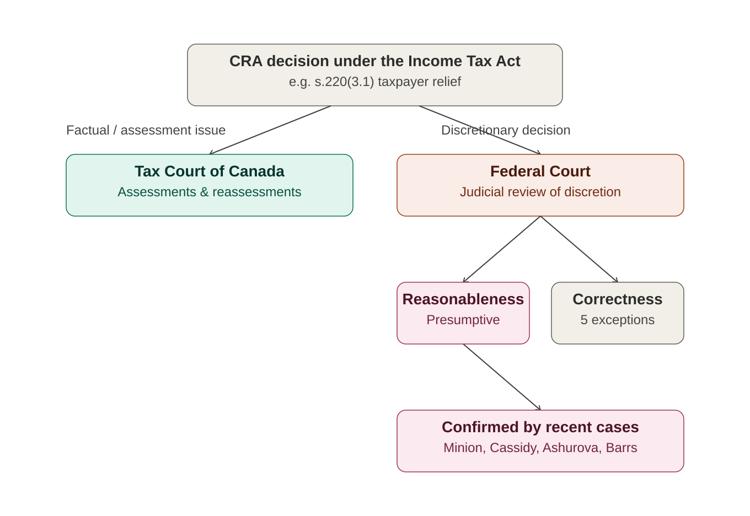
Figure 1: Routing a CRA decision — Tax Court vs. Federal Court, and the Vavilov reasonableness/correctness split.
How the Federal Courts Apply Vavilov to CRA Discretionary Decisions
The Federal Courts have consistently applied the Vavilov framework to discretionary CRA decisions under the Income Tax Act, and reasonableness is now firmly the default standard for these cases.
In Charky v Canada (Minister of National Revenue), 2010 FC 1327, the Federal Court reviewed a decision under subsection 220(3.1) of the Tax Act, which lets CRA waive or cancel penalties and interest that became payable in the ten years preceding a voluntary disclosure application. CRA had rejected the taxpayer’s disclosure for lack of voluntariness. The Court focused on whether the Minister considered all of the evidence fairly and, having answered yes, found the decision fell within a range of acceptable outcomes and was therefore reasonable.
Similarly, in Canada (Attorney General) v Abraham, 2012 FCA 266, the Federal Court of Appeal reviewed a decision under subsection 152(4.2), which lets taxpayers apply, after the normal reassessment period, to have a prior taxation year reassessed within ten years of that year’s end. The FCA showed a high level of deference to the CRA delegate’s decision denying relief, even though the delegate had to work through a legal question involving the Indian Act before exercising the statutory discretion.
Together, these cases establish that the Federal Courts will respect CRA’s discretionary decisions so long as the reasoning is transparent and not the product of bad faith.
2025-2026 Federal Court and FCA Case Law
Since this article was first published, several additional Federal Court and Federal Court of Appeal decisions have reinforced and refined how reasonableness review applies to CRA’s discretionary decisions, particularly under the taxpayer relief provisions in subsection 220(3.1).
In Minion v The King, 2025 FC 1461, the Federal Court reviewed CRA’s refusal of instalment and arrears interest relief sought by a U.S. citizen resident in British Columbia who was also subject to U.S. payroll withholding. CRA had denied the request on the basis that the taxpayer had withdrawn a financial hardship argument and could have asked her U.S. employer to adjust withholding. The decision illustrates that the Federal Court will continue to defer to CRA’s assessment of the evidentiary record on a taxpayer relief application, provided CRA actually engaged with the arguments the taxpayer put forward.
“As an income tax lawyer, I tell clients that cases like Minion are a reminder that reasonableness review is not a rubber stamp, but it is also not a chance to relitigate the facts. If you want to succeed on judicial review, the record CRA built has to show a real gap in its reasoning, not just a result you disagree with.”
— David J. Rotfleisch, Certified Specialist in Taxation Law (Law Society of Ontario)
In Cassidy v Canada (Attorney General), the Federal Court again confirmed reasonableness as the governing standard for a subsection 220(3.1) refusal, in a case involving a taxpayer relief request based on financial hardship, inability to pay, and CRA delay. The Court reiterated that its role is not to decide what result would be fair, but only whether CRA’s decision was reasonable in the administrative law sense.
At the Court of Appeal level, Ashurova v Canada (Attorney General), 2026 FCA, dismissed an appeal from a judicial review that had upheld a CRA officer’s decision finding the applicant ineligible for the Canada Recovery Caregiving Benefit. Although the CRCB is a COVID-era benefit rather than a Tax Act relief provision, the FCA applied the same reasonableness-first framework and emphasized that disagreement with the Federal Court’s weighing of the evidence is not, on its own, enough to succeed on appeal.
“In my income tax practice, I see Ashurova as a sign of how far the Vavilov framework has travelled outside the Tax Court’s own docket. Whether the discretionary decision comes from a taxpayer relief officer or a benefits officer, the Federal Courts are asking the same question: did the decision-maker actually grapple with the evidence in front of them.”
— David J. Rotfleisch, Certified Specialist in Taxation Law (Law Society of Ontario)
These decisions sit alongside the Federal Court of Appeal’s earlier ruling in Barrs v Canada, 2022 FCA 147, which found that a CRA review officer acted unreasonably by failing to meaningfully engage with the taxpayer’s argument for equitable treatment relative to other taxpayers. Read together, the post-2022 case law confirms that reasonableness review of CRA discretionary decisions remains deferential, but is not a rubber stamp: CRA officers must show they turned their minds to the specific arguments and evidence a taxpayer actually put before them.
Precedent Is Not Binding on the Minister
To properly exercise a discretionary power, CRA decision-makers must actually consider the specific facts of each case — they cannot fetter their discretion by mechanically applying published policies, rules of thumb, or earlier decisions. CRA’s Information Circular IC07-1 (now IC07-1R1) lists examples of “extraordinary circumstances” that might justify interest or penalty relief under subsection 220(3.1), including natural or man-made disasters, civil disturbances or service disruptions, serious illness or accident, and serious mental distress such as a death in the immediate family.
In Canada v Guindon, 2013 FCA 153, the Federal Court of Appeal held that discretion under subsection 220(3.1) must be based on the purposes of the Act, the fairness rationale behind the provision, and a rational assessment of all relevant circumstances, and that it must not be fettered or dictated by policy statements such as IC07-1. A taxpayer whose specific circumstances are not listed in IC07-1 is not automatically entitled to relief, but the Minister must still fully consider those circumstances rather than mechanically applying the guideline.
At the same time, relying heavily on published CRA policy is not, by itself, proof of an unreasonable decision. In Baker v Canada (Minister of Citizenship and Immigration), [1999] 2 SCR 817, the Supreme Court noted that compliance with unchallenged policy statements is itself an indicator of reasonableness, while the Federal Court of Appeal in Kane v Canada (Attorney General), 2011 FCA 19, held that an unexplained departure from published policy is a potential indicator of unreasonableness. Because CRA must turn its mind to the facts of each case, it is not strictly bound by its own past decisions, which means two taxpayers in similar circumstances can receive different treatment under a discretionary provision — without that difference, on its own, being grounds for judicial review.
CRA Must Apply Its Own Policy Correctly
A related question is how closely CRA must follow the wording of its own published policy once it chooses to rely on that policy. In Lambert et al v AGC, 2015 FC 1236, three taxpayers sought reassessment under subsection 152(4.2) to claim previously unreported farming losses, shortly after the Supreme Court’s decision in R v Craig, 2012 SCC 43, expanded the circumstances in which farming losses are fully deductible. CRA denied all three requests, relying on IC07-1’s policy that a statute-barred return will not be reassessed where the request is made only because of a favourable court decision affecting another taxpayer.
The Federal Court allowed two of the three judicial review applications, finding that CRA had applied its own policy unreasonably. The Court relied on evidence that those two taxpayers had not learned of their reporting obligation solely because of the Craig decision, but were also correcting a genuine misunderstanding about whether their operation was a taxable business. The third taxpayer, who had explicitly stated that his relief application was prompted only by Craig, was not successful. Lambert places a real onus on CRA officers to follow the precise wording of the policy they invoke, since departing from that wording, or applying it too broadly, can render the resulting decision unreasonable.
Other CRA Discretionary Decisions Beyond Taxpayer Relief
Subsection 220(3.1) taxpayer relief and voluntary disclosure decisions are the discretionary CRA decisions taxpayers challenge most often, but they are far from the only ones. Section 227.1 gives CRA a measure of discretion in how it pursues director’s liability assessments for a corporation’s unremitted payroll or GST/HST debts. Before CRA can assess a director personally, it must first file a certificate of the corporation’s tax liability with the Federal Court and attempt, unsuccessfully, to collect from the corporation itself — procedural steps that are themselves open to judicial review if CRA moves prematurely or without a proper evidentiary basis.
And as Ashurova illustrates, CRA’s benefit-eligibility decisions, such as denying the Canada Recovery Caregiving Benefit, are reviewed under the identical Vavilov framework, even though those benefits sit outside the taxpayer relief and voluntary disclosure provisions most taxpayers associate with CRA discretion. The common thread across all of these decision types is the same: wherever the Income Tax Act or a related statute gives CRA a choice rather than a duty, that choice is reviewed for reasonableness, not appealed to the Tax Court.
Implications for Canadian Taxpayers
Consider a Canadian resident taxpayer with unreported foreign assets who files a voluntary disclosure application out of concern about penalties, interest, or prosecution. Under the current VDP framework in Information Circular IC00-1R7, effective for applications received on or after October 1, 2025, an unprompted disclosure is normally eligible for full penalty relief and 75 percent interest relief, while a prompted disclosure is normally eligible for up to full penalty relief but only 25 percent interest relief.
Whether CRA characterizes a given disclosure as unprompted or prompted, and whether the application qualifies for VDP relief at all, remains a discretionary determination on CRA’s part. If the taxpayer disagrees with that characterization or with CRA’s assessment of eligibility, a Federal Court reviewing the decision will apply the reasonableness standard, and the taxpayer will face a high hurdle unless CRA’s reasoning is genuinely suspect.
Now suppose that same taxpayer is instead audited and assessed gross negligence penalties and interest for ten prior taxation years, potentially amounting to hundreds of thousands of dollars. A taxpayer relief application (formerly called a fairness application) seeking reduced penalties or interest based on financial hardship will, if denied, likewise be reviewed on a reasonableness standard. As Minion and Cassidy confirm, absent bad faith or a failure by CRA to engage with the evidence, the Federal Court is unlikely to interfere so long as CRA’s decision falls within a range of possible, acceptable outcomes.
Takeaway
In light of Vavilov and the body of case law applying it, Federal Court and Federal Court of Appeal review of CRA’s discretionary decisions has become increasingly deferential. Because many of the Minister’s powers under the Income Tax Act are discretionary, taxpayers have no automatic entitlement to the relief a provision contemplates, and they have no right to have that discretion exercised in their favour.
What taxpayers do have a right to expect is that CRA will genuinely turn its mind to their specific circumstances, follow the wording of its own published policies, and provide reasoning that is transparent and internally coherent — and where it fails to do so, Lambert, Barrs, and the broader post-2022 case law show that judicial review remains a real, if narrow, avenue of recourse.
Pro Tax Tips
Taxpayers considering a challenge to a CRA discretionary decision should keep several points in mind.
- CRA has genuine flexibility in how it applies many provisions of the Tax Act, and understanding whether a decision is discretionary, rather than a straightforward factual determination, is the first step in figuring out where an appeal belongs, since discretionary decisions go to the Federal Courts rather than the Tax Court of Canada.
- Before filing for judicial review, it is often worth requesting a second-level review directly from CRA, since having a different officer, who was not involved in the original decision, re-examine the file can sometimes fix the problem without the cost and delay of going to Federal Court.
- Once a matter is before the Federal Court, the focus of the review will almost always be reasonableness rather than an independent assessment of what result would be fair, so the strongest judicial review applications are built around showing that CRA failed to engage with the specific evidence and arguments the taxpayer actually presented, rather than simply arguing the outcome felt unfair.
- It also helps to remember that CRA policy statements and information circulars are guidelines, not binding rules; a taxpayer whose circumstances do not fit neatly within a published circular is not automatically out of luck, and an experienced Canadian tax litigation lawyer can help frame an application, or a subsequent judicial review, around the fact-specific reasoning CRA is required to provide.
FAQ
What is a discretionary decision by the CRA?
A discretionary decision is one where the Income Tax Act gives CRA the choice of whether or how to act, typically signalled by “may” language in the relevant provision, rather than a mandatory duty signalled by “shall.” Taxpayer relief decisions under subsection 220(3.1) are a common example.
Which court hears an appeal of a CRA discretionary decision?
Discretionary decisions are reviewed by the Federal Court, and on further appeal the Federal Court of Appeal, through an application for judicial review. The Tax Court of Canada only hears appeals of assessments and reassessments, not discretionary decisions.
What does “reasonableness” mean when a court reviews a CRA decision?
It means the court asks whether CRA’s decision is justified given the facts and the law, and whether the reasoning is coherent and understandable, not whether the court would have reached the same result. This is the presumptive standard set out in Vavilov.
When will a court apply correctness instead of reasonableness?
Only in five limited situations: where a statute says so explicitly, where a statute provides a right of appeal to a court, on constitutional questions, on general questions of law of central importance to the legal system, and on questions about jurisdictional boundaries between administrative bodies.
Does relying on an information circular make a CRA decision reasonable?
Not automatically. Relying on a published circular can support reasonableness, but CRA must still apply the circular’s exact wording and turn its mind to the taxpayer’s specific circumstances rather than mechanically applying the guideline.
Can the Federal Court order CRA to grant a specific amount of relief?
Generally no. If the Federal Court finds a decision unreasonable, the usual remedy is to send the matter back to CRA for redetermination, not to substitute the court’s own view of the correct amount of relief.
What happened in Minion v The King, 2025 FC 1461?
The Federal Court upheld CRA’s refusal of instalment and arrears interest relief for a U.S. citizen resident in British Columbia, finding the decision fell within a reasonable range given that the taxpayer had withdrawn her financial hardship argument.
How did Ashurova v Canada affect the standard of review for CRA decisions?
In this 2026 decision, the Federal Court of Appeal dismissed an appeal from a Federal Court judicial review that had upheld a CRA officer’s benefit eligibility decision. The FCA reinforced that an appellant must show a genuine error in the Federal Court’s own reasoning on judicial review, not simply disagreement with how the Federal Court weighed the evidence.
What is the difference between a taxpayer relief application and a judicial review?
A taxpayer relief application is the request made directly to CRA under subsection 220(3.1). Judicial review is a separate court process, available after CRA denies relief, asking the Federal Court to assess whether CRA’s decision was reasonable.
Is there a time limit for requesting taxpayer relief or judicial review?
Subsection 220(3.1) relief can only be requested for the ten calendar years preceding the request. A judicial review application must generally be filed within 30 days of the CRA decision being challenged, so taxpayers should act quickly once a request is denied.
Should I hire a tax lawyer for a judicial review of a CRA decision?
Judicial review is a specialized area of administrative and tax law, and the deferential reasonableness standard makes framing the application correctly especially important. A knowledgeable Canadian tax litigation lawyer can assess whether CRA engaged with the evidence you actually submitted and whether a judicial review is likely to succeed.
What law lets the Federal Court review a CRA decision?
The Federal Court’s jurisdiction comes from the Federal Courts Act, not the Income Tax Act. Subsection 18.1(4) sets out the specific grounds, including lack of jurisdiction, breach of procedural fairness, error of law, and a finding of fact made without regard to the evidence.
Can CRA’s discretion over a director’s liability assessment be judicially reviewed?
Yes. Before assessing a director personally under section 227.1 for a corporation’s unremitted payroll or GST/HST debts, CRA must first file a certificate with the Federal Court and attempt, unsuccessfully, to collect from the corporation. If CRA moves prematurely or without a proper basis, those steps can themselves be challenged. A director’s liability assessment raises its own procedural and limitation-period issues worth discussing with a tax lawyer.
Canadian Tax Lawyer Assistance
If you are in a dispute with CRA over a discretionary decision, get in touch with our experienced Canadian tax litigation lawyers. Effective planning and strategy matter at every stage of the tax litigation process, and understanding the distinct roles of the Tax Court and the Federal Courts is critical to a successful outcome.
DISCLAIMER: This article provides broad information. It is only accurate as of the posting date. It has not been updated and may be out-of-date. It does not give legal advice and should not be relied on as tax advice. Every tax scenario is unique to its circumstances and will differ from the instances described in the article. If you have specific legal questions, you should seek the advice of a Canadian tax lawyer.
About the Author