


Published: August 13, 2026
Last Updated: August 13, 2026
Overview: Are Legal Fees Tax Deductible in Canada?
Canadian taxpayers who pay for a lawyer often assume the bill is simply a cost of doing business, or a cost of life, with no tax consequence either way. That assumption does not hold up, in either direction, and guessing wrong can be costly: some legal fees are fully deductible, while many others that taxpayers commonly expect to qualify are not deductible at all. The Income Tax Act does not contain one general rule for the deductibility of legal fees. Instead, whether a legal bill can be deducted depends entirely on why the fee was incurred and which source of income, or which specific provision of the Act, the fee relates to. A legal fee paid to collect a debt owed to a business is treated completely differently than a legal fee paid to obtain a divorce, even though both may have been billed by the same law firm on the same day.
This is one of the most misunderstood areas of Canadian income tax law, and it comes up constantly, whether the taxpayer is a business owner defending a contract dispute, an employee fighting for severance, a separated spouse trying to collect support, or someone correcting a filing error through the CRA’s Voluntary Disclosures Program.
As an experienced Canadian tax lawyer, David Rotfleisch has spent decades untangling exactly these questions for clients and for the accountants and family lawyers who refer them. This article explains the general deductibility test under the Income Tax Act, the specific statutory deductions available to employees, business owners, and taxpayers in dispute with the CRA, and the situations, such as divorce, custody, and voluntary disclosure, where legal fees remain firmly non-deductible.
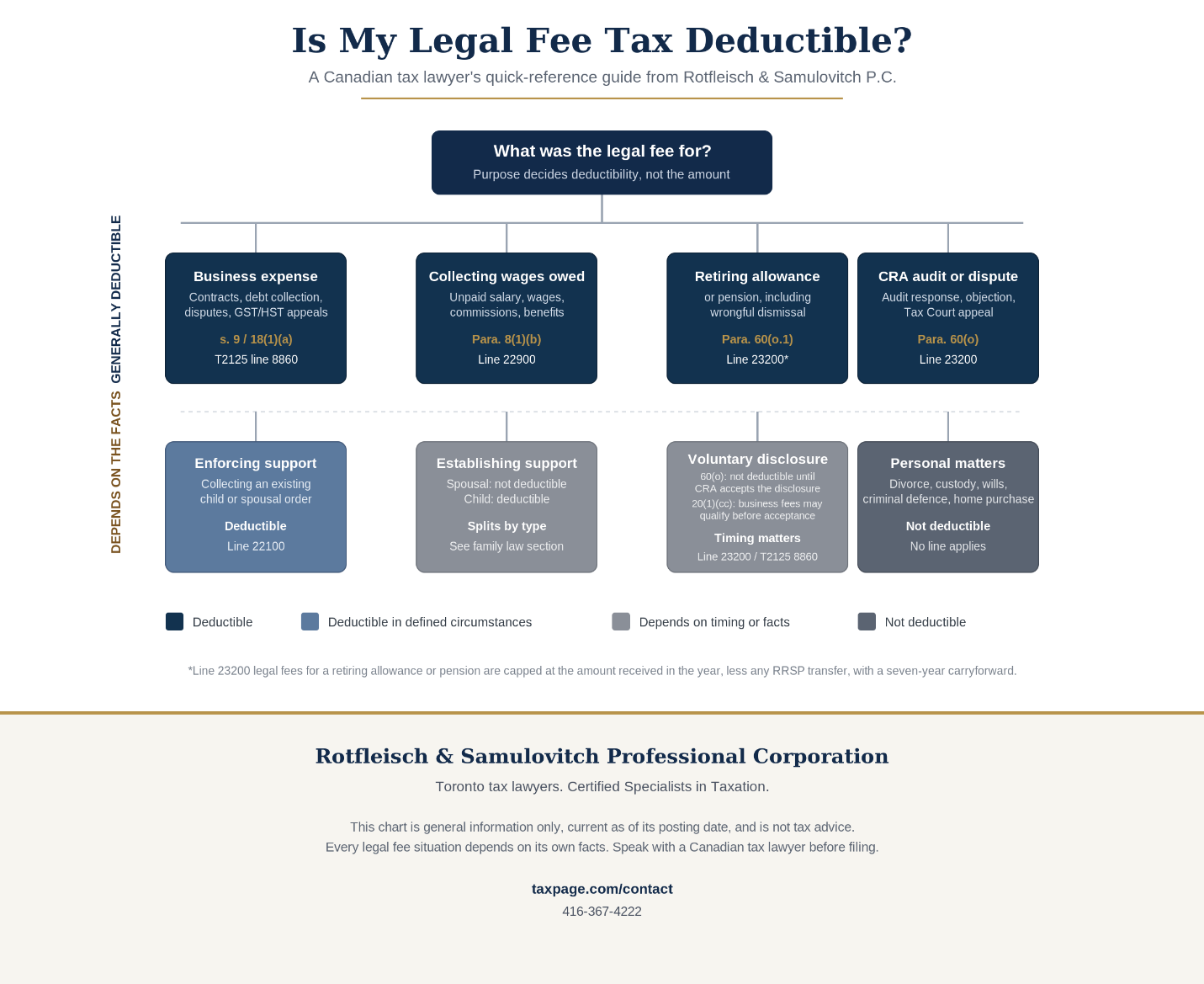
Figure 1. Quick-reference decision chart: Is a given legal fee deductible?
Background: How the Income Tax Act Treats Legal and Accounting Fees
The Canada Revenue Agency’s own administrative guidance on this topic, Interpretation Bulletin IT-99R5, Legal and Accounting Fees, sets out the CRA’s long-standing position. Paragraph 1 of that bulletin states the general rule plainly: except where a specific provision of the Act deals with legal or accounting fees, such fees are deductible only to the extent that they are incurred for the purpose of gaining or producing income from a business or property, and are not outlays of a capital nature. This general test flows from paragraph 18(1)(a) of the Act.
The table below summarizes how the main provisions discussed in this article differ.
| Provision | Who can use it | What it covers | Deduction limit | T1/T2125 line |
|---|---|---|---|---|
| Section 9 and paragraph 18(1)(a) | Businesses and self-employed individuals | Legal fees incurred in the ordinary course of earning business income | No fixed cap, but excludes capital outlays | Line 8860 of Form T2125 |
| Paragraph 8(1)(b) | Employees | Fees to collect or establish a right to salary or wages owed by an employer | Limited to the amount owed; available even if the claim fails | Line 22900 |
| Paragraph 60(o.1) | Any taxpayer | Fees to collect or establish a right to a pension benefit or retiring allowance, including wrongful dismissal damages | Capped at the retiring allowance or pension amount received, less RRSP transfers; seven-year carryforward | Line 23200 |
| Paragraph 60(o) | Any taxpayer, regardless of income source | Fees to object to or appeal a tax, CPP, or certain EI assessment, including audit-stage representations | No dollar cap, but cannot create a non-capital loss | Line 23200 |
| Paragraph 20(1)(cc) | Businesses | Certain capital-nature fees for representations to a government or regulatory body relating to the business | Deductible in full, or elected over ten years under subsection 20(9) | Line 8860 of Form T2125 |
| Support payment fees (see Family law below) | Support recipients | Fees to enforce or collect an existing support obligation | No fixed cap | Line 22100 |
That general test works well for businesses. A corporation or self-employed individual can generally deduct legal fees incurred in the ordinary course of earning business income, including fees for drafting sales contracts, collecting trade debts, preparing corporate minute books, conducting routine tax appeals such as GST/HST objections, and defending civil claims that arise from day-to-day operations.
A self-employed individual claims these on line 8860, Professional fees, of Form T2125, while a corporation deducts them directly against income on the T2 return. The Tax Court has also confirmed that a taxpayer does not need to be the person actually assessed in order to deduct fees under paragraph 60(o), and that legal fees tied closely enough to a taxpayer’s professional standing can qualify as an ordinary business expense as well.
In Flood v. The Queen, 2006 TCC 186, a Brockville estates and trusts lawyer, acting as executor and beneficiary of his mother’s estate, paid legal fees to file a notice of objection after the CRA revalued the estate’s real property upward and, over the same valuation dispute, opened a tax evasion investigation into him personally.
Even though the assessment being objected to belonged to the estate rather than to him, the Tax Court held he could deduct the objection fees under paragraph 60(o), since that provision does not require the fees to relate to the taxpayer’s own assessment, and also as an ordinary business expense, because what was under attack was not only a valuation practice he had followed for years but his standing and integrity as a member of the bar, on which his ability to keep earning income from his law practice depended.
The court noted in passing, though it was not the question under appeal, that his separately incurred criminal defence fees had also been allowed.
Employment income and other sources outside business or property do not get the benefit of this general test. Employment expenses are disallowed by the Act unless a specific provision allows them, and legal fees are no exception. This is why the Act contains a series of narrow, carefully worded exceptions that apply regardless of the taxpayer’s source of income, layered on top of the general business deduction.
Key Issues: The Specific Deductions That Actually Apply
Legal fees to collect employment income: paragraph 8(1)(b)
An employee can deduct legal fees paid in the year to collect, or to establish a right to, an amount owed by an employer or former employer under paragraph 8(1)(b) of the Act that would be taxed as employment income, such as unpaid salary, wages, commissions, or taxable benefits. The deduction is available even if the employee’s claim turns out to be unsuccessful, as long as the amount is genuinely alleged to be owed. It does not extend to legal fees spent protecting a job, negotiating a new employment contract, or pursuing a promotion.
These fees are claimed on line 22900, Other employment expenses, of the T1 return. Our Toronto tax lawyer guidance on employee legal expenses deduction goes through this provision, and the related rules for retiring allowances, in more detail.
Legal fees for pensions, retiring allowances, and wrongful dismissal: paragraph 60(o.1)
Paragraph 60(o.1) allows a taxpayer to deduct legal fees paid to collect or establish a right to a pension benefit or a retiring allowance, a defined term broad enough to capture damages or a settlement for wrongful dismissal. The deduction is capped at the amount of the retiring allowance or pension benefit actually received and included in income, minus any portion transferred to an RRSP or registered pension plan, and unused amounts can be carried forward for up to seven years. A taxpayer who loses their wrongful dismissal claim outright generally cannot deduct the associated legal fees under this provision, because no qualifying amount was ever received. These fees are claimed on line 23200, Other deductions, of the T1 return.
Legal fees to dispute a tax assessment: paragraph 60(o)
Paragraph 60(o) is arguably the most important provision in this area for the firm’s own clients. It allows any taxpayer, regardless of whether their income comes from employment, business, property, or capital gains, to deduct fees paid for advice or assistance in preparing, instituting, or prosecuting an objection or appeal in respect of a tax, interest, or penalty assessment under the Income Tax Act or a similar provincial law, a Canada Pension Plan assessment, or certain Employment Insurance decisions.
The CRA has confirmed that this deduction also covers fees incurred at the tax audit stage, once the taxpayer has been informed that their return is under review, even if no formal objection or appeal is ever filed. Because paragraph 60(o) is a subdivision e deduction applied against total net income from all sources rather than against a specific source, it is available to a salaried employee just as much as it is to a business owner. Our article on legal fees deduction to fight tax reassessments walks through the statutory mechanics of this deduction in more detail.
These fees are also claimed on line 23200, Other deductions, alongside retiring allowance and pension legal fees. Note that because GST/HST is assessed under the separate Excise Tax Act, paragraph 60(o) does not apply to fees for contesting a GST/HST reassessment, although those fees may still be deductible as an ordinary business expense.
There is a further trap worth flagging for taxpayers whose legal fees exceed their income in a given year. The CRA confirmed in a March 2020 technical interpretation, 2019-0824081E5, that legal fees deductible under paragraph 60(o) cannot create or increase a non-capital loss, and therefore cannot be carried forward to a future taxation year under subsection 111(8), because paragraph 60(o) deductions are applied against total net income under paragraph 3(c) rather than against a specific source of income under paragraph 3(a).
In practical terms, a taxpayer whose paragraph 60(o) legal fees exceed their income for the year permanently loses the excess rather than banking it for a future refund, which makes the timing of when fees are paid, and when they are billed, a real planning consideration rather than a formality.
Legal fees related to government representations: paragraph 20(1)(cc)
Paragraph 20(1)(cc) allows a deduction, generally of a capital nature, for expenses incurred in making representations to a government, a public body, or a regulatory agency in connection with a business the taxpayer carries on, including representations made to obtain a licence, permit, or similar authorization. This provision does not cover litigation expenses, since a court is not a government or public body for these purposes, but it becomes important for business owners dealing with certain filings that fall short of a formal tax objection, discussed further below in connection with voluntary disclosures.
Legal fees in family law disputes
The rules here are unusually granular, and they trip up taxpayers and their advisors constantly. Legal fees to obtain a divorce, a separation agreement, or an initial spousal support order are not deductible, because the CRA and the courts treat them as personal or capital in nature. Child support is different: because children have a pre-existing right to support arising from legislation, legal fees to obtain a child support order are deductible.
Once any support obligation, spousal or child, already exists under a written agreement, court order, or legislation, legal fees to enforce that pre-existing right, or to defend against an attempt to reduce it, are deductible for the recipient.
Legal fees to increase support, or to seek a reduction in support owed, remain non-deductible in either direction. The deduction runs only one way: fees paid by the person who owes support to defend against an attempt to enforce or collect that same obligation, or to resist paying it at all, are not deductible, since only the recipient has an existing right to income that the fees can be said to enforce or protect; from the payer’s side, resisting collection is a personal expense regardless of how the invoice is worded.
Where deductible, these fees are claimed on line 22100, Carrying charges, interest expenses and other expenses, not on the employment expenses line, since the CRA specifically directs support-related legal fees there regardless of the recipient’s other income sources.
Our articles on the deduction of legal fees in family litigation and on the taxation and deduction of legal fees related to support payments set out the case law the Tax Court and Federal Court of Appeal have developed to distinguish enforcement of an existing right from creation of a new one, which is the dividing line the CRA actually applies.
Legal fees on the purchase or sale of capital property
Legal and accounting fees incurred to acquire capital property are added to the cost of that property rather than deducted currently, and fees incurred to dispose of property are added to the adjusted cost base in calculating the resulting capital gain or loss. Legal and accounting costs incurred defending against a hostile takeover bid are not deductible at all, because the courts have found they relate to the ownership structure of the corporation’s shares rather than to earning income from a business.
Legal fees and voluntary disclosures
This is an area where the CRA’s administrative position is easy to get wrong, and it matters increasingly given how often unreported offshore income and cryptocurrency holdings end up being corrected through the Voluntary Disclosures Program. The CRA addressed the question directly in a 2016 technical interpretation, 2016-0625731C6, released at the January 2016 CPA Canada personal income tax roundtable. Its position, in the CRA’s own words, is as follows:
“L’ARC considère que les frais pour effectuer une divulgation volontaire ne sont pas déductibles en vertu de l’alinéa 60o) de la L.I.R. et ne seraient généralement pas engagés ou effectués par le contribuable en vue de tirer un revenu d’une entreprise ou d’un bien. Toutefois, lorsqu’un contribuable gagne un revenu provenant d’une entreprise, les frais pour effectuer une divulgation volontaire qui se rapporte à cette entreprise pourraient être déductibles, à titre de frais de démarche auprès d’un gouvernement, en vertu de l’alinéa 20(1)cc).
Par ailleurs, dès que l’ARC a informé le contribuable qu’elle accepte la divulgation volontaire et qu’elle procédera à la révision du revenu ou de l’impôt à payer de ce dernier en vertu du PDV, nous accorderons généralement une déduction, en vertu de l’alinéa 60o), pour les honoraires professionnels engagés, à partir de ce moment, par le contribuable pour faire valoir ses prétentions à l’égard de cette révision.”
In English, the CRA is saying that fees to prepare and file a voluntary disclosure are not deductible under paragraph 60(o), and generally would not be considered to have been incurred to earn income from a business or property. However, where the taxpayer earns income from a business, fees for making a voluntary disclosure relating to that business may be deductible as a government representation expense under paragraph 20(1)(cc).
Separately, once the CRA has informed the taxpayer that it accepts the voluntary disclosure and will proceed to review the taxpayer’s income or tax payable under the program, the CRA will generally allow a deduction under paragraph 60(o) for the professional fees incurred from that point forward to advance the taxpayer’s position in that review.
In practical terms, that means the fee to prepare and submit the voluntary disclosure itself is typically not deductible for a taxpayer with only employment, property, or capital gains income, though it may be deductible as a paragraph 20(1)(cc) representation expense for a taxpayer disclosing business income. Once the CRA accepts the disclosure and begins reviewing the numbers, and particularly if a dispute develops over the resulting reassessment, the professional fees incurred to defend the taxpayer’s filing position from that point on become deductible under paragraph 60(o).
This is exactly the reasoning our own affiliated site sets out in more detail in Deduction of Professional Fees to Defend Voluntary Disclosure, and it is a point our Canadian tax lawyers raise with clients before a voluntary disclosure is filed, since fee invoices should be structured with this timing distinction in mind. The same framework applies where the disclosed income involves cryptocurrency; see Legal Fees are Deductible if You Hire a Lawyer for a Crypto Tax Audit for how it plays out once a crypto-tax audit or objection is underway.
“We think the CRA draws this line in the wrong place,” says David Rotfleisch. “A voluntary disclosure is itself an attempt to head off a reassessment with penalties and interest, so there is a real argument that the professional fees to prepare it should be treated no differently than fees to fight a reassessment after the fact. Until that position changes, though, clients need to plan around the CRA’s timing rule rather than around the rule we think should apply, which means separating the disclosure invoice from any later defence work.”
Legal fees and tax evasion prosecutions
Legal and accounting fees incurred defending a section 239 tax evasion prosecution are generally not deductible, since in most cases they are not laid out to earn income and are not covered by paragraph 60(o), because a criminal information is not an assessment within the meaning of that provision.
In Flood v. The Queen above, the Tax Court noted, in passing rather than as part of what it actually decided, that the taxpayer’s separate criminal defence fees had also been allowed because the prosecution threatened his ability to keep practising law. That is a narrow, fact-specific exception rather than a general rule, and taxpayers should not assume a criminal tax defence bill will be deductible without specific advice.
Implications for Canadian Taxpayers
The practical effect of this patchwork is that the same taxpayer can have some legal fees that are fully deductible and others, billed by the same lawyer in the same year, that are not deductible at all. A taxpayer going through a divorce who is also disputing a CRA reassessment might have their divorce lawyer’s fees denied entirely while their tax lawyer’s fees are fully deductible under paragraph 60(o).
A business owner who receives a proposal letter from a CRA auditor can generally deduct the legal fees for responding to that letter even before a formal objection is filed, while an employee negotiating a severance package needs the settlement agreement to clearly allocate amounts between employment income, a retiring allowance, and general damages, because only some of those categories support a deduction.
“Clients are often surprised that the deductibility of a legal bill has nothing to do with how much it costs and everything to do with why it was incurred,” says David Rotfleisch. “The same invoice can be fully deductible or entirely denied depending on whether the underlying claim enforced an existing right or created a new one, and that distinction needs to be addressed before the engagement letter is signed, not after the return is filed.”
Because the deduction rules turn so heavily on characterization, invoices and settlement documents matter as much as the underlying law. A lawyer’s statement of account that clearly identifies the portion of work relating to a paragraph 60(o) objection, a paragraph 60(o.1) retiring allowance claim, or a paragraph 8(1)(b) wage collection claim gives the taxpayer’s accountant something concrete to rely on if the CRA later asks questions.
A settlement agreement that lumps a severance payment into one undifferentiated number, without allocating it between retiring allowance and other damages, can make it far harder to support a deduction after the fact.
Takeaway: Getting the Deduction Right the First Time
The deductibility of legal fees in Canada is not a single rule; it is a set of overlapping tests that depend on the source of income involved, the nature of the underlying dispute, and, in many cases, the outcome of that dispute.
Business expenses generally follow the broad test in paragraph 18(1)(a) and section 9. Employees rely on the narrow exceptions in paragraph 8(1)(b) for wage claims and paragraph 60(o.1) for pensions and retiring allowances. Every taxpayer, regardless of income source, can rely on paragraph 60(o) for the fees of contesting a tax assessment.
Family law fees turn on whether the legal work enforced a pre-existing right or created a new one. Voluntary disclosure fees are typically not deductible until the CRA accepts the disclosure and begins its review, at which point professional fees to defend the taxpayer’s position become deductible under paragraph 60(o). Getting the characterization right before the invoices are issued, not after the tax return is filed, is what actually protects the deduction.
Top Tax Tips
Taxpayers who anticipate a legal dispute involving any tax consequence should ask their lawyer, at the outset, to bill in a way that separates work relating to a tax objection, appeal, or audit response from work relating to other issues, since only the former is protected by paragraph 60(o) regardless of the taxpayer’s source of income.
Employees negotiating a severance or wrongful dismissal settlement should insist that the settlement agreement allocate the payment between categories such as retiring allowance, general damages, and reimbursement of legal fees, since an undifferentiated lump sum makes it much harder to support a deduction later and may cost the employee twice over if the claim is unsuccessful.
Separated or divorced taxpayers should understand that legal fees to establish spousal support or obtain a divorce are not deductible no matter how the invoice is worded, while fees to enforce an existing support order, or to defend against a reduction in support already owed, generally are. Business owners considering a voluntary disclosure should discuss the timing of professional fees with their Canadian tax lawyer before the disclosure is filed, since fees incurred before CRA acceptance are treated differently than fees incurred afterward to defend the resulting review, and fees relating to a business may be separately deductible under paragraph 20(1)(cc) even before that point.
Anyone who receives a CRA proposal letter, audit query, or notice of reassessment should keep in mind that legal and accounting fees incurred from that point forward are generally deductible under paragraph 60(o), which meaningfully reduces the real cost of retaining experienced representation early rather than waiting until a formal objection becomes necessary.
Frequently Asked Questions
Are legal fees tax deductible in Canada?
Sometimes. There is no blanket rule. Legal fees are deductible only where a specific provision of the Income Tax Act allows it, most commonly where the fees were incurred to earn business income, to collect employment income owed by an employer, to establish a right to a pension or retiring allowance, or to dispute a tax assessment. Legal fees for personal matters such as divorce, custody, wills, or real estate purchases are generally not deductible.
Can I deduct legal fees paid to fight a CRA reassessment?
Yes. Paragraph 60(o) of the Income Tax Act allows any taxpayer to deduct fees paid for advice or assistance in preparing, instituting, or prosecuting an objection or appeal of a tax, interest, or penalty assessment. This deduction is available even to taxpayers whose only source of income is employment or capital gains, because it is applied against total net income rather than against a specific source.
Are legal fees deductible if the CRA reviews my return before I file a formal objection?
Yes. The CRA’s own Interpretation Bulletin IT-99R5 confirms that legal and accounting fees incurred for advice and assistance after the taxpayer has been informed that their return is under review are deductible under paragraph 60(o), whether or not a formal notice of objection or appeal is ultimately filed.
Can employees deduct legal fees to collect unpaid wages or severance?
Employees can deduct legal fees paid to collect or establish a right to salary or wages already owed by an employer or former employer under paragraph 8(1)(b). This deduction is available even if the claim is ultimately unsuccessful, but it does not cover fees spent protecting a job or negotiating future employment terms.
Are legal fees for a wrongful dismissal claim deductible?
Legal fees to collect or establish a right to a retiring allowance, a category that includes damages for wrongful dismissal, are deductible under paragraph 60(o.1), but only up to the amount of the retiring allowance actually received and included in income, less any amount transferred to an RRSP. Unused amounts can be carried forward for up to seven years.
Are divorce and separation legal fees tax deductible?
No. Legal fees incurred to obtain a divorce, a separation agreement, or an initial order for spousal support are considered personal expenses and are not deductible, regardless of how the invoice is worded.
Are legal fees to collect child or spousal support deductible?
Legal fees to obtain an order for child support are deductible, because children have a pre-existing legislative right to support. Legal fees to enforce an existing spousal or child support obligation, or to defend against an attempt to reduce support already owed, are also deductible. Legal fees to establish a new spousal support obligation, or to increase support, are not. These deductions run only to the recipient: a payer’s legal fees to resist paying support, whether by contesting the original claim, defending against enforcement or collection, or seeking a reduction, are personal expenses and are not deductible.
Can a business deduct legal fees for contract disputes or collecting trade debts?
Yes. Legal fees incurred in the ordinary course of earning business income, including drafting contracts, collecting trade debts, and defending routine civil claims, are generally deductible under section 9 and paragraph 18(1)(a), provided they are not capital in nature.
Are legal fees for filing a CRA voluntary disclosure deductible?
Generally not at the outset. The CRA has confirmed that fees to prepare and file a voluntary disclosure are not deductible under paragraph 60(o), and would not normally be considered incurred to earn income from a business or property. However, once the CRA accepts the disclosure and begins reviewing the taxpayer’s income or tax payable, professional fees incurred from that point to defend the taxpayer’s filing position are generally deductible under paragraph 60(o). Where the disclosure relates to business income, fees for the disclosure itself may separately qualify under paragraph 20(1)(cc) as a government representation expense.
Are accounting fees treated the same way as legal fees for tax purposes?
In most of these provisions, yes. Paragraph 60(o), for example, applies to fees or expenses incurred for advice or assistance in a tax dispute, which includes accounting fees as well as legal fees, and the CRA has confirmed that the person providing the service does not need to be a lawyer for the fee to qualify, provided the work performed matches what the provision covers.
Can I deduct legal fees to fight a GST/HST reassessment the same way as an income tax reassessment?
Not under paragraph 60(o), because GST/HST is assessed under the Excise Tax Act rather than the Income Tax Act, and paragraph 60(o) is limited to assessments under the Income Tax Act or similar provincial legislation. The fees may still be deductible as an ordinary business expense if they relate to a business, and any GST/HST paid on the legal fees themselves may be recoverable as an input tax credit.
Are legal fees to defend against a criminal tax evasion charge deductible?
Generally not, because such fees are usually not considered to be laid out to earn income and are not covered by paragraph 60(o), since a criminal charge is not an assessment. In narrow circumstances where the defence relates directly to the taxpayer’s ordinary income-earning practices, such as a professional’s standard method of valuing property, the Tax Court has allowed the deduction as an ordinary business expense.
Do I need to repay a legal fee deduction if I later receive an award of costs or a reimbursement?
Yes. Any costs awarded to a taxpayer, or reimbursement received, in respect of legal expenses previously deducted under paragraph 60(o) or paragraph 60(o.1) must be included in income in the year received. Where legal expenses were deducted as an ordinary business expense, a later recovery similarly reduces the amount originally allowed.
What line do I claim deductible legal fees on in my Canadian tax return?
It depends on which provision applies. Legal fees to collect employment income under paragraph 8(1)(b) go on line 22900, Other employment expenses. Legal fees for a tax dispute under paragraph 60(o), or for a retiring allowance or pension benefit under paragraph 60(o.1), both go on line 23200, Other deductions. Legal fees relating to support payments go on line 22100, Carrying charges, interest expenses and other expenses, even if the recipient has no other investment carrying charges to claim there. Self-employed individuals claim business-related legal fees on line 8860, Professional fees, of Form T2125, and corporations deduct them directly on the T2 return.
DISCLAIMER: This article provides broad information. It is only accurate as of the posting date. It has not been updated and may be out-of-date. It does not give legal advice and should not be relied on as tax advice. Every tax scenario is unique to its circumstances and will differ from the instances described in the article. If you have specific legal questions, you should seek the advice of a Canadian tax lawyer.
About the Author