


Published: October 19, 2026
What are Tax Residence Rules for Individuals? A Canadian Tax Lawyer 2026 Guide to CRA Test for Snowbirds, International Executives, and High-Net-Worth Canadians
Planning a move abroad, wintering in the U.S., or answering a CRA letter about your status? Everything turns on one question: are you a Canadian resident for tax purposes? Canada taxes on residence, whereas the U.S. taxes on citizenship. Canada’s residence rules determine whether a person must report worldwide income or only Canadian-source income. This guide summarizes the CRA’s approach in Income Tax Folio S5-F1-C1, Determining an Individual’s Residence Status, the leading case law behind it, and the practical consequences of a residence change. This guide deals only with individuals; a corporation’s residence is decided under a different test, based on where it was incorporated or where its central management and control is exercised.
Overview: What Canadian Tax Residence Means
A person resident in Canada is generally taxable on worldwide income from all sources; a non-resident is generally taxable only on Canadian-source income. A person may also be resident for only part of a year, in which case worldwide income is generally relevant only during the Canadian-resident period.
The term “resident” is not exhaustively defined in the Income Tax Act. Subsection 250(3) provides that a reference to a person resident in Canada includes a person ordinarily resident in Canada. The analysis therefore considers a person’s settled and regular pattern of life, not merely citizenship, immigration status, or the number of days spent in Canada.
“Canadian residence is best understood as a whole-facts test. The question is where a person has settled or centralized his or her ordinary life, including home, family, financial affairs, and social connections,” explains David J. Rotfleisch, founding tax lawyer and CPA at Rotfleisch & Samulovitch, and a Law Society of Ontario Certified Specialist in Taxation.
Background: Where the Residence Test Comes From (Thomson v. MNR)
The “ordinarily resident” standard used by the CRA today traces back to the Supreme Court of Canada’s 1946 decision in Thomson v. Minister of National Revenue, 1946 CanLII 1 (SCC), [1946] SCR 209. The Court held that residence is a matter of degree, the extent to which a person settles into, maintains, or centralizes his or her ordinary mode of living, including social relations, interests, and conveniences, in a given place, and that no single element (time, intention, or physical presence alone) is decisive on its own.
The Court also established that intention matters but is not determinative, and that a person can, in principle, be resident in more than one country at once, which is precisely why treaty tie-breaker rules exist. On the facts, the Court held Mr. Thomson resident in Canada even though he claimed to have left for Bermuda and the United States, because he built and regularly returned to a home in New Brunswick.
The courts have also weighed the same ties differently depending on the direction of travel. For an analysis of why a home, spouse, or dependants in Canada have proved less decisive for immigrants than for emigrants, see our article on whether significant residential ties are less significant for immigrants to Canada.
Resident vs. Non-Resident: What Gets Taxed
| Factual / deemed resident | Non-resident | |
| Worldwide income | Taxable | Not taxable |
| Canadian-source income | Taxable | Taxable |
| Canadian real property gains | Taxable | Taxable (with section 116 withholding and clearance certificate rules) |
| Canadian dividends and interest paid after departure | N/A | Subject to Part XIII withholding (often 25%, reduced by treaty) |
| Canadian pensions paid after departure | N/A | 25% Part XIII withholding (often reduced by treaty); a section 217 election, made on a Canadian return, may lower the tax |
| Canadian rent after departure | N/A | 25% Part XIII withholding on gross rent, or elect under section 216 (Form NR6 undertaking, then a section 216 return on Form T1159) to be taxed on net rental income |
| Provincial tax | Generally payable to province of residence | Provincial tax applies only to Canadian employment or business income earned in a province; other taxable Canadian income attracts a federal surtax instead |
| Benefits (CCB, GST/HST credit, OAS) | Generally accessible | CCB and GST/HST credit generally lost; OAS can continue abroad for a pensioner with 20 or more years of Canadian residence after age 18, subject to non-resident tax |
| RRSP/TFSA contribution room and access | Full access | Restricted; TFSA holders face a 1% monthly tax on contributions made while non-resident |
Key Issues and Findings: Residential Ties and the Three Tiers
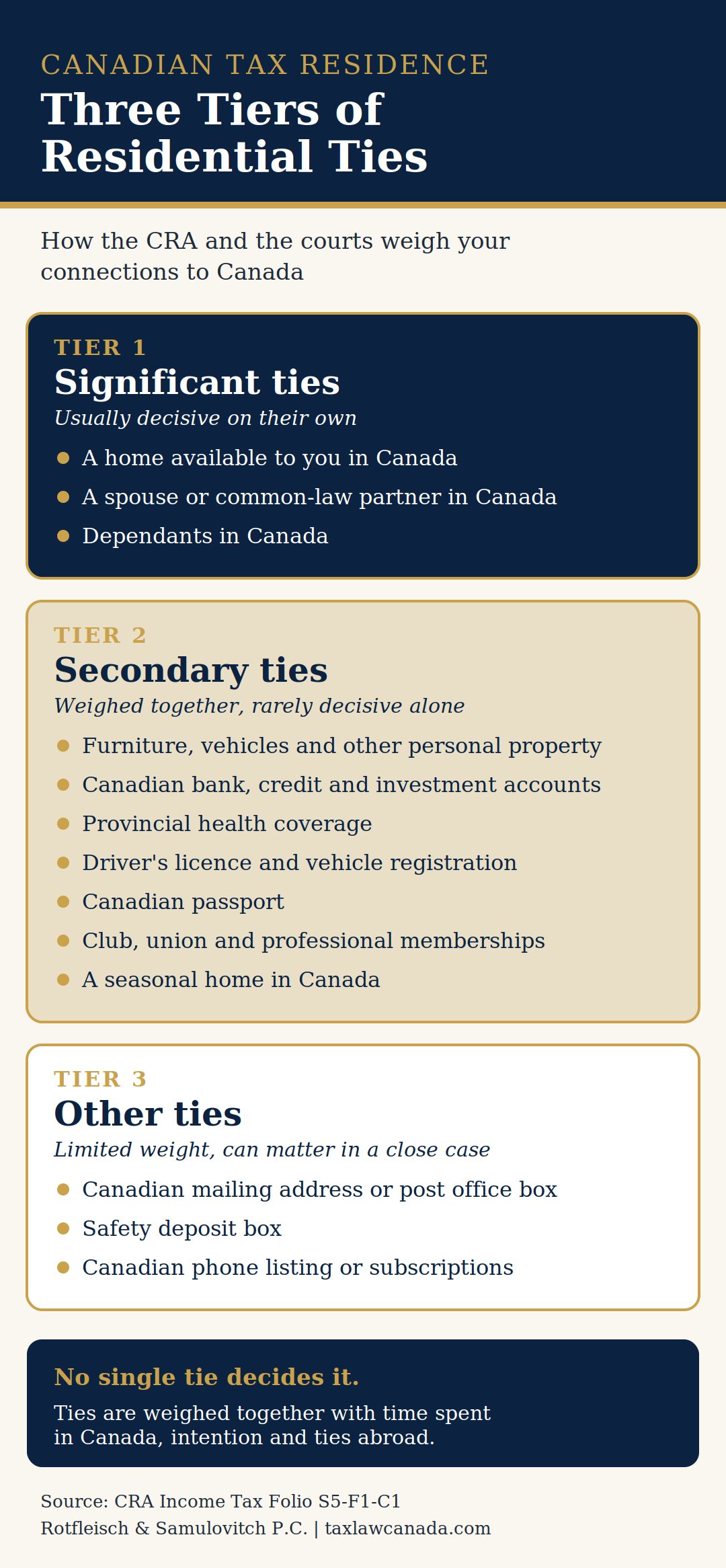
The CRA and the courts generally group residential ties into three tiers rather than a single flat list, and the ties are considered collectively rather than in isolation:
Significant ties (the ties that carry the most weight):
- a dwelling place available for use in Canada;
- a spouse or common-law partner in Canada; and
- dependants in Canada.
Secondary ties (rarely decisive alone, but they add up):
- personal property in Canada, such as furniture, clothing, and vehicles;
- a seasonal dwelling place in Canada;
- Canadian employment or business involvement;
- bank accounts, credit cards, and investment accounts;
- provincial health coverage;
- a driver’s licence and vehicle registration;
- a Canadian passport; and
- memberships and social or religious affiliations.
Other ties (minor on their own, but relevant in a close case): mailing address, Canadian telephone number, a Canadian post office box or safety deposit box, and subscriptions or memberships that continue after departure.
There is no fixed number of days that automatically makes a person a non-resident. A lengthy absence may still be temporary if significant Canadian ties remain. Intention, regularity of visits back to Canada, the person’s residence abroad, and concrete steps taken to sever ties are all relevant. A Canadian home leased to an arm’s-length tenant may carry less weight, but the outcome stays fact-dependent.
For individuals entering Canada, the CRA considers that obtaining permanent resident (landed immigrant) status and provincial health coverage will usually constitute significant residential ties, although the Tax Court has not always agreed where the newcomer’s working life remained abroad.
How the Courts Have Weighed the Ties
The case law shows how finely balanced these ties can be for people leaving Canada. In Hauser v. The Queen, 2005 TCC 492, aff’d 2006 FCA 216, an Air Canada pilot who sold his Canadian home and moved his family to the Bahamas was held to have remained a Canadian resident. He still spent about a third of each year in Canada for work, used his mother-in-law’s Canadian address for mail, and kept clothing and a spare uniform at her home. In Laurin v. The Queen, 2006 TCC 634, aff’d 2008 FCA 58, another Air Canada pilot on similar facts was held to have become a non-resident. He had sold his interest in his Canadian home, exchanged his driver’s licence, closed all but his payroll bank account, rented a home in the Turks and Caicos Islands, and stayed with friends only as a guest when working in Canada.
Students abroad are judged the same way. In Perlman v. The Queen, 2010 TCC 658, a 22-year-old left Toronto to pursue rabbinical studies in Israel and stayed for 16 years, yet was held to have remained a Canadian resident. His parents kept a furnished, self-contained basement apartment for his exclusive use, and he left his personal library of Talmudic, Biblical, Jewish philosophy and Jewish law texts there. He also kept Canadian bank accounts, credit cards, a safety deposit box, provincial health coverage and close ties to his Toronto synagogue, voted in Canadian elections, filed Canadian returns as a resident, and always intended to return to a job waiting in Canada. The Tax Court found no precedent in which the length of an absence alone ends the residence of a Canadian who keeps a home to come back to. The CRA bore the burden of proof in that appeal and did not discharge it. Our analysis of the two airline pilot cases explains how small details separated the results.
For people coming to Canada, even significant ties have proved less decisive. In Shih v. The Queen, 2000 DTC 2072 (TCC), a taxpayer whose wife and three sons lived in the home he had bought in Canada was held not to be resident, because he kept working in Taiwan and spent no more than about three months a year in Canada. In Yoon v. The Queen, 2005 TCC 366, a Canadian citizen who returned to Korea to work in 2001 was held resident in Korea rather than Canada for that year, even though her husband stayed in Canada, with the Tax Court relying in part on the Canada–Korea treaty tie-breaker. In Song v. The Queen, 2009 FCA 278, the Federal Court of Appeal upheld a finding that a taxpayer claiming the Canada Child Tax Benefit was not resident in Canada although her husband lived here. The practical lesson is that an emigrant is judged by what he or she leaves behind, while a newcomer is judged by whether his or her settled daily routine has actually moved to Canada.
Deemed Residence and the 183-Day Rule
Subsection 250(1) creates deemed-residence rules that apply after the factual residence test has been considered. Most notably, a person who sojourns in Canada for 183 days or more during a calendar year may be deemed resident throughout that year. Any part of a day may count, but a daily commuter who returns each night to a normal foreign residence may not be “sojourning” in Canada in the legal sense.
Other deemed-residence categories include members of the Canadian Forces, certain government employees, qualifying international-development workers, specified overseas school staff, certain dependent children, and people receiving broad treaty-based exemptions because of a Canadian-resident family connection. Importantly, deemed residence under the sojourner rule only comes into play if the person isn’t already a factual resident; the factual test is always considered first.
Our analysis of part-year residence explains how the sojourner rule interacts with section 114 and subsection 250(5) in the year a person arrives in or leaves Canada.
“Leaving Canada is more persuasive to the CRA when conduct matches intention. That means disposing of or leasing the home, moving the family, establishing a foreign residence, and dealing with departure tax before the fact, not after a CRA tax audit begins,” notes David J. Rotfleisch.
Treaty Tie-Breakers
A person can be resident under Canadian domestic law and resident in another country at the same time. Subsection 250(5) provides that a person is deemed not resident in Canada when a tax treaty treats him or her as resident in the other country and not resident in Canada.
Treaty analysis commonly starts with the permanent-home test. If permanent homes exist in both countries, the centre-of-vital-interests test examines which country has the closer personal and economic relationships. If that test is also inconclusive, most treaties look next to habitual abode, then citizenship or nationality, and finally mutual agreement between the two countries’ competent authorities. The person claiming residence abroad must generally establish comprehensive tax liability there in the treaty sense, although actual tax paid is not always required (Crown Forest Industries Ltd. v. Canada, [1995] 2 SCR 802).
Our guide to tax treaty residence determination walks through each tie-breaker step in order, including where the Canada–U.S. treaty departs from the OECD model.
Snowbirds and the Canada–U.S. Angle
This tie-breaker question comes up constantly for snowbirds who spend part of the year in the U.S. The IRS uses a substantial presence formula that counts each day in the U.S. this year in full, one-third of days from the prior year, and one-sixth of days from the year before that. Reaching 183 weighted days, with at least 31 days of U.S. presence in the current year, can trigger U.S. residence exposure even without spending 183 actual days in the current year. A Canadian who meets that threshold can still avoid U.S. residence by claiming a closer connection to Canada or relying on the treaty tie-breaker, though the closer-connection claim requires filing IRS Form 8840 by the due date of the U.S. non-resident return, including extensions (generally June 15 for a snowbird with no U.S. wages), and is unavailable to anyone present in the U.S. for 183 or more actual days in the year or who has applied for a green card. Relying on the treaty tie-breaker instead requires a U.S. non-resident return with Form 8833 treaty disclosure. Anyone splitting significant time between the two countries should track days year-round, not just around tax season. Because the U.S. filings raise questions of U.S. law, snowbirds should also coordinate with a knowledgeable US tax attorney.
Becoming a Non-Resident: What Actually Happens
A person becoming non-resident may face two separate consequences on top of the ordinary loss of Canadian tax residence:
- Departure tax (deemed disposition). On ceasing Canadian residence, most property is deemed under subsection 128.1(4) to be disposed of and immediately reacquired at fair market value, which can trigger Canadian tax on gains accrued while the property was held as a resident. This applies to assets held outside registered accounts as well, including business shares and other capital property, though Canadian real estate is specifically excluded from the deemed-disposition rule, as are registered accounts such as RRSPs and TFSAs. For a Canadian principal residence retained when an individual leaves Canada, the taxpayer may generally elect under paragraph 128.1(4)(d), on Form T2061A, to trigger a deemed disposition at fair market value and claim the principal residence exemption for eligible years at that time. Alternatively, the taxpayer may leave the property outside the departure deemed disposition and claim the exemption, to the extent available, when the property is eventually sold. The better approach depends on the property’s accrued gain, expected future appreciation, Canadian-resident years, rental use, foreign tax consequences, and other facts. Under subsection 220(4.5), an emigrant can also elect on Form T1244 to defer payment of departure tax until the property is actually sold; no security is required on the first $16,500 of federal tax deferred, but adequate security must be posted above that amount. Our article on emigration tax issues covers the reporting forms, and our guide to deferring departure tax explains what the CRA accepts as security.
- Part XIII withholding on future Canadian payments. Once non-resident, dividends, interest, rent, and pension payments from Canadian sources are generally subject to non-resident withholding tax, often reduced under an applicable treaty. A non-resident who rents out a Canadian property can generally elect under section 216 to be taxed on net rental income rather than 25% of gross rent: filing Form NR6 before the year’s first rent payment lets the agent withhold on net rent, and the section 216 return is then filed on Form T1159. A pensioner can similarly elect under section 217 to file a Canadian return where that produces less tax than the flat withholding. See our overview of withholding tax for non-residents.
The likely non-residence date generally corresponds to the latest of: the date of departure, the date a spouse or dependants also leave, and the date residence is established in the new country, subject to exceptions. For example, a person returning to a country where he or she lived before coming to Canada usually becomes a non-resident on the date of departure, even if a spouse stays behind temporarily to sell the home.
A deemed resident under subsection 250(1) is not factually resident in any province for provincial-tax purposes. That person instead pays a federal surtax in lieu of provincial tax and loses access to certain provincial credits and benefits. Form NR73 or NR74 can provide an administrative opinion on residence status (see our note on Form NR73), but that opinion is not binding on the CRA.
A Practical Checklist for Leaving Canada
- Establish a genuine foreign residence before or immediately after departure, such as a lease or purchase, not a hotel stay.
- Move your spouse, common-law partner, and dependants with you, or be prepared to explain why they remain in Canada.
- Close or convert Canadian ties: cancel provincial health coverage, surrender your driver’s licence if appropriate, and close or restructure bank accounts and credit cards tied to a Canadian address.
- Deal with your home: sell it, or lease it on genuine arm’s-length terms rather than leaving it available for your own use.
- Notify Canadian banks, brokers, and other payers of your non-resident status so that the correct Part XIII tax is withheld after departure.
- Repay any Home Buyers’ Plan or Lifelong Learning Plan balance within 60 days of becoming non-resident, or before filing the departure return if earlier, to avoid an income inclusion.
- File a departure return for the year residence ends, reporting worldwide income up to the departure date and disclosing deemed dispositions on Form T1243, plus Form T1161 if the fair market value of your reportable property exceeds $25,000; the return is due April 30 of the following year.
- Track days in Canada after departure to avoid inadvertently sojourning 183+ days in a later year.
- Keep dated evidence of every step above. This is the file that supports your position if the CRA later reviews it.
Forms at a Glance: Leaving or Entering Canada
| Form | What it does | When it applies |
| NR73 (leaving Canada) | Asks the CRA for a non-binding opinion on your residence status | Optional; usually filed around departure |
| NR74 (entering Canada) | The same opinion request for newcomers | Optional; after arrival |
| T1161 | Lists property owned on the date you emigrate | With the departure-year return if reportable property exceeds $25,000 |
| T1243 | Reports deemed dispositions under subsection 128.1(4) | With the departure-year return |
| T1244 | Elects under subsection 220(4.5) to defer departure tax; security needed above $16,500 of federal tax | By the balance-due date for the departure year |
| T2061A | Elects under paragraph 128.1(4)(d) to trigger a deemed disposition of Canadian real or business property | With the departure-year return |
| NR301 | Claims treaty-reduced withholding from Canadian payers | Given to banks and payers after you become a non-resident |
| NR6 | Lets a non-resident landlord have tax withheld on net rent and file a section 216 return | Before the first rent payment of the year |
| T1134 | Reports foreign affiliates (generally a stake of 10% or more in a foreign corporation, alone or with related persons) | Each year while resident in Canada; not required in the year an individual first becomes resident |
| T1135 | Reports specified foreign property costing more than $100,000 | Each year while resident in Canada; not required in the year an individual first becomes resident |
| T1159 | The section 216 return reporting net Canadian rental income | After the rental year, where the section 216 election is made |
| IRS Form 8840 | Claims the U.S. closer connection exception | By the Form 1040-NR due date, including extensions |
| IRS Form 8833 | Discloses a treaty-based U.S. return position | With the U.S. non-resident return |
Practical Implications for Canadian Taxpayers
Residence status also determines access to federal benefits. Programs like the Canada Child Benefit are tied to Canadian tax residence, and non-residents generally lose access to the GST/HST credit. Old Age Security is different: a pensioner with at least 20 years of Canadian residence after age 18 can generally continue receiving it abroad, subject to non-resident tax. Registered accounts are affected too: TFSA contributions made while non-resident are subject to a 1% monthly tax, and RRSP withdrawals by non-residents are generally subject to non-resident withholding tax rather than regular income tax treatment.
Residence cuts both ways. A person who becomes a Canadian resident is deemed under subsection 128.1(1) to have acquired most property at fair market value on arrival, which steps up the tax cost of foreign assets. From that point, worldwide income is reportable and a Form T1135 is generally required where the total cost of specified foreign property exceeds $100,000, and a Form T1134 where the person owns a foreign affiliate. Individuals are exempt from both in the year they first become resident.
Takeaway
Canadian tax residence is a fact-based legal conclusion, not a form you fill out. Home, family, days in Canada, foreign connections, intention, treaty residence, departure tax exposure, and documented compliance steps must all be reviewed together. Since Thomson in 1946, the courts have consistently held that no single factor decides it alone.
Pro Tax Tips: Keep a Residence Evidence File
If leaving or entering Canada, maintain a dated file containing leases, travel records, immigration documents, health-coverage changes, family-move records, asset dispositions, and foreign-residence evidence. Consistent documentation can support the intended residence position and identify departure-tax or withholding obligations ahead of time, rather than after a CRA review.
If it later turns out you were incorrectly classified as a non-resident, or had unreported foreign income during a period the CRA views as Canadian residence, a voluntary disclosure application may still be available to correct the record before the CRA opens a tax audit or otherwise contacts you about the issue. Our experienced Canadian tax lawyers can analyze the residential ties, apply the relevant treaty tie-breaker, review filing requirements, calculate departure tax exposure, and prepare a defensible residence memorandum or an NR73 or NR74 determination request where appropriate.
Frequently Asked Questions
Does Canadian citizenship automatically make a person a Canadian resident for tax purposes?
No. Citizenship alone does not decide residence. The analysis focuses on residential ties, ordinary living patterns, days in Canada, and applicable deeming rules under the Income Tax Act.
Does spending 183 days in Canada always create tax residence?
The 183-day rule applies when a person sojourns in Canada for at least 183 days in a calendar year and isn’t already a factual resident. Daily commuting may not constitute sojourning.
Does keeping a Canadian home make a person resident?
A Canadian dwelling available for personal occupation is normally a significant residential tie. A genuine arm’s-length rental may reduce its importance, depending on the surrounding facts.
What happens if a spouse remains in Canada?
A spouse or common-law partner who remains in Canada will usually be a significant residential tie. A relationship already legally separated because of a breakdown may be treated differently.
Can a person be resident in two countries at once?
Yes. Domestic law may treat a person as resident in both countries simultaneously; this is exactly what the Supreme Court recognized in Thomson v. MNR. A tax treaty may then assign residence to one country through the permanent-home, centre-of-vital-interests tests or other applicable tests.
Does a foreign permanent residence automatically end Canadian residence?
No. Foreign residence is important but does not, by itself, eliminate Canadian residence. Canadian family, housing, economic, and social ties remain relevant.
What is a deemed resident?
A deemed resident is not factually resident but falls within a statutory category, such as a qualifying 183-day sojourner, Canadian Forces member, or specified government employee.
Does departure trigger tax even if nothing is actually sold?
Yes, generally. Most property is deemed disposed of and reacquired at fair market value on the date residence ends, which can create a tax liability on accrued gains without an actual sale; Canadian real estate and registered accounts like RRSPs and TFSAs are notable exceptions.
Is Form NR73 binding on the CRA?
No. An NR73 or NR74 response is an administrative opinion based on submitted facts. A later review may require additional documentation or produce a different result.
When does non-residence usually begin after departure?
The date is factual, but generally aligns with the latest relevant date among departure, the departure of a spouse or dependants, and establishment of residence abroad.
Are Canadian-source payments still taxable after departure?
Generally, yes. Non-residents remain subject to Canadian tax on Canadian-source income, and Part XIII withholding may apply to payments such as dividends, interest, rent, and pensions.
Can a snowbird accidentally become a U.S. tax resident?
Yes, if he or she meets the IRS substantial presence formula and does not file the appropriate closer-connection or treaty paperwork on time.
How do I become a non-resident of Canada for tax purposes?
Sever your significant residential ties (home, spouse or common-law partner, and dependants), reduce secondary ties, establish residence in another country, and report the departure on your final Canadian return. Departure tax and Part XIII withholding must then be addressed.
Do I pay departure tax on my RRSP or TFSA?
No. RRSPs, RRIFs, TFSAs, and similar registered plans are excluded from the deemed disposition. Later RRSP withdrawals are subject to non-resident withholding tax, and TFSA contributions made while non-resident attract a 1% monthly tax.
When do I become a Canadian resident after moving to Canada?
Generally on the date you establish significant residential ties in Canada. The CRA usually treats permanent resident status plus provincial health coverage as significant ties, and most property is deemed acquired at fair market value on arrival.
What happens if the CRA disagrees with my departure date?
The CRA can reassess on the basis that you remained a Canadian resident, taxing your worldwide income for the later years and adding interest and, in some cases, penalties. A well-documented residence file and a timely notice of objection are the main protections.
DISCLAIMER: This article provides broad information. It is only accurate as of the posting date. It has not been updated and may be out-of-date. It does not give legal advice and should not be relied on as tax advice. Every tax scenario is unique to its circumstances and will differ from the instances described in the article. If you have specific legal questions, you should seek the advice of a Canadian tax lawyer.
About the Author