

Published: March 26, 2020
Last Updated: July 6, 2026
Did You Recently See a Video Claiming You Can Legally Stop Paying Income Tax in Canada?
If you came across a TikTok, YouTube video, Telegram post, or online forum thread claiming that a specific document, declaration, or legal trick can exempt you from paying income tax in Canada — you have encountered what Canadian courts call an “organized pseudolegal commercial argument,” or OPCA. These arguments have circulated in various forms for over twenty years under different names and brands. Not one of them has ever succeeded in a Canadian court.
The CRA warned Canadians in March 2026 about a new generation of AI-generated tax scams. The underlying argument — that the Income Tax Act does not apply to you — is not new. What is new is the polished presentation: professionally scripted videos, AI-generated supporting materials, and template documents that look authoritative. The legal result is the same as it has always been.
As David J. Rotfleisch, Toronto tax lawyer and Certified Specialist in Taxation, explains: “Freeman and de-taxer promoters sell a fantasy. The Income Tax Act imposes obligations on everyone who resides or earns income in Canada — full stop. No private document, no ‘notice of understanding,’ no bill of lading trick changes that. Taxpayers who pay these promoters end up with large reassessments, gross negligence penalties, and sometimes criminal convictions. The promoters take the money and disappear.”
“Taxpayers who pay these promoters end up with large reassessments, gross negligence penalties, and sometimes criminal convictions. The promoters take the money and disappear.”
— David J. Rotfleisch, Toronto Tax Lawyer, Certified Specialist in Taxation
Freeman on the land: At a Glance
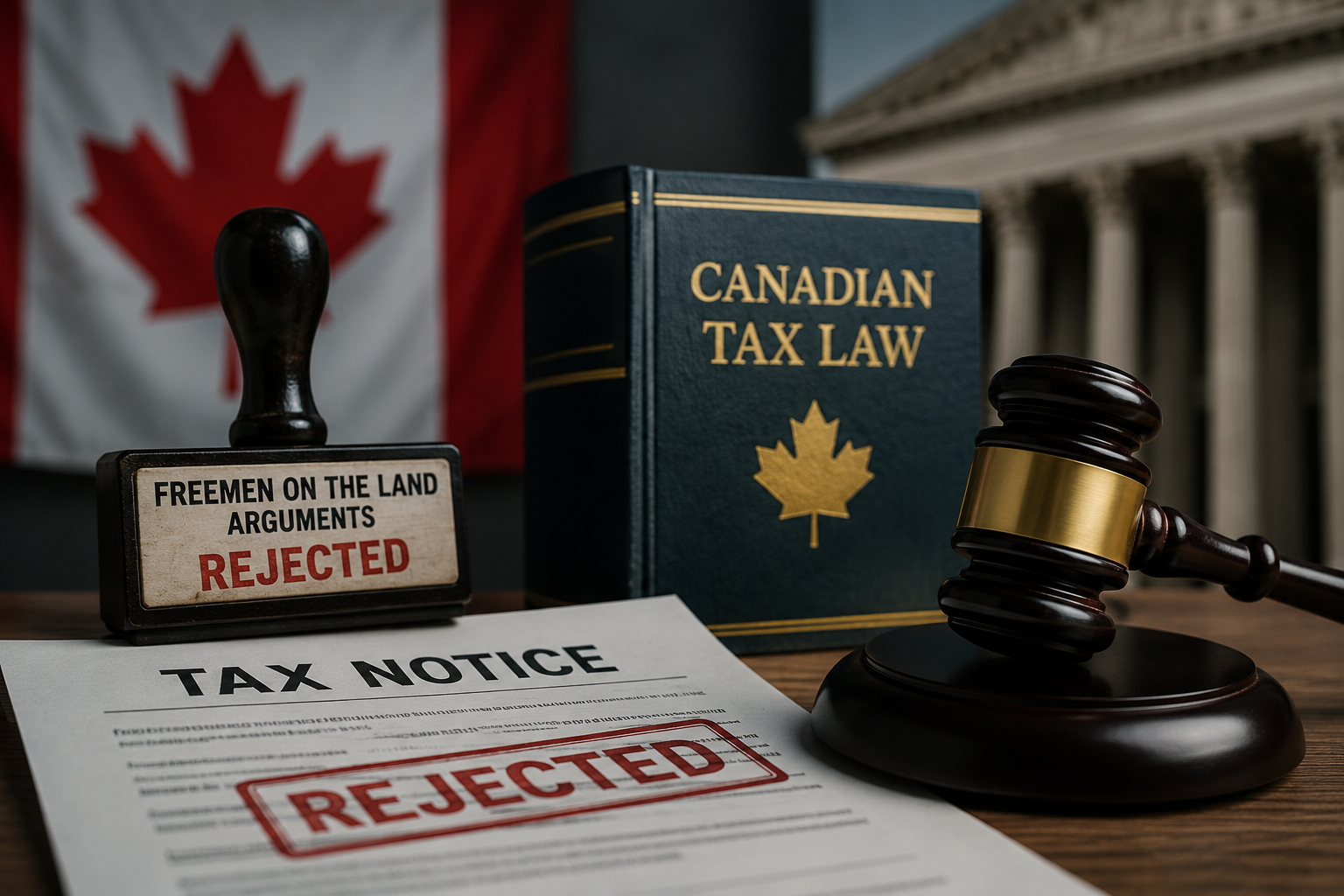
Courts across Canada have uniformly rejected every freeman-on-the-land and de-taxer argument ever advanced against tax obligations — including the newest AI-assisted variants. This article explains what these arguments are, why they inevitably fail, and what legitimate options actually exist for taxpayers with ≈. If you are searching for ways to legally stop paying taxes in Canada, this article explains why de-taxer schemes are not the answer — and what legitimate remedies actually work.
Can You Legally Stop Paying Taxes in Canada?
This is one of the most common questions Canadian taxpayers ask — and it deserves a direct answer.
No Canadian resident can legally stop paying income tax entirely. The Income Tax Act imposes a statutory obligation on every person resident in Canada to pay tax on their worldwide income. That obligation cannot be contracted out of, opted out of, or eliminated by any private document, declaration, or legal manoeuvre. Anyone who tells you otherwise is wrong, or is selling you something.
What is legal — and what every taxpayer is entitled to do — is arrange their affairs to minimize the amount of tax they pay within the law. The Supreme Court of Canada confirmed this right in Stubart Investments Ltd. v. The Queen, [1984] 1 SCR 536. Legitimate tax minimization strategies available to Canadian taxpayers include:
- RRSP contributions: Contributions to a Registered Retirement Savings Plan reduce taxable income in the year of contribution and defer tax until withdrawal, typically at a lower rate in retirement.
- TFSA contributions: Tax-Free Savings Account growth and withdrawals are entirely tax-free. No deduction on contribution, but all investment income earned inside the account is exempt.
- Income splitting: Transferring income to a lower-income spouse or family member through legitimate structures — spousal RRSPs, prescribed rate loans, family trusts — reduces the household’s overall tax burden.
- Incorporation: Business owners can defer personal tax by leaving income inside a corporation taxed at the small business rate, then timing personal withdrawals to minimize total tax.
- Tax credits and deductions: Maximizing all available deductions — business expenses, capital cost allowance, charitable donations, childcare expenses — reduces net income and therefore tax owing.
These strategies are legal, well-established, and routinely used by Canadians at every income level. They are entirely different from the “freeman on the land,” “detaxer,” and “sovereign citizen” schemes that promise to eliminate all tax obligations through pseudolegal arguments. The rest of this article explains exactly what those schemes are, why they always fail, and what the consequences are for taxpayers who follow that advice. If you have a legitimate tax planning question, Rotfleisch & Samulovitch P.C. can help.
What Are Freemen on the Land, De-Taxers, and Sovereign Citizens in Canada?
The “freeman on the land” movement emerged in the United States in the 1990s as part of the broader “sovereign citizen” ideology and migrated to Canada in the early 2000s. Adherents believe they can opt out of government authority — including CRA tax collection — by invoking a series of pseudolegal doctrines. The movement has never had a single organizational structure; it operates through informal networks, seminars, and increasingly through social media.
Canadian variants include overlapping movements known variously as:
- Freemen on the Land
- De-taxers or Detaxers (Detax Canada)
- Sovereign citizens
- Common law gurus
- Fiscal Arbitrators participants
- Organized pseudolegal commercial arguments (OPCA) — the umbrella judicial term coined in Meads v. Meads, 2012 ABQB 571
While the specific arguments vary by promoter and era, all share a common structure: by performing some quasi-legal act, the individual claims to become exempt from the statutory obligations that bind everyone else. As Associate Chief Justice Rooke put it in the landmark Meads v. Meads judgment: all are “different shades of lipstick on the same pig.”
Active in 2026: These movements are not historical. New promoters using identical arguments continue to recruit actively in Canada as of 2026, primarily through TikTok, YouTube Shorts, Telegram channels, and private Facebook groups. The arguments have been rebranded under new names — “common law trusts,” “living man” declarations, “notice of liability” templates — and now increasingly feature AI-generated supporting materials that appear authoritative. The doctrine is unchanged. The legal outcome is the same.
Common Pseudolegal Arguments Advanced by Freemen and De-Taxers in Canada
- The capital letter name argument: Tax obligations run to a fictional government-created entity (the name in capital letters on official documents), not to the flesh-and-blood individual.
- The natural person argument: A ‘natural person’ as opposed to a ‘legal person’ is not subject to income tax. Rejected in every case in which it has been advanced.
- The Bill of Exchange / ‘accepted for value’ argument: Template documents purporting to discharge tax debts through the Bank of Canada or Treasury. Thousands of Canadians paid for these; none worked.
- The constitutional argument: Direct taxation of individuals is said to be unconstitutional under a misreading of section 125 of the Constitution Act, 1867.
- The ‘master and servant’ / contract argument: Tax obligations are said to be contractual and can be opted out of. Courts have rejected this as a fundamental misunderstanding of how statutory law operates.
- The ‘lawful rebellion’ argument: Invoking Magna Carta provisions is said to permit withholding tax payments from the government.
- The ‘common law trust’ argument: Income directed to a purported common law trust claimed to be outside the Income Tax Act’s reach. Courts have rejected these structures as shams.
- The ‘living man’ / ‘living woman’ declaration: A rebranded version of the natural person argument circulating widely on social media since approximately 2019. Jeffrey Curran used this exact argument in Curran v. The King, 2026 TCC 79, signing correspondence as “:Jeff-Lawrence:” with a red fingerprint stamp. The Tax Court called it “absolute nonsense” and dismissed his appeal entirely.
- AI-assisted pseudolegal filings: Courts have begun seeing OPCA arguments dressed up with AI-generated supporting text and fabricated case citations. The Federal Court sanctioned a self-represented litigant in June 2026 for filing AI-generated fake case law. AI presentation does not make a pseudolegal argument legal.
Warning — Verify Every Case Citation a Promoter Provides: If a de-taxer promoter or any online source provides you with court decisions that appear to support the legitimacy of their scheme, treat them with serious scepticism. AI tools can generate plausible-looking case names, neutral citations, and even convincing summaries of decisions that do not exist. The Federal Court sanctioned a litigant in June 2026 specifically for this conduct. Before relying on any case citation a promoter provides, verify it independently on CanLII (canlii.org) — Canada’s free public legal database. If a citation does not appear on CanLII, the case does not exist. A promoter who provides fabricated case law to support their scheme is not just wrong; they are potentially committing fraud.
Meads v. Meads, 2012 ABQB 571: The Definitive Canadian Judicial Response
Meads v. Meads, 2012 ABQB 571 is the leading Canadian authority on pseudolegal and freeman arguments. The judgment was delivered by Associate Chief Justice J.D. Rooke of the Alberta Court of Queen’s Bench on September 18, 2012. Although the underlying proceeding was a family law dispute, Justice Rooke used the occasion to produce an exhaustive 188-page analysis of the OPCA movement in Canada — its history, its arguments, and why every argument fails.
Justice Rooke’s central characterization: “All are simply different shades of lipstick on the same pig.”
“All are simply different shades of lipstick on the same pig.”
— Associate Chief Justice J.D. Rooke, Meads v. Meads, 2012 ABQB 571
The judgment has since been cited in hundreds of decisions across every province and territory. Courts now routinely dismiss OPCA arguments at the threshold — before any substantive hearing — and award costs against the party advancing them. In Curran v. The King, 2026 TCC 79, the Tax Court expressly followed Meads in characterizing the appellant’s “living man” arguments as a “profound abuse of process” warranting summary dismissal.
A key passage from Meads at paragraph 370 explains the inescapable jurisdictional reality:
“There is always a court, though perhaps not this one, that has jurisdiction over these litigants and their activities. They cannot opt out. All arguments that invoke ‘immunity’ and indeed any schemes that claim a person can possess or acquire a status that allows them to ignore court authority are incorrect in law.”
Justice Rooke’s Seven Questions for Evaluating a De-Taxer Promoter
Justice Rooke identified a specific set of questions that any taxpayer should put to a de-taxer or OPCA promoter before engaging with them:
- Can you show me examples where your process has worked — specifically, where a Canadian court has accepted your argument and ruled in your favour?
- Has your approach ever been tested and rejected by a court? If so, what happened to the person who relied on it?
- Can you show me a written legal opinion from a licensed Canadian lawyer supporting the validity of your approach?
- What happens to me if I rely on your advice and it does not work? Will you cover my tax liability, penalties, and interest?
- Are you registered as a tax preparer or advisor with any professional body that holds you accountable?
- Will you give me your full legal name and contact information so that I can verify your credentials and reach you after we conclude our arrangement?
- Are you charging me for documents, notices, or templates that you claim will eliminate my taxes? Can I see the fee arrangement in writing?
No de-taxer or freeman promoter in Canada has ever satisfactorily answered all seven questions, because no such promoter has legitimate answers to give.
Red Flags: Warning Signs That a Promoter Is Selling a De-Taxer Scheme in Canada
| Red Flag | What It Tells You |
|---|---|
| Cash-only or cryptocurrency payment | Legitimate tax professionals invoice through traceable means. Cash-only arrangements avoid accountability and make recourse nearly impossible. |
| “Guaranteed” tax elimination | No legitimate tax professional guarantees outcomes. A promise to eliminate all tax liability is a misrepresentation. |
| “Don’t tell your accountant or lawyer” | This instruction exists solely to prevent a second opinion that would expose the scheme. It is one of the most reliable indicators of fraud. |
| No written engagement agreement | Licensed professionals are required by professional rules to have a written engagement. No written contract means no accountability and no professional insurance. |
| No verifiable professional credentials | Ask for the promoter’s full legal name plus Law Society number or CPA registration number. OPCA promoters are not licensed lawyers or accountants and cannot provide these. |
| Testimonials but no court decisions | Ask for names of cases where the argument succeeded. If the promoter cannot name a single Canadian court decision in their favour, testimonials come from people who have not yet faced enforcement — not from people who ultimately prevailed. |
| Urgency and secrecy | Pressure to act quickly and keep the arrangement confidential are manipulation tactics. Legitimate tax planning is documented, transparent, and unhurried. |
| Template documents sold at a fixed price | Legitimate legal advice is tailored to each client’s facts. Template ‘notices,’ ‘declarations,’ or ‘bills of exchange’ sold to anyone willing to pay are commercial products, not legal advice. |
| Recruited through social media or paid online courses | Current promoters recruit through TikTok, Telegram, YouTube Shorts, and platforms like Teachable or Kajabi to avoid regulatory scrutiny. AI-polished presentation does not change the legal outcome. |
| AI-generated supporting materials | The CRA warned in March 2026 about AI-generated tax scams. A convincing-looking document produced by AI has no more legal force than a hand-typed one. Courts are now specifically alert to AI-fabricated case citations. |
Curran v. The King, 2026 TCC 79: The Living Man Argument Fails Again — and Costs Money
Curran v. The King, 2026 TCC 79 is the most recent significant Tax Court of Canada decision on OPCA arguments and provides a vivid illustration of how quickly and completely these tactics now backfire.
Jeffrey Curran had an active Tax Court appeal concerning CRA reassessments for his 2003 and 2008 taxation years, related to claimed deductions through the Guidepost Exploration & Mining L.P. His appeal was part of a group litigation cluster. When the group dissolved in 2025 and most appellants discontinued, Curran was left to prosecute his case independently. His lawyer withdrew in December 2025 after a breakdown in the relationship.
Rather than obtain new counsel and comply with the court-ordered discovery schedule, Curran sent a registered letter to CRA counsel signed as “:Jeff-Lawrence:” and stamped with a red fingerprint. The letter declared he was a “living breathing man” exempt from the Income Tax Act, alleged CRA copyright infringement, and asserted that the tax system was entirely voluntary. He then phoned the CRA’s lawyer to confirm he would boycott the scheduled examination for discovery because of these beliefs.
The Tax Court was unsparing. The court characterized Curran’s submissions as “absolute nonsense”, noted that his arguments were classic OPCA doctrines comprehensively debunked in Meads v. Meads, and held that his calculated boycott of discovery — combined with five months of complete disengagement — constituted an egregious abuse of process. The appeal was dismissed in its entirety, and Curran was ordered to pay $1,500 in fixed costs to the Canadian tax lawyer acting for the CRA.
“OPCA arguments do not deserve protracted responses. They require swift, decisive disposal to protect the integrity of the judicial system.”
— Tax Court of Canada, Curran v. The King, 2026 TCC 79
The court emphasized a principle with broad applicability: OPCA arguments do not deserve protracted responses. They require swift, decisive disposal to protect the integrity of the judicial system and the use of scarce court resources.
Practical lesson from Curran: A taxpayer who had a legitimate underlying dispute — whether the deductions were allowable — lost any chance to have that dispute adjudicated on the merits because they chose to advance OPCA arguments instead. OPCA tactics do not just fail; they destroy whatever legitimate legal position the taxpayer may have had.
How Canadian Courts and the CRA Treat Freeman and De-Taxer Arguments in Canada
At the Tax Court of Canada
The Tax Court of Canada has dismissed OPCA and freeman arguments in hundreds of cases. Following Meads v. Meads, and now reinforced by Curran v. The King, 2026 TCC 79, courts dismiss these arguments quickly, often at a preliminary stage, without extended written reasons, and with costs. Courts have also imposed conditions under section 18.15 of the Tax Court of Canada Act on self-represented OPCA litigants who have demonstrated a pattern of abusive conduct.
CRA Reassessments, Penalties, and Gross Negligence
The CRA does not treat de-taxer arguments as legitimate positions. When a taxpayer files on a de-taxer theory, or stops filing because of de-taxer advice, the CRA will:
- Issue a reassessment for the full amount of tax owing, with interest running from the original due date
- Impose gross negligence penalties under section 163(2) of the Income Tax Act, calculated as the greater of $100 or 50% of the understated or unpaid tax
- Issue third-party penalty assessments against promoters under section 163.2 where the promoter knew or should have known the advice was false
- Refer cases to the CRA Criminal Investigations Program where the conduct constitutes tax evasion under section 239
The gross negligence standard from Venne v. Canada, [1984] CTC 223 (FCTD) requires something more than simple inadvertence — conduct approaching wilful blindness or recklessness. Courts consistently find that a taxpayer who follows de-taxer advice without obtaining an independent qualified legal opinion satisfies this standard. In fiscal year 2023–24, the CRA obtained 13 convictions for tax evasion totalling $13.5 million in evaded tax. From 2020 to 2025, the CRA recorded 106 convictions with sentencing for significant tax offences. A taxpayer who has already received a reassessment should act immediately — the 90-day deadline to file a Notice of Objection runs from the date on the notice.
The Statute-Barred Year Defence Does Not Protect De-Taxer Clients in Canada
Taxpayers who followed de-taxer advice and stopped filing sometimes argue the normal three-year reassessment limitation period bars earlier years. This defence fails in de-taxer cases. Section 152(4)(a)(i) of the Income Tax Act opens statute-barred years where the taxpayer made a misrepresentation attributable to neglect, carelessness, or wilful default. Following de-taxer advice — filing on a pseudolegal theory or failing to file entirely — almost invariably satisfies this threshold. Paquet c. Le Roi, 2024 TCC 61 confirmed this analysis. A taxpayer who stopped filing in 2016 cannot rely on the three-year limit: the CRA can reassess every year of non-compliance with interest compounding throughout. For taxpayers in this position, a voluntary disclosure application may still be available if the CRA has not yet commenced an audit — but the window closes as enforcement advances.
Criminal Prosecution of De-Taxer Promoters and Clients in Canada
The Public Prosecution Service of Canada has prosecuted de-taxer promoters and in some cases their clients under section 239 of the Income Tax Act, section 327 of the Excise Tax Act, and section 380 of the Criminal Code. Several promoters have received custodial sentences:
- The Fiscal Arbitrators scheme — which convinced clients to claim false business losses — resulted in prison sentences for promoters. One promoter received a 30-month custodial sentence. An employee of a related firm was sentenced in 2016.
- Dean Clifford, a prominent Canadian freeman-on-the-land promoter who toured the country giving paid lectures on avoiding tax, was arrested on a Canada-wide warrant.
- A Brampton tax preparer was sentenced in March 2024 to three years in jail after pleading guilty to falsely claiming $34 million in charitable donations on client returns.
The criminal jeopardy is a material risk that de-taxer promoters consistently fail to disclose to their clients.
Summary: Legal Consequences of Pursuing Freeman or De-Taxer Arguments in Canada
| Consequence | Details |
|---|---|
| Tax reassessment | Full tax owing reassessed with interest from original due date; statute-barred year protection eliminated under s.152(4)(a)(i) where misrepresentation or wilful default established — confirmed in Paquet c. Le Roi, 2024 TCC 61 |
| Gross negligence penalties (s.163(2) ITA) | 50% of unpaid tax (minimum $100); applied routinely in de-taxer cases on wilful blindness theory per Venne; failure to obtain independent legal opinion sufficient to satisfy the standard |
| Third-party promoter penalties (s.163.2 ITA) | CRA can assess the promoter directly; does not reduce the taxpayer’s own liability |
| Summary dismissal and costs | Tax Court dismisses OPCA appeals at threshold with costs awarded against taxpayer; OPCA conduct forfeits ability to argue legitimate underlying issues — confirmed in Curran v. The King, 2026 TCC 79 |
| Criminal prosecution (s.239 ITA / s.380 CC) | Custodial sentences imposed on promoters; clients prosecuted where amounts are large and non-compliance prolonged; 106 convictions with sentencing 2020–2025 per CRA |
| Collection enforcement | Federal liens on property, wage garnishment, bank account seizure, requirements to pay issued to third parties |
CRA Enforcement: How the CRA Identifies and Responds to Promoter-Influenced Files in Canada
The CRA has dedicated compliance infrastructure for promoter-driven non-compliance. Files bearing the hallmarks of promoter influence are flagged for priority audit and referred to specialist compliance teams.
- Section 163.2 third-party civil penalty assessments: Assessed against persons who know or should know that a tax position they advise is false.
- Federal Court injunctions: The Department of Justice has obtained Federal Court injunctions prohibiting specific promoters from continuing to sell de-taxer schemes. Violating an injunction is contempt of court and can result in immediate imprisonment.
- Criminal referrals and published convictions: The CRA publishes enforcement notifications of completed prosecutions as a deterrence measure. From 2020 to 2025, the CRA recorded 106 convictions with sentencing for significant tax offences.
- Promoter registration requirements: Tax shelter registration requirements and reportable transaction rules under section 237.3 are increasingly applied to promoter-driven schemes. Failure to register or report carries its own penalties.
- AI-generated scam warnings: In March 2026, the CRA issued a specific warning about AI-generated tax scams, noting that AI-polished materials are being used to make fraudulent schemes appear more credible. The underlying legal analysis applies equally to AI-assisted OPCA arguments.
How De-Taxer and Freeman Schemes Are Promoted Online in Canada in 2026
The mechanics of promoter recruitment have changed substantially since the seminars and printed materials of the Detax Canada era. Current OPCA promotion in Canada operates primarily through:
- TikTok and YouTube Shorts: Short-form videos with titles like “How I legally stopped paying income tax in Canada” attract viewers who are financially stressed. These videos rarely disclose the promoter’s legal name or credentials, and typically direct viewers to a private channel or paid course.
- Telegram channels and groups: Promoters maintain private Telegram groups where they distribute template documents, share “success stories,” and collect fees. Research into Dutch sovereign citizen groups published in October 2025 in Sage Journals documented nearly identical recruitment dynamics, suggesting this is an international pattern.
- Facebook groups and Reddit communities: Semi-public groups with names suggesting financial freedom or tax minimization frequently circulate OPCA content. Members who express scepticism are typically removed.
- Paid online courses: Promoters sell access to course platforms (Teachable, Kajabi, or similar) where they deliver recorded content and template documents for fees ranging from a few hundred to several thousand dollars.
- AI-generated content: The newest variant involves AI-generated videos, AI-written supporting memoranda, and AI-assisted document templates that appear authoritative. The Federal Court sanctioned a self-represented litigant in June 2026 for filing AI-generated fake case law. The CRA specifically warned Canadians about AI-generated tax scams in March 2026.
The enforcement environment has become materially more sophisticated. Courts and the CRA monitor known promoter channels, but the volume of content and the ease of creating new accounts mean that the most reliable protection is for taxpayers to understand these arguments well enough to recognize them on sight.
Named Canadian De-Taxer Movements: Detax Canada and Fiscal Arbitrators
Two named Canadian de-taxer schemes are worth understanding because they illustrate the pattern that every such scheme follows:
Detax Canada operated primarily in the 2000s, distributing “accepted for value” bills of exchange purporting to discharge tax debts. Courts uniformly rejected these documents. Several promoters were prosecuted.
Fiscal Arbitrators convinced clients — primarily in Quebec — to claim large false business losses on their personal income tax returns. The Tax Court of Canada saw at least 500 Fiscal Arbitrators appeals. Promoters received custodial sentences. The scheme is comprehensively documented in academic literature, including peer-reviewed work by Dr. Donald Netolitzky KC, who has also written about the history and sociological dynamics of the OPCA movement in Canada.
Both organizations are defunct. The arguments they promoted are not. New promoters continue to recycle identical materials under new names.
Why Do Financially Stressed Taxpayers Pursue De-Taxer Schemes?
Many individuals who engage de-taxer promoters are in genuine financial distress. They have accumulated significant tax debt, are facing collection action, and are looking for any viable path. De-taxer promoters target this vulnerability, presenting pseudolegal arguments in confident, authoritative language designed to sound persuasive to someone unfamiliar with tax law. AI-polished presentation makes this more effective than ever.
Others are ideologically motivated — attracted to the idea that tax obligations are illegitimate impositions and predisposed to accept arguments that support that conclusion.
In both cases, the outcome is the same: the taxpayer pays the promoter, follows the advice, accumulates additional penalties and interest, and eventually faces enforcement action — often in a materially worse legal and financial position than if they had done nothing. The promoter has long since moved on.
The practical point: A taxpayer carrying significant tax debt has genuine legal remedies available — the CRA’s Voluntary Disclosure Program, the taxpayer relief provisions under section 220(3.1) of the Income Tax Act, objection and appeal rights, and in appropriate cases negotiated payment arrangements or insolvency proceedings. These remedies are available through licensed tax counsel and have a demonstrated record of success in reducing or resolving large tax debts. De-taxer arguments have no such record.
“The irony is that most of the taxpayers I see who were drawn into these schemes had real tax problems that had real solutions. A voluntary disclosure, a properly structured objection, or a taxpayer relief application could have resolved the underlying debt — often at a fraction of what they ultimately paid between the promoter’s fees, the penalties, and the interest.”
— David J. Rotfleisch, Toronto Tax Lawyer, Certified Specialist in Taxation
Legitimate Options for Canadian Taxpayers with CRA Tax Debt
Voluntary Disclosure Program (VDP)
The CRA’s Voluntary Disclosure Program allows taxpayers to correct previously filed returns or file unfiled returns in exchange for relief from penalties and, in some cases, interest. For a taxpayer who followed de-taxer advice and stopped filing, a voluntary disclosure application handled by a qualified tax lawyer can materially reduce accumulated debt. The program requires that the disclosure be voluntary — the CRA must not yet have commenced an audit or investigation.
Taxpayer Relief — Section 220(3.1) ITA
Section 220(3.1) of the Income Tax Act gives the Minister discretion to cancel or waive penalties and interest in circumstances of financial hardship, illness, or CRA error. A well-documented taxpayer relief application can significantly reduce amounts owing for a taxpayer who incurred penalties and interest while following de-taxer advice.
Objection and Appeal
Where a reassessment has been issued, the taxpayer has the right to file a Notice of Objection within 90 days (extendable to one year in some circumstances). A tax objection pursued by qualified tax counsel can challenge both the underlying reassessment and any gross negligence penalties.
Negotiated Payment Arrangements
Where the tax owing cannot be reduced, the CRA has discretion to accept payment arrangements that allow a taxpayer to discharge a large debt over time. Properly documented financial hardship submissions can also suspend collection action while an arrangement is being negotiated.
Pro Tax Tip — Do Not Confuse Legitimate Tax Planning with Tax Protest: Every Canadian taxpayer has the right to arrange their affairs to minimize tax within the law — the Supreme Court of Canada confirmed this in Stubart Investments Ltd. v. The Queen, [1984] 1 SCR 536. What is not legal is advancing pseudolegal arguments that falsely deny the application of the Income Tax Act. The line between legitimate planning and tax protest is not blurry; it runs between arrangements that comply with the statute and arrangements that falsely deny its application.
Key Judicial Authorities on Freeman and De-Taxer Arguments in Canada
| Case | Key Principle |
|---|---|
| Curran v. The King, 2026 TCC 79 | Most recent Tax Court OPCA decision; ‘living man’ argument called ‘absolute nonsense’; appeal dismissed with costs; OPCA conduct forfeits right to have legitimate underlying issues adjudicated |
| Paquet c. Le Roi, 2024 TCC 61 | S.152(4) statute-barred year limitation eliminated where de-taxer conduct constitutes misrepresentation attributable to wilful default; s.163(2) gross negligence penalties upheld |
| Meads v. Meads, 2012 ABQB 571 | Foundational 188-page analysis; coined ‘organized pseudolegal commercial arguments’; ‘all are different shades of lipstick on the same pig’; cited in hundreds of subsequent decisions |
| Groulx v. The Queen, 2007 TCC 272 | Natural person argument rejected; all individuals earning income in Canada are subject to the Income Tax Act regardless of asserted legal status |
| Kennedy v. Canada (CRA), 2000 FCA 337 | Federal Court of Appeal rejected ‘notice of understanding and intent’ as a mechanism for opting out of tax obligations |
| Pomerleau v. The Queen, 2014 TCC 123 | Gross negligence penalties upheld; wilful blindness found where taxpayer followed de-taxer advice without seeking independent qualified legal opinion |
| Revell v. The Queen, 2011 TCC 261 | Bill of exchange / ‘accepted for value’ scheme rejected; documents found to have no legal effect; costs awarded |
| Venne v. Canada, [1984] CTC 223 (FCTD) | Articulated the gross negligence standard: wilful blindness or conduct approaching recklessness; foundational authority applied in every de-taxer penalty case |
| Stubart Investments Ltd. v. The Queen, [1984] 1 SCR 536 | Supreme Court confirmed the right of every taxpayer to arrange affairs to minimize tax within the law — the legitimate planning right that de-taxer arguments falsely claim to expand |
Conclusion: Freeman on the Land and De-Taxer Arguments Always Fail in Canadian Tax Law
Meads v. Meads settled the doctrinal question in 2012. Curran v. The King, 2026 TCC 79 confirms nothing has changed fourteen years later: calling yourself a “living man,” stamping documents with a red fingerprint, and refusing to participate in court proceedings earns a summary dismissal, a costs award, and the permanent loss of any legitimate underlying legal argument.
The consequences — reassessments reaching back to statute-barred years, gross negligence penalties, interest compounding over years, costs awards, and in serious cases criminal prosecution — are severe and take years to fully materialize. De-taxer promoters collect fees during that interval. The CRA’s 106 convictions with sentencing from 2020 to 2025 document what happens at the end of that interval.
These schemes are not historical. New promoters continue to recruit actively in Canada in 2026, now with AI-polished materials, through social media channels that did not exist when Detax Canada operated. The arguments are identical to everything that has already been rejected.
Legitimate tax minimization is legal, well-established, and achievable through qualified counsel. Pseudolegal tax protest is not. The two should never be confused.
“Taxpayers who followed de-taxer advice are not without options. I have resolved situations involving years of unfiled returns, large reassessments, and gross negligence penalties through voluntary disclosure and taxpayer relief applications. The CRA’s enforcement process is slow enough that legitimate remedies are often still available — but only if the taxpayer acts before the CRA does.”
— David J. Rotfleisch, Toronto Tax Lawyer, Certified Specialist in Taxation
Taxpayers who have followed de-taxer advice, who are facing reassessments connected to OPCA arguments, or who are carrying a large CRA debt and looking for legitimate solutions should contact Rotfleisch & Samulovitch P.C. Options may include voluntary disclosure, taxpayer relief, or objection to a reassessment. David J. Rotfleisch is a Toronto tax lawyer and Certified Specialist in Taxation with decades of experience resolving complex CRA disputes — through legitimate means that actually produce results.
Disclaimer:
"This article provides information of a general nature only. It is only current at the posting date. It is not updated and it may no longer be current. It does not provide legal advice nor can it or should it be relied upon. All tax situations are specific to their facts and will differ from the situations in the articles. If you have specific legal questions you should consult a lawyer."
About the Author




Frequently Asked Questions: Freemen on the Land and Canadian Tax Law
It applies to individuals. Section 2(1) of the Income Tax Act imposes tax on “every person resident in Canada at any time in the year.” Section 248(1) defines “person” to include individuals. Every court that has considered this argument has rejected it.
No. Unilateral declarations have no legal effect. In Curran v. The King, 2026 TCC 79, the Tax Court called a ‘living man’ declaration “absolute nonsense” and dismissed the entire appeal as a result of the taxpayer advancing it.
Yes. Section 152(4)(a)(i) opens statute-barred years where there has been a misrepresentation attributable to neglect, carelessness, or wilful default. Following de-taxer advice satisfies this standard. Paquet c. Le Roi, 2024 TCC 61 confirmed this. The CRA can reassess every year of non-compliance with interest running throughout.Q: I have seen testimonials from people who claim to have successfully used de-taxer methods. Are they reliable?
They come from people in the window between adopting the scheme and facing full enforcement — a gap that routinely spans several years. They are not from people who have completed the full CRA audit, reassessment, objection, appeal, and collection cycle. No de-taxer method has survived that complete cycle.
Consult a qualified Canadian tax lawyer immediately. Depending on where the CRA is in its review of your file, you may still be eligible for voluntary disclosure, a taxpayer relief application, or a Notice of Objection. The window for these remedies narrows as enforcement advances. Contact Rotfleisch & Samulovitch P.C. for an immediate consultation.
The CRA can assess the promoter under section 163.2. You may have civil claims in negligence or fraud. In practice, recovery is difficult: promoters carry no professional insurance, may be judgment-proof, and often cannot be located by the time enforcement action materializes. The taxpayer absorbs most of the financial harm.
Yes. Curran v. The King, 2026 TCC 79 is the latest confirmation. Courts now dismiss OPCA arguments with minimal written reasons, award costs as a matter of course, and — critically — treat the adoption of OPCA tactics as a forfeiture of the right to have any legitimate underlying issues adjudicated. The trend is toward faster and more expensive consequences.
No. The arguments are identical. AI presentation makes the materials look more polished, but courts assess arguments on their legal merit, not their production quality. The CRA warned specifically about AI-generated tax scams in March 2026. The Federal Court sanctioned a litigant for filing AI-generated fake case citations in June 2026. AI-assisted OPCA arguments fail for exactly the same reasons as handwritten ones.
Work with a qualified Canadian tax lawyer to assess all legitimate options: voluntary disclosure, taxpayer relief, objection, payment arrangements, or in appropriate cases insolvency proceedings. The tax lawyers at Rotfleisch & Samulovitch P.C. have decades of experience resolving large and complex CRA debts through legitimate means.