


Published: April 10, 2020
Last Updated: October 28, 2026
Overview: Multiplying the Lifetime Capital Gains Exemption Through a Family Trust in 2026
A family trust holding shares of a qualified small business corporation can allocate a capital gain realized on the sale of those shares among its beneficiaries, and each beneficiary who is a Canadian-resident individual with unused exemption room can claim the lifetime capital gains exemption against his or her allocated share. Because the exemption is a per-individual entitlement of $1,275,000 for 2026, a trust with four adult beneficiaries can shelter over $5,100,000 of gain where a sole owner could shelter only $1,275,000.
The technique is mainstream, is expressly contemplated by the allocation rules in subsection 104(21.2) of the Income Tax Act, and has been used for decades. Two things have changed since most of the published material on it was written, and one trap decides whether it works at all.
- The first change is that the tax on split income rules, which took effect in 2018, closed much of the income-splitting rationale that originally justified settling the trust.
- The second is that the alternative minimum tax amendments effective for the 2024 taxation year reach a sheltered capital gain at an effective 30% inclusion, which means multiplication now has a minimum tax dimension. That dimension is favourable rather than adverse, because each beneficiary brings a separate basic exemption, and a trust that allocates with the thresholds in mind can shelter over $3,000,000 across five beneficiaries with no minimum tax at all.
The trap is subsection 120.4(4) and (5). Where the shares are transferred to a person with whom the beneficiary does not deal at arm’s length, a minor beneficiary’s gain is recharacterized as a dividend, and the penalty is considerably worse than simply losing the exemption.
Background: How the Multiplication Works
The lifetime capital gains exemption under section 110.6 belongs to the individual. A corporation cannot claim it, and a trust cannot claim it. What a trust can do is allocate a capital gain it has realized to its beneficiaries in a way that preserves the character of the gain in their hands, so that each beneficiary claims his or her own exemption against his or her own share.
The mechanism is subsection 104(21.2), which sets out how the net taxable capital gains of a trust are attributed to beneficiaries for the purposes of section 110.6. Without a designation under that provision, an amount distributed to a beneficiary is ordinary trust income in that beneficiary’s hands and the exemption is unavailable. With it, the beneficiary is treated as having realized a taxable capital gain from the disposition of qualified small business corporation shares, and section 110.6 applies to them directly.
A simple illustration. A discretionary family trust holds the common shares of an operating company. The company is sold to a third-party purchaser for a capital gain of $5,100,000. The trustees allocate $1,275,000 of the gain to each of four adult beneficiaries, being the owner, the owner’s spouse and two adult children, and make the designation under subsection 104(21.2). Each beneficiary reports a taxable capital gain of $637,500 and claims the exemption against it. No regular federal or provincial income tax arises on the gain at all, where a sole owner on the same sale would have sheltered $1,275,000 and paid tax on the remaining $3,825,000.
In practice the trust rarely acquires the shares by purchase. The usual route is an estate freeze. The founder exchanges his or her common shares for fixed-value preferred shares, typically under section 85 or section 86, which caps the value accruing to the founder at today’s figure. New common shares, carrying all future growth, are then issued to the family trust for nominal consideration, because at the moment of issue those shares have little or no value. Everything the business is worth from that day forward accrues inside the trust and is available to be allocated among beneficiaries on an eventual sale.
This explains why the structure cannot be assembled late. The trust must subscribe before the growth happens, not after. A trust that acquires shares already worth several million dollars has acquired an accrued gain that belongs to the transferor, and the transferor realizes it on the transfer. The freeze is also what keeps the twenty-one year exposure manageable, since the trust holds only post-freeze growth rather than the entire historical value of the business.
Four conditions have to hold for that outcome. The shares must be qualified small business corporation shares at the time of disposition, which engages the asset tests and the 24-month holding period in the ordinary way. The trust deed must actually authorize the trustees to allocate capital gains to the chosen beneficiaries. Each beneficiary must be a Canadian resident with unused exemption room. And the disposition must not engage the recharacterization rules discussed below.
For the qualification conditions, see our guide to the lifetime capital gains exemption, and for the holding period in particular, How to Master the 24-Month Holding Period Requirement for QSBC Shares.
Key Issues and Findings
The Decisive Question Is Who Buys the Shares, Not How Old the Beneficiary Is
Published commentary on this planning divides into two camps, and both are half right. Some sources state that gains on qualified small business corporation shares are outside the tax on split income rules regardless of a beneficiary’s age or involvement in the business. Others state that an allocation to a minor is recharacterized as a dividend. The statute reconciles them, and the reconciling words are routinely omitted.
The definition of “excluded amount” in subsection 120.4(1) excludes from split income a taxable capital gain from the disposition of qualified farm or fishing property or qualified small business corporation shares, unless the amount would be deemed to be a dividend under subsection 120.4(4) or (5). That closing qualification is the hinge.
Subsection 120.4(4) applies where a specified individual who has not attained the age of 17 years before the taxation year would have a taxable capital gain, other than an excluded amount, from a disposition of shares, other than shares listed on a designated stock exchange or shares of a mutual fund corporation, that are transferred directly or indirectly, in any manner whatever, to a person with whom that individual does not deal at arm’s length. Where it applies, the taxable capital gain is deemed not to be a taxable capital gain, and twice that amount is deemed to be received as a taxable dividend that is not an eligible dividend.
Subsection 120.4(5) extends the same treatment to an amount attributable to a trust’s taxable capital gain from a disposition of shares to a non-arm’s-length person, and disapplies subsections 104(13) and 105(2) in respect of that amount. Subsection 120.4(5) is the one that matters here, because it is directed at precisely the structure described above.
The consequence is severe and is frequently understated. The deemed dividend is twice the taxable capital gain. Because the taxable capital gain is one half of the capital gain, the deemed dividend equals the entire capital gain. An allocation the family expected to be sheltered in full becomes a non-eligible dividend taxed at the top marginal rate, with no exemption, no one-half inclusion, and no capital gains treatment of any kind.
So the operative test is not the beneficiary’s age in isolation and not the share class in isolation. It is the identity of the purchaser. On an arm’s length sale to a third party, the exclusion in paragraph (d) holds and a minor beneficiary’s allocation is sheltered in the ordinary way. On a non-arm’s-length transfer, including the common case of a transfer to a holding corporation connected with the family, subsections 120.4(4) and (5) apply to minor beneficiaries and the planning fails in the worst possible manner.
“This is the point in the structure where I see the most expensive mistakes, and they are almost never mistakes about the exemption itself,” says David J. Rotfleisch, founding tax lawyer and CPA at Rotfleisch & Samulovitch, and a Law Society of Ontario Certified Specialist in Taxation. “The family has done the trust properly, the corporation qualifies, the deed is in order. Then the transaction turns out to be a sale to a holding company rather than to an outside purchaser, the minor beneficiaries are caught by subsection 120.4(5), and what was going to be a tax-free allocation is a dividend equal to the whole gain taxed at the top rate. The structure did not fail. The transaction was the wrong shape for it.”
The Original Reason for the Trust Was Closed in 2018
Much of the material published on family trusts for small business, including material still online, was written before the tax on split income rules took effect for 2018 taxation years. That material leads with income splitting: retained earnings paid out as dividends to the trust and divided among beneficiaries taxed at lower marginal rates.
Section 120.4 now subjects split income of a specified individual to tax at the top marginal rate unless an excluded amount applies. For dividends from a private corporation paid to family members, the exclusions turn on whether the individual is actively engaged on a regular, continuous and substantial basis in the business, holds excluded shares, or receives a reasonable return having regard to contributions of labour, capital and risk. A spouse or adult child who is not involved in the business will generally fail those tests.
The practical consequence is that the dividend-sprinkling rationale for a family trust is largely gone, while the capital gains multiplication rationale survives intact, because paragraph (d) of the excluded amount definition preserves qualified small business corporation share gains. A trust settled in 2015 on advice about income splitting may still be entirely worthwhile, but for a different reason than the one it was sold on, and the reasons should not be conflated when advising a family today. For the split income rules generally, see Amendments to the Income Tax Act: Split Income Rules.
“The trust is frequently still worth having, but almost never for the reason the family was given when they settled it,” says David J. Rotfleisch. “These structures were sold on dividend splitting, and in 2018 Parliament largely closed that door. What survived is the capital gains side, which is the more valuable half in any event. The mistake I see is a family concluding the trust is now useless and collapsing it, when what has actually happened is that its purpose has narrowed to the one event that matters most.”
Multiplication Multiplies the Minimum Tax Exemption as Well
The alternative minimum tax amendments effective for 2024 reach a sheltered capital gain at an effective 30% inclusion. A capital gain enters adjusted taxable income at 100%, while subparagraph 127.52(1)(h)(ii) recognizes 7/5 of the capital gains deduction claimed under section 110.6. Because that deduction is claimed against the taxable half of the gain, 7/5 of one half offsets 70% of the whole gain, leaving 30% of it in the minimum tax base.
What is not generally noticed is that multiplication improves the minimum tax position rather than worsening it, because the basic exemption is a per-individual amount. Each beneficiary brings a separate exemption of $181,440 for 2026, and minimum tax applies only to the extent that beneficiary’s adjusted taxable income exceeds it.
Since a sheltered gain contributes 30% of itself to adjusted taxable income, an allocation of $604,800 contributes exactly $181,440 and produces no minimum tax at all. A trust with five adult beneficiaries, none of whom has other income in the year, can therefore allocate up to roughly $3,024,000 of gain and produce no minimum tax whatever, where a sole owner sheltering $1,275,000 would face federal and Ontario minimum tax in the order of $50,100.
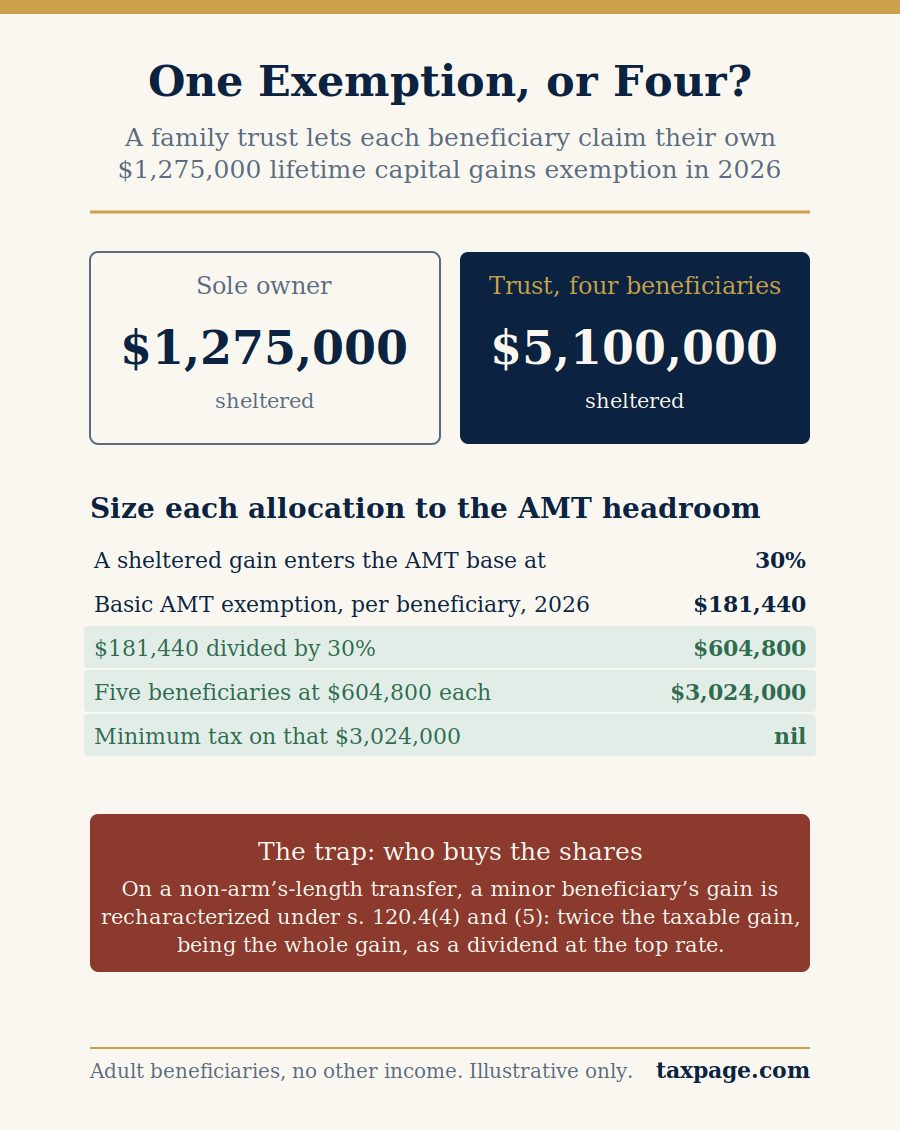

Infographic comparing a sole owner sheltering $1,275,000 under the lifetime capital gains exemption against a family trust with four beneficiaries sheltering $5,100,000, showing the $604,800 per-beneficiary alternative minimum tax headroom and the subsection 120.4(4) and (5) recharacterization trap on a non-arm’s-length transfer.
Take a worked comparison. A trust realizes a capital gain of $2,419,200 on an arm’s length sale of qualifying shares and allocates it equally among four adult beneficiaries with no other income, being $604,800 each. Each beneficiary’s adjusted taxable income is $181,440, exactly equal to the basic exemption, so no minimum tax arises for any of them and the entire $2,419,200 is sheltered at no tax cost. Had the same gain been realized by a sole owner, $1,275,000 would have been sheltered, producing minimum tax of roughly $50,100, and the remaining $1,144,200 would have attracted regular tax on a taxable capital gain of $572,100, which at Ontario’s top combined marginal rate is in the order of $306,000.
Two qualifications on that figure.
- The headroom of $604,800 falls as a beneficiary’s other income rises, because the basic exemption applies once against the whole of that beneficiary’s adjusted taxable income rather than against the allocated gain alone, so an adult child earning a salary has less room than the figure suggests.
- And $604,800 is deliberately the conservative number: because non-refundable credits are allowed at 50% in computing minimum tax, the basic minimum tax credit absorbs a small amount of tax above the threshold, so the true nil-tax point is nearer $621,700 on these assumptions. The difference is not worth planning into, since the credit varies with each beneficiary’s circumstances.
That the trustees may allocate unequally is well established and is a function of the discretion in the deed rather than anything in the minimum tax rules. What is less often said is that the minimum tax now gives a concrete reason to use that discretion. Allocating a larger share to a beneficiary with no other income, and a smaller share to one drawing a salary, can eliminate minimum tax across the family where an equal division would not, and the threshold against which to size each allocation is that beneficiary’s own remaining headroom rather than an equal fraction of the gain. For the equivalent analysis where a single owner triggers a gain deliberately, see Crystallizing the Lifetime Capital Gains Exemption.
“Trustees have always had discretion to allocate unevenly. What is new since 2024 is that there is a number to allocate against,” says David J. Rotfleisch. “Each beneficiary brings a separate minimum tax exemption, and a beneficiary already drawing a salary has less of it left than one who is not. A trustee who divides the gain into equal shares because equal shares feel fair can create minimum tax in one beneficiary’s hands while leaving room unused in another’s. The fair allocation and the efficient allocation are rarely the same, and the deed usually permits both.”
The 21-Year Deemed Disposition Is Always Running
A personal trust is deemed to dispose of its capital property at fair market value on the twenty-first anniversary of its creation. A trust holding business shares therefore cannot be settled and forgotten, and the anniversary has to be addressed before it arrives, usually either by realizing the gain on a sale in advance of it or by rolling the shares out to beneficiaries under subsection 107(2).
The minimum tax position on a 21-year deemed disposition is materially worse than on a sale, for two reasons. Most trusts have no access to the basic exemption available to individuals, so if the gain is realized at the trust level the exposure begins at the first dollar. And a deemed disposition produces no cash, so any resulting liability has to be funded from elsewhere, which is the same difficulty that afflicts a crystallization.
Allocating the deemed gain out to beneficiaries under subsection 104(21.2), where the trust deed permits and the shares still qualify, restores both the individual exemptions and the individual basic minimum tax exemptions.
Two constraints on the rollout route deserve more attention than they usually receive, because each can remove it entirely.
- Subsection 107(4.1): Where subsection 75(2), the reversionary trust rule, has applied to any property of the trust at any time, subsection 107(4.1) denies the tax-deferred rollout under subsection 107(2) while the transferor is alive, other than to that transferor or that transferor’s spouse, and subsection 107(2.1) applies instead so that the distribution occurs at fair market value. No income need ever actually have been attributed under subsection 75(2) for this to bite, and the denial extends to all the property of the trust rather than only the contributed property. The circumstances that trigger subsection 75(2) are frequently inadvertent: a trust settled with a coin or a nominal sum contributed by someone who is also a beneficiary, a beneficiary buying property from or selling property to the trust even at fair market value, a default distribution mechanism in the deed under which property could revert, or shares issued to the trust at less than fair market value. The CRA accepts that subsection 75(2) does not apply where a trust subscribes for shares at fair market value, which is why the initial subscription is worth documenting carefully. The one relieving feature is that the problem ends on the death of the contributor, so a trust that is blocked today may not be blocked permanently.
- Subsection 107(5): This denies the rollout in respect of property distributed to a non-resident beneficiary. A family with a child who has moved abroad cannot simply roll that child’s share out, and the position should be established well before the anniversary rather than at it.
Nor can the anniversary be reset by moving the property into a new trust. Subsection 104(5.8) is a long-standing anti-avoidance rule that carries the original trust’s deemed disposition date across to a transferee trust on a tax-deferred transfer between trusts, so a second trust inherits the first trust’s clock rather than starting a fresh twenty-one years. Whether that is available depends on facts fixed years earlier, which is why the anniversary should be diarized from the date of settlement rather than discovered.
“A twenty-one year clock that nobody diarized is the single most common way I see this planning unravel,” says David J. Rotfleisch. “The anniversary arrives, the trust is deemed to have sold shares it has not sold, there are no proceeds to pay the tax with, and most trusts cannot claim the basic minimum tax exemption that an individual would. The answer is almost always available, but only if the work begins several years out. Discovering the date in the year it falls is discovering it too late.”
The Structural Requirements That Actually Fail
In practice, multiplication fails for unglamorous reasons more often than for technical ones.
The trust deed may not authorize the trustees to allocate capital gains to the particular beneficiaries chosen, or may not permit the subsection 104(21.2) designation at all. A deed drafted for income splitting before 2018 may be silent on the point.
The shares may fail the 24-month tests. Shares issued to a trust shortly before a sale will fail the ownership requirement, and because the test looks to ownership by the individual or a person or partnership related to the individual, the trust’s own holding period matters.
A beneficiary may have no exemption room left, or may have a cumulative net investment loss balance or a prior allowable business investment loss that reduces the deduction actually available to that beneficiary. Room is tested beneficiary by beneficiary, and one depleted beneficiary does not reduce the others.
Cost is a legitimate part of the analysis and is often left out of published material. Settling a trust together with a corporate estate freeze is a premium legal and accounting engagement rather than a filing, and published figures for the combined set-up generally run in the several thousands of dollars and upward depending on the complexity of the corporate structure and the valuation required. A T3 return is then due annually for the life of the trust, and the twenty-first anniversary brings a further planning engagement. Against a potential shelter of $5,100,000 across four beneficiaries the arithmetic is usually straightforward, but the structure is not worth settling for a business that is unlikely to be sold, or whose eventual sale will be an asset sale.
Finally, the amount allocated has to be paid or made payable in accordance with the deed and the trust law of the province. Allocations recorded only in the accounts, without the corresponding entitlement actually arising, are a familiar point of attack on a CRA tax audit.
Practical Implications for Canadian Taxpayers
Multiplication planning is a structuring exercise undertaken years before a sale, not a filing position adopted afterwards. The trust must exist, hold the shares, and satisfy the 24-month tests, and the shares must be issued to it at a time when the growth being multiplied has not yet accrued. A trust settled when a letter of intent arrives achieves nothing, because the vendor realizes the gain on the transfer into the trust and the trust holds shares with no accrued gain to allocate.
Before closing, three questions should be answered in writing:
- Whether the purchaser deals at arm’s length with every beneficiary, which determines whether subsections 120.4(4) and (5) apply to any minor.
- Whether the deed authorizes the intended allocations and the subsection 104(21.2) designation.
- And what each beneficiary’s exemption room, cumulative net investment loss balance and other income for the year actually are, since those determine both the regular tax outcome and the minimum tax outcome of the allocation chosen.
Where a sale to a child or grandchild is contemplated rather than a third-party sale, the analysis changes character entirely and should be run against the intergenerational business transfer provisions instead. Section 84.1 is live in that setting, and so is the recharacterization risk described above. See Canadian Tax Planning via the Lifetime Capital Gains Exemption: Beware the Section 84.1 Tax Trap and Tax Planning for Intergenerational Business Transfers and Alternative Minimum Tax.
Allocations of this size attract CRA attention. The documentation that defends the position is the trust deed, the trustee resolutions recording the allocations and the designation, the valuation supporting the gain, and corporate records establishing qualification throughout the relevant periods. Where the CRA reassesses, the ordinary rights apply: a notice of objection under section 165 of the Income Tax Act and, if that does not resolve matters, an appeal to the Tax Court of Canada.
Takeaway: The Structure Survives, the Rationale Has Moved, and the Purchaser Decides
Multiplying the lifetime capital gains exemption through a family trust remains one of the most valuable planning techniques available to a Canadian business owner, and it is worth more in 2026 than it has ever been, both because the exemption itself is larger and because each beneficiary brings a separate minimum tax exemption.
What has changed is why the trust is worth having and what can destroy the benefit. The income-splitting rationale that sold most of these structures was substantially closed in 2018. The capital gains rationale survives and has been improved by the minimum tax arithmetic. And the single decisive variable is whether the eventual purchaser deals at arm’s length with the beneficiaries, because a non-arm’s-length transfer turns a minor beneficiary’s sheltered allocation into a dividend equal to the entire capital gain.
Pro Tax Tips
Any family considering or holding a trust for this purpose should obtain a review covering four things well before a sale is contemplated. The trust deed should be read specifically against the allocations intended, to confirm that the trustees may allocate capital gains to the chosen beneficiaries and make the designation under subsection 104(21.2), because deeds drafted before 2018 were frequently built for dividend splitting rather than for capital gains allocation.
The corporation should be tested against the asset and holding period requirements, and purification undertaken if required, remembering that the 24-month conditions cannot be remedied within two years of a closing. Each beneficiary’s exemption room, cumulative net investment loss balance and expected other income should be established individually, because the allocation that minimises tax across the family is rarely the equal one. And the twenty-first anniversary of the trust should be diarized with a review scheduled several years in advance of it.
Where any beneficiary has not attained the age of 17 before the year of the sale, the arm’s length status of the purchaser should be confirmed in writing before the transaction is structured, and an alternative allocation to adult beneficiaries modelled in case it is not. Finally, the allocation should be sized against each beneficiary’s minimum tax headroom rather than divided mechanically, since a thoughtful allocation can frequently eliminate minimum tax across the whole family where an equal division would not.
FAQs
How does a family trust multiply the lifetime capital gains exemption?
The exemption belongs to the individual, so a trust cannot claim it. What the trust can do is realize a capital gain on qualifying shares and allocate it among its beneficiaries using the designation in subsection 104(21.2) of the Income Tax Act, which preserves the character of the gain in the beneficiaries’ hands. Each beneficiary then claims his or her own exemption against his or her own allocated share.
How much can a family shelter in 2026?
The exemption is $1,275,000 per individual for 2026, so a trust with four adult beneficiaries can shelter over $5,100,000 of capital gain, and one with five can shelter over $6,375,000, provided each beneficiary is a Canadian resident with full unused room and the other conditions are met.
Can capital gains be allocated to a minor beneficiary?
Yes on an arm’s length sale, and that is the critical qualification. The excluded amount definition in subsection 120.4(1) takes qualified small business corporation share gains outside split income, but only where the amount would not be deemed a dividend under subsection 120.4(4) or (5). Those provisions apply where the shares are transferred to a person with whom the individual does not deal at arm’s length. On a third-party sale they do not apply and the allocation is sheltered normally.
What happens if the sale is to a non-arm’s-length purchaser?
For a beneficiary who has not attained the age of 17 before the year, subsection 120.4(4) or (5) applies and the taxable capital gain is deemed not to be a capital gain. Twice that amount is deemed to be received as a taxable dividend that is not an eligible dividend. Because the taxable capital gain is one half of the capital gain, the deemed dividend equals the whole gain, taxed at the top marginal rate with no exemption and no one-half inclusion.
Does the tax on split income apply to adult beneficiaries?
Qualified small business corporation share gains are excluded amounts, so an adult beneficiary’s allocated capital gain is generally outside split income even if that beneficiary is not involved in the business. The same carve-out for amounts deemed to be dividends under subsections 120.4(4) and (5) applies. Dividends paid to the same adult, by contrast, are a different matter and will usually be caught unless an exclusion applies.
Is income splitting through a family trust still worthwhile?
Much less so than before 2018. The tax on split income rules now tax dividends paid to family members who are not actively engaged in the business at the top marginal rate unless an exclusion applies. The capital gains multiplication benefit survives intact, so a trust settled for income splitting may still be valuable, but for a different reason than it was originally recommended for.
Does the alternative minimum tax apply to a multiplied exemption?
It applies to each beneficiary separately, which is favourable. A sheltered gain enters a beneficiary’s adjusted taxable income at an effective 30%, and each beneficiary has a separate basic exemption of $181,440 for 2026. Minimum tax arises only where a beneficiary’s adjusted taxable income exceeds their own exemption.
How much can be allocated to each beneficiary without minimum tax?
Roughly $604,800 for a beneficiary with no other income, because 30% of that amount equals the $181,440 basic exemption. Five such beneficiaries can absorb approximately $3,024,000 of gain with no minimum tax at all. The figure falls as a beneficiary’s other income rises, since the exemption applies once against the whole of that beneficiary’s adjusted taxable income.
Should the gain be divided equally among beneficiaries?
Usually not. Trustees with a properly drafted deed may allocate unequally, which has long been understood. Beneficiaries differ in exemption room, cumulative net investment loss balances and other income for the year, and the allocation that eliminates minimum tax across the family will generally be uneven. Allocating more to a beneficiary with no other income and less to one drawing a salary is frequently worth several tens of thousands of dollars.
What is the 21-year rule and how does it affect the trust?
A personal trust is deemed to dispose of its capital property at fair market value every twenty-one years. A trust holding business shares must address the anniversary before it arrives, usually by a sale in advance of it or by rolling the shares out to beneficiaries under subsection 107(2). The deemed gain produces no cash, and most trusts cannot claim the basic minimum tax exemption, so realizing it at the trust level is the worst of the available outcomes.
Does the trust deed need to say anything in particular?
Yes. The trustees must have authority to allocate capital gains to the beneficiaries chosen and to make the designation under subsection 104(21.2). Deeds drafted before 2018 were often built around dividend distribution and may be silent or restrictive on capital gains allocation. The deed should be read against the intended allocations before a sale is structured, not afterwards.
Do the 24-month tests apply to shares held by a trust?
Yes. The shares must satisfy the ownership requirement throughout the 24 months before the disposition, and the holding period of the trust matters. Shares issued to a trust shortly before a sale will fail the test, which is why the structure has to be in place years in advance.
What if a beneficiary has already used part of his or her exemption?
Room is tested beneficiary by beneficiary. A beneficiary with partial room shelters only to the extent of that room, and the balance allocated to him or her is taxable in the ordinary way. A cumulative net investment loss balance or a prior allowable business investment loss reduces the deduction available to that beneficiary without affecting the others.
Can a family trust be set up once a buyer has been found?
No, not for this purpose. Transferring shares into a trust at that point triggers the accrued gain in the transferor’s hands, and the trust then holds shares with no accrued gain to allocate. The structure must precede the growth being multiplied, and must also satisfy the 24-month conditions.
Can the 21-year rollout always be used?
No, and the exceptions are easy to trip over. Subsection 107(4.1) denies the tax-deferred rollout under subsection 107(2) where the reversionary trust rule in subsection 75(2) has applied to any property of the trust at any time, while the contributor is alive. Subsection 107(5) denies it for property distributed to a non-resident beneficiary. The subsection 75(2) problem is frequently inadvertent, arising from matters as small as who settled the trust and with what, and it should be reviewed years before the anniversary rather than at it.
Can a new trust reset the 21-year clock?
No. Subsection 104(5.8) carries the original trust’s deemed disposition date across to a transferee trust on a tax-deferred transfer between trusts, so a second trust inherits the first trust’s clock rather than beginning a fresh twenty-one years.
What does a family trust cost to set up and maintain?
Settling a trust alongside a corporate estate freeze is a premium legal and accounting engagement, with published figures for the combined set-up generally running in the several thousands of dollars and upward depending on complexity and the valuation required, followed by an annual T3 return and a further planning engagement before the twenty-first anniversary. Measured against a potential shelter of $5,100,000 across four beneficiaries the cost is usually easy to justify, but it is not worth incurring for a business unlikely to be sold or likely to be sold as assets.
When should a Canadian tax lawyer be involved?
Before the trust is settled, and again well before any sale is structured. The deed, the share subscription, the 24-month timing, the arm’s length status of the purchaser and the allocation strategy all determine the outcome, and each is fixed by decisions made long before the return is filed. An experienced Canadian tax lawyer can structure the trust, confirm the allocations are authorized, model the minimum tax across beneficiaries, and defend the position on a subsequent CRA tax audit or tax reassessment.
DISCLAIMER: This article provides broad information. It is only accurate as of the posting date. It has not been updated and may be out-of-date. It does not give legal advice and should not be relied on as tax advice. Every tax scenario is unique to its circumstances and will differ from the instances described in the article. If you have specific legal questions, you should seek the advice of a Canadian tax lawyer.
About the Author